
Intel Patents a Faster Method for Handling Math Inside AI Systems
Deep neural networks do the same expensive calculations billions of times per second. Intel's new patent asks a simple question: what if the chip just looked the answer up instead of doing the math fresh each time?
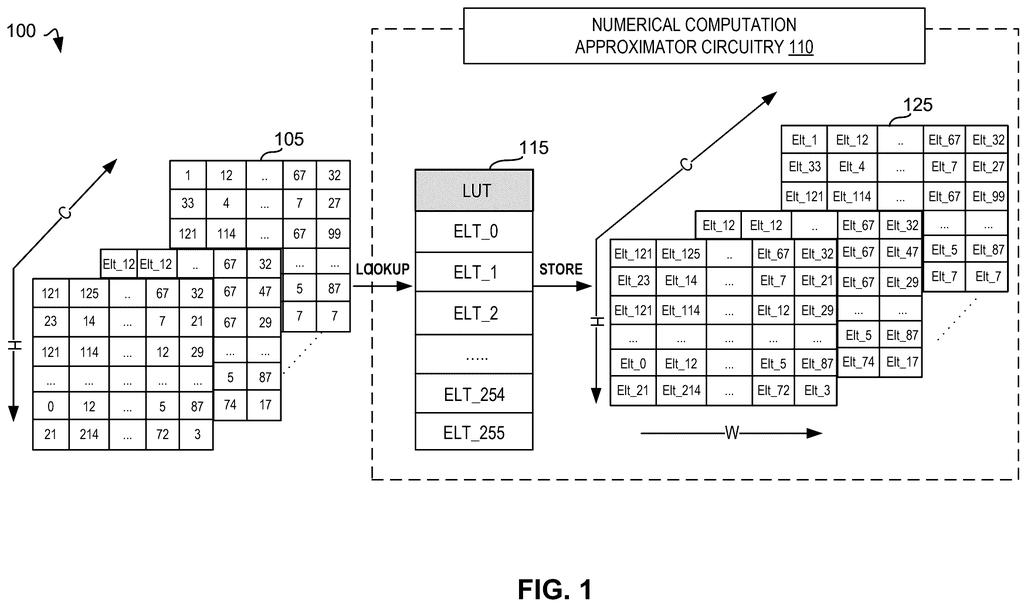
How Intel wants AI chips to skip the hard math
Every time an AI model on your phone or laptop processes a photo, translates a sentence, or filters your spam, it runs through enormous piles of arithmetic at breakneck speed. Those calculations cost power, slow things down, and generate heat.
Intel's approach here is to pre-calculate as many of those results as possible and store them in a lookup table, basically a cheat sheet baked into the chip. Instead of grinding through the full equation every time, the hardware just finds the row in the table that matches the current input and reads out the answer.
The trick is that this happens during the AI's training phase, so by the time the model is actually running on your device, a lot of the hardest work is already done. The output is still a proper floating-point number, the kind AI models expect, so nothing downstream needs to change.
generate a lookup table based on input elements associated with a training phase of a deep neural network; index the lookup table using tensor values, the tensor values associated with an output index; and output a vector in destination numeric format based on the lookup table …
Translation: It builds a quick reference list during training to convert data into new number formats much faster.
How the lookup table indexes tensor values at runtime
The patent describes programmable circuitry (configurable hardware, somewhere between a fixed chip and pure software) that handles a common bottleneck in neural networks: repeated numerical functions that eat up compute time.
During the training phase of a deep neural network (the period when the AI is learning from data), the system generates a lookup table based on the range of values the network is likely to encounter. Think of it as a pre-printed reference table a student might bring to an exam.
At inference time (when the model is actually running and making predictions), the hardware takes incoming tensor values (the multi-dimensional arrays of numbers that flow through a neural network) and uses them as an index into that table. Instead of computing a result from scratch, it retrieves a pre-computed approximation.
- The output is a vector (an ordered list of numbers) formatted in standard floating-point representation, which keeps it compatible with the rest of the model pipeline.
- The destination numeric format is configurable, giving hardware designers flexibility in how precise the approximation needs to be.
- The system is designed for programmable circuitry, meaning it could be implemented on FPGAs or in custom silicon alongside traditional CPU and GPU cores.
Methods, apparatus, and systems are disclosed for approximating numerical computations in deep neural networks.
Translation: The patent describes ways to speed up heavy math inside AI models by estimating numbers instead of calculating them from scratch.
What faster AI inference means for everyday devices
For anyone using an AI-powered feature on a phone, a laptop, or a cloud service, this kind of optimization is what determines whether that feature feels instant or slow. Reducing how much raw arithmetic a chip needs to do lowers power draw and heat, which matters most on battery-powered devices where every milliwatt counts.
Intel's sustained investment in AI inference hardware suggests the company sees programmable silicon as a key piece of the efficiency puzzle. A lookup-table approach also has an advantage in predictability: the chip takes a fixed, short amount of time to retrieve a stored value, rather than a variable amount of time to compute one, which makes it easier to build real-time applications around it.
This is the 39th Intel filing we've tracked in AI chip wars since May, adding to earlier work like one that shifts processing mid-task and one improving software on hardware.
Lookup tables are a decades-old trick for making math faster: pre-calculate the answers you'll likely need, then retrieve them instead of doing the full calculation each time. Intel is applying that same shortcut to the number-crunching inside AI models.
The important detail is that the results come back in full floating-point precision, meaning the model gets an accurate answer every time, not an approximation that degrades as errors stack up across hundreds of layers. That distinction is what separates a speed trick that actually ships in a product from one that breaks things in subtle ways nobody catches until it's too late.
For you, that means an AI assistant or photo tool that responds faster and pulls less power from your battery, without giving you slightly wrong answers. You'd notice it as a phone that stays cooler during a long AI session, or a laptop that gets through the workday without hunting for an outlet.
There are more where this came from
We read every patent application Big Tech publishes and send you the ones worth knowing. Plain English, free, every week.
The drawings
25 drawing sheets from US 2026/0267369 A1 · click any drawing to enlarge


Want this weekly breakdown for a company we don't cover? Patentlyze Pro →