
Sony Patents a Two-Sensor Robot Foot That Feels the Ground Beneath It
Walking robots usually need expensive, complicated sensors just to feel the floor. Sony is filing a patent on a simpler approach: two cheap distance sensors hidden inside a springy robot foot.
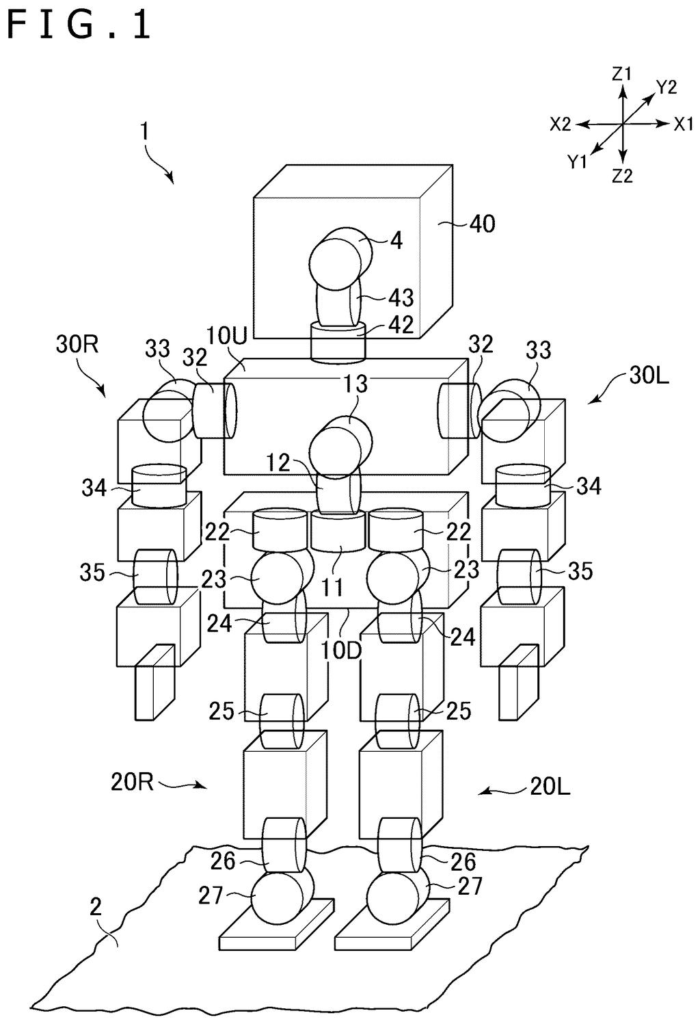
What Sony's spring-loaded robot foot actually does
Imagine a humanoid robot taking a step on uneven ground. To stay upright, it needs to know exactly how hard each part of its foot is pressing down, is the heel taking all the weight, or is it balanced? Right now, getting that information typically requires bulky, costly force sensors.
Sony's approach replaces that with something more elegant. The robot foot has two layers: a rigid top piece connected to the leg, and a bottom piece that touches the floor. A springy material sits between them. When the robot steps down, the bottom layer squishes up slightly against the spring.
Two small range sensors measure how much that gap closes in different spots across the foot. Because the sensors sit at different positions, the system can figure out not just how hard the foot is pressing, but where the pressure is concentrated. No expensive force plates required.
… a foot structure for a robot and a robot that suffer small restrictions and are capable of detecting reactive forces from a walking surface with a simple structure.
Translation: This design lets robots feel the ground simply and efficiently without bulky hardware.
How two range sensors map a foot's compression
The patent describes a foot assembly with three main layers. At the top is the instep member, which bolts to the robot's leg. At the bottom is the sole member, the part that touches the walking surface. Between them sits an elastic member (think of it as a structured rubber or spring layer) that physically separates the two plates while allowing a small amount of compression.
The key measurement hardware is a pair of range sensors mounted on either the instep or sole, each pointing at the opposite plate. A range sensor measures the distance to a target, similar to how a proximity sensor on a phone detects your face during a call. When the robot's foot presses against the floor, the sole plate rises slightly, compressing the elastic layer and shrinking the gap each sensor sees.
Because the two sensors sit at different positions (say, one near the toe and one near the heel), comparing their readings lets the robot's control system calculate:
- How much total force the foot is receiving
- Where on the foot that force is applied (the tilt or torque of the contact)
This gives the robot's balance software the information it needs to adjust posture in real time without requiring traditional multi-axis force/torque load cells, which are fragile, expensive, and add wiring complexity.
What this means for affordable walking robots
For robotics engineers, force sensing in feet has always been a trade-off: accurate sensors are heavy, stiff, and pricey, while cheap sensors often can't capture enough detail for reliable balance control. Sony's design tries to get useful spatial force data out of two simple, low-cost range sensors and a spring layer, which could bring the hardware cost of a walking robot's feet down considerably.
For you as a consumer, this is the kind of behind-the-scenes engineering that determines whether a humanoid robot can eventually be priced for real-world use rather than research labs. a growing pile of Sony robotics filings suggests the company is thinking carefully about what it takes to build walking robots that are practical, not just impressive in a demo.
Sony's 11th filing in our robotics coverage since May adds to a body of work that includes a path safety check system and a force-sensing robot arm, all of which we've tracked here.
Claim 1 covers any robot foot built from two rigid plates connected by a springy layer, with two sensors at different positions measuring how the gap between those plates changes under pressure. The claim specifies no particular sensor technology, no required material for the spring layer, and no method for interpreting the readings. That is an unusually wide net.
In practice, almost any robot foot that detects ground pressure through compression would land inside those boundaries. Any company building a humanoid robot that senses how the floor pushes back by measuring how much a cushioned foot compresses in two different spots would need to work around this patent.
As humanoid robots move toward everyday use, cheap and reliable foot sensing is a foundational problem, and this claim covers one of the most direct physical solutions to it. The breadth here has real consequences.
There are more where this came from
We read every patent application Big Tech publishes and send you the ones worth knowing. Plain English, free, every week.
The drawings
7 drawing sheets from US 2026/0277223 A1 · click any drawing to enlarge


Want this weekly breakdown for a company we don't cover? Patentlyze Pro →