
AMD Patents a GPU That Schedules Its Own Math Work Without Asking the CPU
Every time a GPU has to ask the CPU for its next assignment, work sits idle. AMD's new patent describes a chip design where the GPU figures out its next task on its own, keeping the math running without the usual back-and-forth.
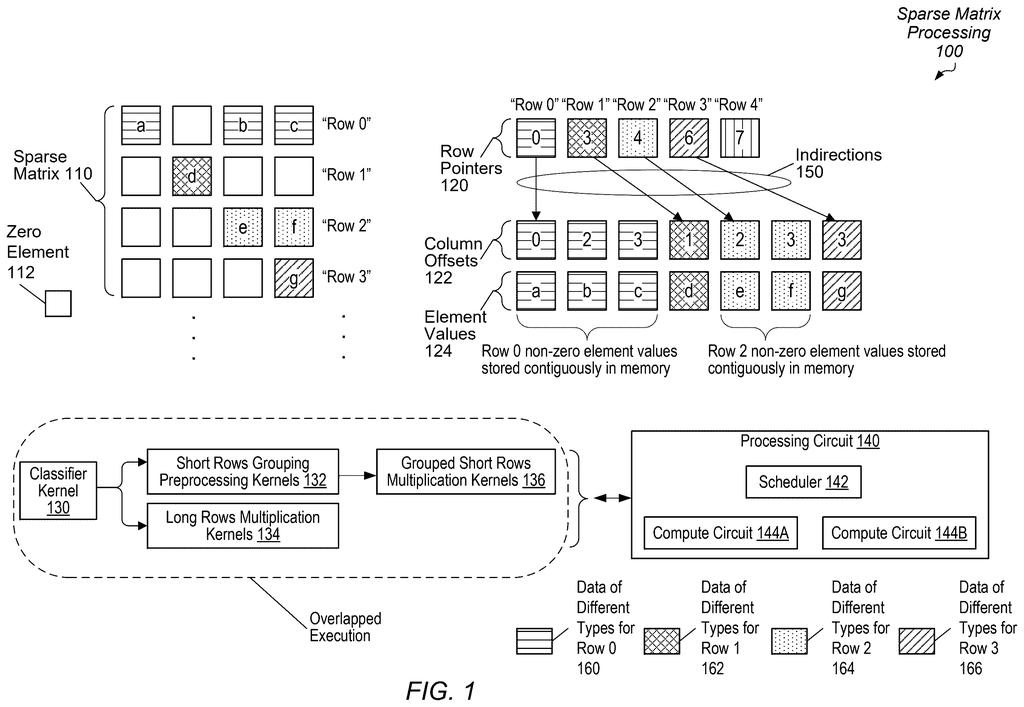
What AMD's self-scheduling GPU math actually does
Most graphics and AI chips spend a surprising amount of time waiting. When a chip finishes one chunk of math, it often has to report back to the main processor and wait for instructions before starting the next chunk. That pause is small but it adds up fast, especially when the chip needs to repeat the cycle thousands of times per second.
AMD's patent describes a design where the chip itself decides what to do next. Specifically, it handles a type of math called sparse matrix multiplication, which is common in AI models. A sparse matrix is just a grid of numbers where most entries are zero, so the chip doesn't need to do every multiplication, only the ones that matter. The trick is figuring out which rows of that grid are easy (short, with few non-zero values) and which are hard (long, with many), then running both types of work at the same time.
By generating its own internal task lists and feeding them directly into a scheduling queue, the chip can keep all its compute units busy without constantly checking in with the CPU.
generate one or more kernels of the plurality of kernels independently of the host processing circuit; and send the one or more kernels to the control circuit for dispatch.
Translation: The graphics card creates its own math tasks without needing help from the main processor.
How the GPU sorts matrix rows and overlaps four work types
The patent covers an accelerator device (a chip designed to handle specific math-heavy tasks, like a GPU) that can manage its own workload pipeline for a class of operations called sparse matrix-vector multiplication, or SpMV.
SpMV shows up constantly in AI inference, scientific simulation, and graph processing. The input is a large grid (the matrix) where most values are zero, and the task is to multiply it by a list of numbers (the vector). The challenge is that the non-zero values are scattered unevenly, so some rows of the matrix have a handful of them while others have hundreds.
The patent describes four overlapping operation types the chip runs in parallel:
- Classification: label each row as "short" (few non-zero values) or "long" (many non-zero values)
- Long-row multiplication: start processing the hard rows immediately
- Partitioning: group the short rows into efficient batches
- Short-row multiplication: process those batches
The key claim is that the compute circuits generate their own kernels (self-contained units of work) and push them directly into the scheduler's queue, without involving the host CPU. This removes the round-trip delay that normally sits between finishing one phase of work and starting the next.
… classifying operations that classify rows of the sparse matrix as short rows or long rows, matrix multiplication operations using long rows, partitioning operations that group short rows together for subsequent matrix multiplication operations, and matrix multiplication operations using short rows.
Translation: The chip sorts data into short and long rows before multiplying them separately.
What this means for AI workloads on AMD hardware
For anyone running AI models or scientific simulations on AMD hardware, this is about raw throughput. The bottleneck this patent targets is subtle but real: every time the CPU has to intervene to hand out the next task, your GPU is sitting idle. Shave that pause across millions of operations and the difference in total run time becomes measurable.
The practical payoff would show up in workloads that are already sparse-matrix-heavy, including most large language model inference passes and recommendation system scoring. Whether AMD ships this design in a product, and whether the improvement is large enough to feel in practice, depends on details the patent doesn't settle. But the architectural direction, letting the accelerator manage its own task queue, is a real pattern in high-performance chip design.
AMD's 37th filing we've tracked since May in the AI chip race builds on earlier applications, including one redirecting storage for AI and one compressing GPU model data.
For anyone running AI models or scientific simulations on AMD-powered hardware, the chip occasionally sits idle waiting for its next set of instructions instead of doing the calculation it was built to do. This patent moves that scheduling work directly into the hardware, eliminating those small pauses.
The people who notice this are in data centers and high-end workstations, where the same type of math repeats thousands of times in a row. Cutting even a small delay from each cycle adds up to faster model outputs or shorter simulation runs without purchasing any new equipment.
Ordinary consumer use stays unaffected. The improvement targets the specific frustration of a powerful processor stalling on administrative overhead rather than delivering results, and it matters most when those results are time-sensitive or expensive to produce.
There are more where this came from
We read every patent application Big Tech publishes and send you the ones worth knowing. Plain English, free, every week.
The drawings
8 drawing sheets from US 2026/0288514 A1 · click any drawing to enlarge


Want this weekly breakdown for a company we don't cover? Patentlyze Pro →
Be the first to weigh in