
Qualcomm
Qualcomm · AI / ML · Filed Oct 23, 2025 · USPTO published Sep 24, 2026 · Sep 24 release
Qualcomm Patents a System That Picks the Right AI Photo Model by Resolution
Most AI photo-processing systems force every image through the same model, no matter the size. Qualcomm's new patent describes a device that first checks how big your image is, then picks the AI model that was specifically trained to handle that size.
- Publication number
- US 2026/0289997 A1(US20260289997A1)
- Applicant
- QUALCOMM Incorporated
- Filed · Published
- Oct 23, 2025 · Sep 24, 2026
- Inventors
- Nan ZHANG, Jianying DUAN, Qi ZENG
- Status when we published
- Waiting for an examiner
- Document
- 22 claims
- US classification
- 382/155
- Parent application
- National Stage Entry of PCT/CN2023/103705 (filed Jun 29, 2023)(PCTCN2023103705)
What Qualcomm's resolution-matching photo AI actually does
Every time your phone processes a photo, something has to decide how to handle it. A snapshot from a low-res front camera is a very different job than an image from a high-resolution main sensor, and treating them identically can waste power or produce worse results.
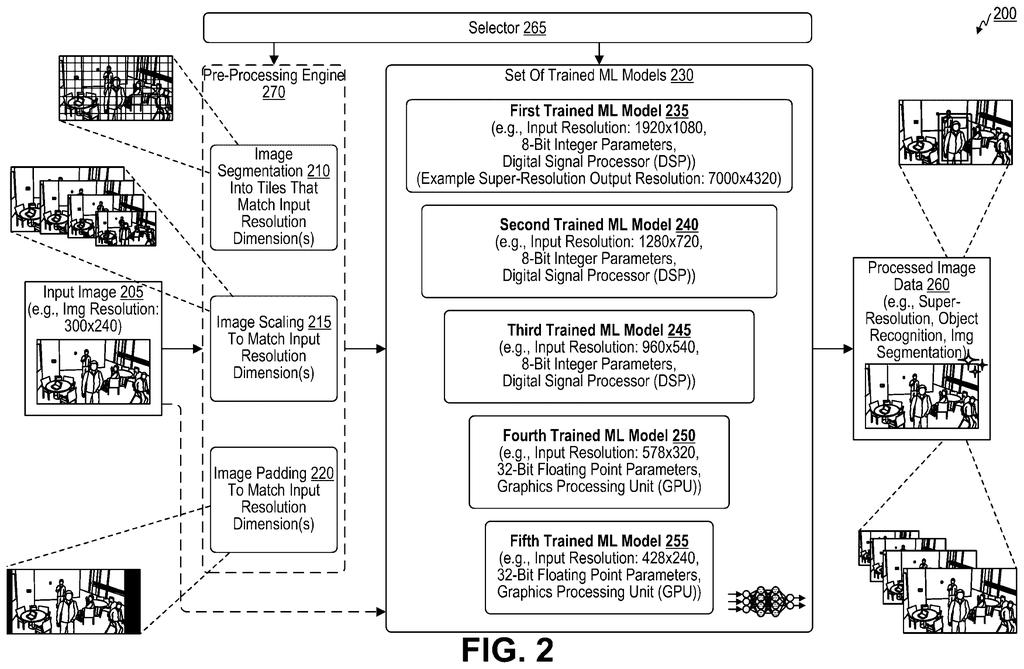
Qualcomm's patent describes a system that keeps multiple AI models on hand, each one trained to work best at a specific image resolution. Before any processing begins, the device checks the size of the incoming image and picks the model whose input size is the closest match. Then that model does the work.
The idea is straightforward: instead of one AI trying to do everything, you have a team of specialists, and a coordinator that routes each image to the right one. The result should be more efficient processing and, in theory, better output quality because each model is doing exactly what it was trained for.
… select a trained machine learning model from a plurality of trained machine learning models based on an image resolution of the image and a plurality of input resolutions of the plurality of trained machine learning models …
Translation: The system picks the best AI model by comparing your picture size with what each model expects.
How the system matches image size to a trained model
The patent describes a device (a phone chip, most likely) with at least one processor configured to run a three-step routine.
- Receive the image: The system ingests an incoming photo or video frame.
- Select a model: It compares the image's resolution against the known input resolutions of a library of trained AI models, then picks the best match.
- Process and output: The selected model runs on the image and produces processed image data, the enhanced or transformed result.
The core idea is model selection based on resolution matching. Rather than resizing every image to fit a single model's expected input (which can introduce distortion or wasted computation), the system finds the model that already expects images of roughly that size.
The patent is written at the chip level, meaning this could run locally on a Qualcomm Snapdragon processor inside a phone, camera, or other device, without sending images to the cloud. The trained models themselves are stored ahead of time; the selection logic is what's being patented here.
What this means for AI photo processing on your phone
For everyday users, this kind of system could mean photos processed more accurately and with less battery drain, because the chip isn't forcing a high-resolution shot through a model designed for thumbnails, or vice versa. It's a routing problem, and routing it correctly is one of those background improvements you'd never notice but would definitely feel.
Qualcomm's long bet on on-device AI makes a system like this a natural fit: the more AI workloads you run locally, the more you need efficient ways to manage which model handles what. This patent adds one more piece to that infrastructure, even if it's a quiet, plumbing-level one.
Qualcomm's eighth patent we've tracked since July on AI models working in teams follows earlier work on recording when models disagree and letting users control photo reading.
Source: US 2026/0289997 A1 at the USPTO (PDF). Full patent text and figures are in the official publication.
Get our take in your Top Stories
Liked this breakdown? Add Patentlyze as a preferred source on Google, and our plain-English take shows up more often in your Top Stories the next time Qualcomm patent news breaks.
Add Patentlyze on Google
One click.
There are more where this came from
We read every patent application Big Tech publishes and send you the ones worth knowing. Plain English, free, every week.
The drawings · 8 sheets
8 drawing sheets from US 2026/0289997 A1 · click any drawing to enlarge


More from Qualcomm
All 624 Qualcomm patents →
More in AI training & infrastructure
All 316 AI training & infrastructure patents →
OpenAI
OpenAI Patents a Watchdog AI That Reads Other Models' Internal Reasoning
Samsung
Samsung Patents a Way to Blend Specialized AI Models Into One Without Starting Over
Google
Google Patents Technology That Sends Each Learning Task to Its Most Qualified AI Specialist
IBM
No comments yet