
Qualcomm Patents a Way to Blend Sharp and Blurry VR Image Zones at the Chip Level
VR headsets already cheat by rendering the center of your vision in sharp detail and the edges in lower quality. Qualcomm's new patent tries to make the seam between those two zones invisible, and do it inside the display chip itself.
What Qualcomm's foveated blending actually does for VR
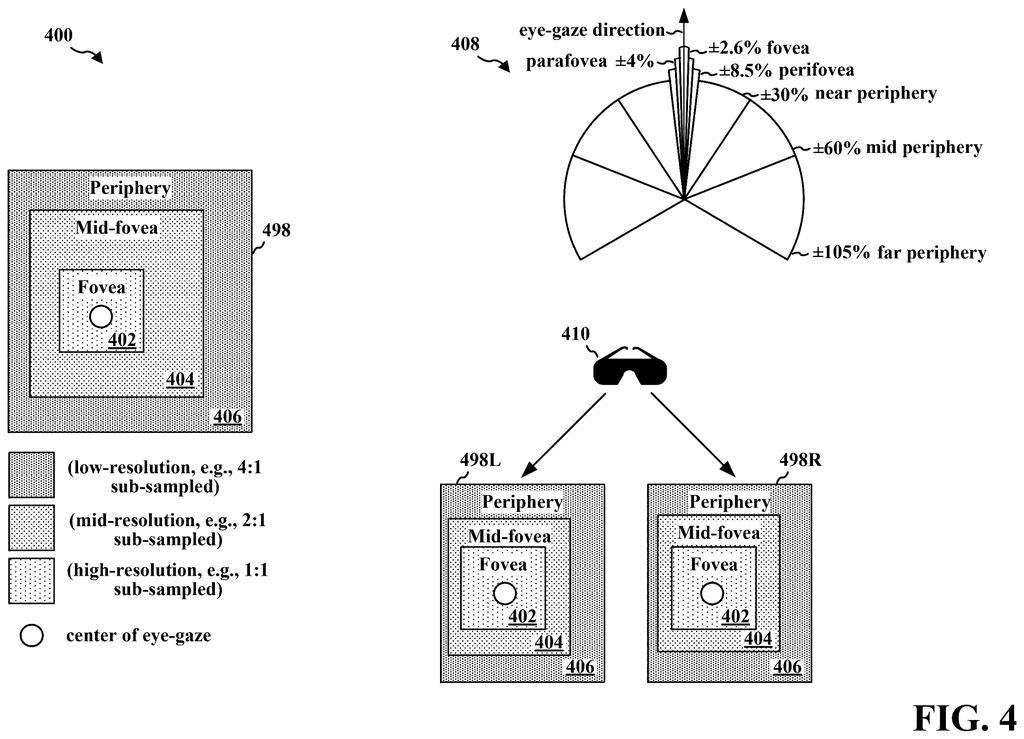
Your eye can only see fine detail in a small area right at the center of your vision. Everything in your peripheral vision is naturally blurrier, and your brain mostly ignores that. VR headsets have started exploiting this with a trick called foveated rendering: render the center of the screen at full quality, and render the edges at a much lower resolution to save processing power.
The catch is that where those two zones meet, you can often see a visible ring or edge, like a soft border between the sharp center and the blurry surroundings. Qualcomm's patent describes a way to smooth that boundary out by processing the high-resolution center zone and the low-resolution outer zone together, letting each inform the other before the final image is assembled.
The result, in theory, is a blended image that looks consistent across the whole frame, without the display chip having to render everything at maximum resolution. That keeps the power bill down while making the image look more natural to your eyes.
obtain a first portion of image data at a first resolution, the first portion corresponding to a first field of view (FOV); obtain a second portion of the image data at a second resolution that is lower than the first resolution, the second portion of the image data corresponding to a second FOV, wherein the second FOV is larger than the first FOV and comprises the first FOV; …
Translation: The chip grabs two different image layers, one sharp for the center and one blurry for the edges.
How the chip filters two resolutions at once
The patent describes a display processor that handles two image streams at the same time: a first field of view (FOV), which is the high-resolution center zone, and a second FOV, which is a larger, lower-resolution zone that contains the first one like a picture frame around a photo.
Instead of filtering (smoothing and processing) each zone separately and then stitching them together, the processor filters them jointly. That means when it sharpens or cleans up the center image, it uses pixel information from the outer zone to make better decisions, and vice versa. Think of it like color-correcting two overlapping photos by considering both at once rather than one at a time.
The system then produces two filtered outputs: one for the center zone at full resolution, one for the outer zone at lower resolution. Those two outputs are blended into a final image that is sent to the display.
The key technical claim is the joint filtering step. Most foveated pipelines process each zone independently, which can leave artifacts (visual glitches) at the boundary. By sharing data across zones during the filter pass, Qualcomm's approach aims to produce a cleaner transition without adding a separate post-processing stage.
… determine a first filtered output for the first FOV at the first resolution and a second filtered output for the second FOV at the second resolution by filtering the first and second portions of the image data together.
Translation: It blends the sharp and blurry layers together so the transition looks smooth to your eyes.
What this means for VR headset battery and image quality
For anyone wearing a VR or mixed-reality headset, the practical payoff would be fewer distracting visual boundaries in their peripheral vision. Current foveated rendering can create a subtle halo or softness ring that breaks immersion, especially during head movement. A cleaner blend handled inside the chip, rather than bolted on in software, could reduce that without demanding more battery life.
Qualcomm supplies the chips inside headsets like the Meta Quest line, so Qualcomm's track record in display processing patents gives this filing some weight. If the approach works as described, headset makers could push foveated rendering more aggressively, rendering even less of the frame at full quality, which would extend battery life or free up processing power for other tasks.
Qualcomm's 48th patent application we've tracked since July in the AR glasses race adds to earlier work on single-chip dual views and a fix for blurry AR.
When you wear a VR headset, the device renders what you're directly looking at in sharp detail and everything around it in soft blur, trading visual quality for battery life. The problem is the border between those two zones, which can feel like a visible seam or a flicker that pulls you out of the experience without you quite knowing why.
What Qualcomm is working on here smooths that border at the hardware level, processing both the sharp center and the blurred edges together rather than separately and then trying to paste them together after the fact. The result, if it ships, is a headset that still saves power but stops announcing that it's doing so.
Most people will never think about any of this. They will just notice that a headset feels immersive or somehow off, and that sensation lives entirely in details like this one.
There are more where this came from
We read every patent application Big Tech publishes and send you the ones worth knowing. Plain English, free, every week.
The drawings
14 drawing sheets from US 2026/0289729 A1 · click any drawing to enlarge


Want this weekly breakdown for a company we don't cover? Patentlyze Pro →
Be the first to weigh in