
Tesla Patents a Way to Run Self-Driving AI Faster on Less Hardware
Tesla has filed a patent for a method that lets its self-driving AI run a critical calculation using cheaper, faster integer math instead of the power-hungry floating-point operations that dominate today's chips. The goal is to get the car's brain thinking faster without needing more hardware.
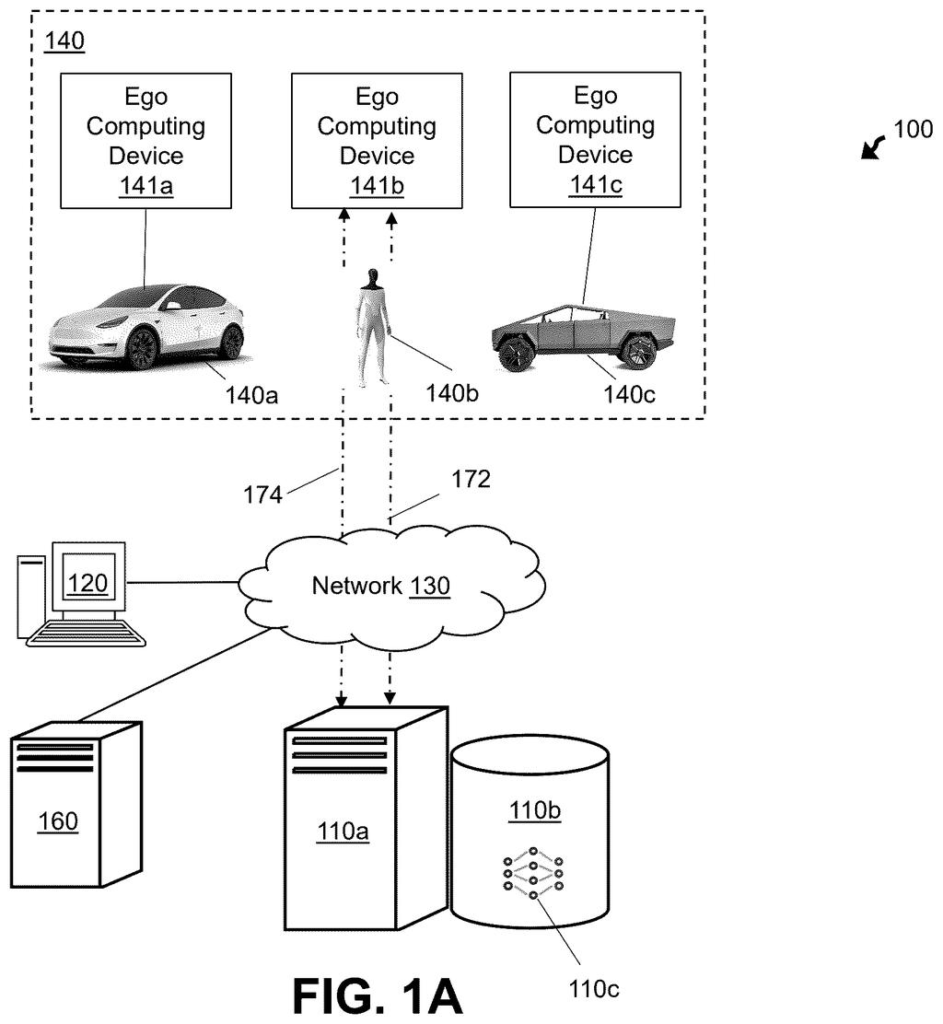
What Tesla's on-chip AI shortcut means for your car
Ever wondered how a self-driving car decides, in a fraction of a second, which bit of the road ahead actually matters? The AI doing that job runs a process called "attention" - basically ranking every piece of sensor data by importance before deciding what to do next. That calculation is normally expensive.
Tesla's patent describes a way to make that calculation much cheaper. Instead of using the kind of heavy-duty math that requires a lot of chip power, the system uses simpler operations - like shifting numbers left or right in binary, the way you'd move a decimal point - to get close enough to the same answer at a fraction of the cost.
The practical result is that your car's AI could process the world around it more quickly, or handle more sensor data within the same power budget, without upgrading the chip underneath.
… identifying, by the one or more processors, from the set of quantized values, a maximum value using an integer comparison operation; for at least one quantized value in the set of quantized values, computing, by the one or more processors, a difference between the quantized value and the maximum value; …
Translation: The system compares numbers to find the highest value and calculates the difference between it and the other values.
How Tesla replaces floating-point math with bit shifts
At the center of modern AI systems - including those used in self-driving cars - is something called a transformer model. It works by running an "attention" calculation that figures out which parts of its input (camera feeds, radar, lidar) are most relevant to a decision right now.
The standard way to compute attention involves softmax, a mathematical function that converts a list of raw scores into probabilities. Softmax normally requires floating-point arithmetic (the kind of math that handles decimal numbers and is computationally expensive on dedicated hardware).
Tesla's method replaces the hardest parts of that process with operations that integer-based chips handle very cheaply:
- Integer comparison to find the highest score in the set, which anchors the rest of the math.
- Bit shifting (moving binary digits left or right, equivalent to multiplying or dividing by powers of two) to approximate scaling that would normally require division.
- Base-2 exponentiation (raising 2 to a power) instead of the natural-exponent calculation that standard softmax uses - base-2 is far simpler for a chip to compute.
The output feeds back into the same navigation model and produces a driving instruction. The key claim is that all of this works on quantized values - numbers that have already been compressed into integers to save memory and compute - keeping the entire pipeline in integer space from start to finish.
… executing a bit shift operation, on the difference between the quantized value and the maximum value, corresponding to a power-of-two quantization scale to generate bit-shifted values; executing a base-2 exponentiation operation to the bit shifted values to generate base-2 exponentiated values; …
Translation: It shifts bits and applies math operations to process the data efficiently on the hardware.
What cheaper AI math means for real-time driving decisions
Self-driving AI runs continuously, processing dozens of sensor frames per second. Every millisecond shaved off the attention calculation is a millisecond the car gains back for other decisions - or a reduction in the chip power needed to keep up. On a purpose-built chip like Tesla's own Dojo or FSD hardware, operations that map cleanly to integer logic run faster and cooler than floating-point equivalents.
For you as a driver, that could mean a system that reacts slightly faster to unexpected hazards, or one that supports more sensors without requiring a bigger, pricier chip. Tesla has been filing around on-chip AI efficiency since at least 2023, and this patent fits a clear pattern of trying to extract more navigation intelligence from hardware that's already in the car.
Tesla's fourth filing we've tracked in the AI chip wars since October follows a faster-inference trick and a per-token precision method.
Running a self-driving car means making thousands of predictions per second about what other cars, pedestrians, and road markings will do next. Each prediction burns power, and a car's electrical system has hard limits on how much of that it can spare without affecting everything else drawing from the same battery.
This patent targets one specific step in that prediction process: a calculation that normally requires expensive floating-point arithmetic, replaced here with simpler operations that chips can execute far faster and with less energy. The engineering bet is that the cheaper math stays accurate enough that driving decisions don't suffer.
Whether the accuracy holds under real road conditions is the question the filing doesn't fully answer, but the power problem it addresses is a daily constraint on every autonomous vehicle shipping today.
There are more where this came from
We read every patent application Big Tech publishes and send you the ones worth knowing. Plain English, free, every week.
The drawings
5 drawing sheets from US 2026/0296410 A1 · click any drawing to enlarge


Want this weekly breakdown for a company we don't cover? Patentlyze Pro →
Be the first to weigh in