
Qualcomm Patents a System That Measures and Reports Live Video Lag to the Network
When you watch live sports and the play-by-play announcer's voice drifts out of sync with the picture, that's latency. Qualcomm has filed a patent for a system that lets your streaming app measure that delay precisely and report it back to the network in real time.
What Qualcomm's video delay measurement system actually does
You're watching a live concert stream and the singer's lips are moving a half-second behind the audio. The stream is late, but your phone has no official way to tell the network just how late it is.
Qualcomm's patent describes a method where the app on your phone first syncs its internal clock with the network's clock. Then, when a chunk of video arrives, the app uses a timestamp the network attached at the moment the video was created to calculate exactly how long that video sat in transit before reaching your screen. That gap is called presentation latency, and the app then sends that number back to the network.
The idea is that once the network knows the real delay your device is experiencing, it can adjust delivery to shrink it. Right now, networks often have to guess how viewers are being affected. This approach gives them actual measurements from actual devices.
… measuring, by the media client, presentation latency of media data included in the media segment using the producer reference time to form measured presentation latency …
Translation: The app calculates how much the video is delayed by comparing it against an official timestamp.
How the client clocks sync and report playback delay
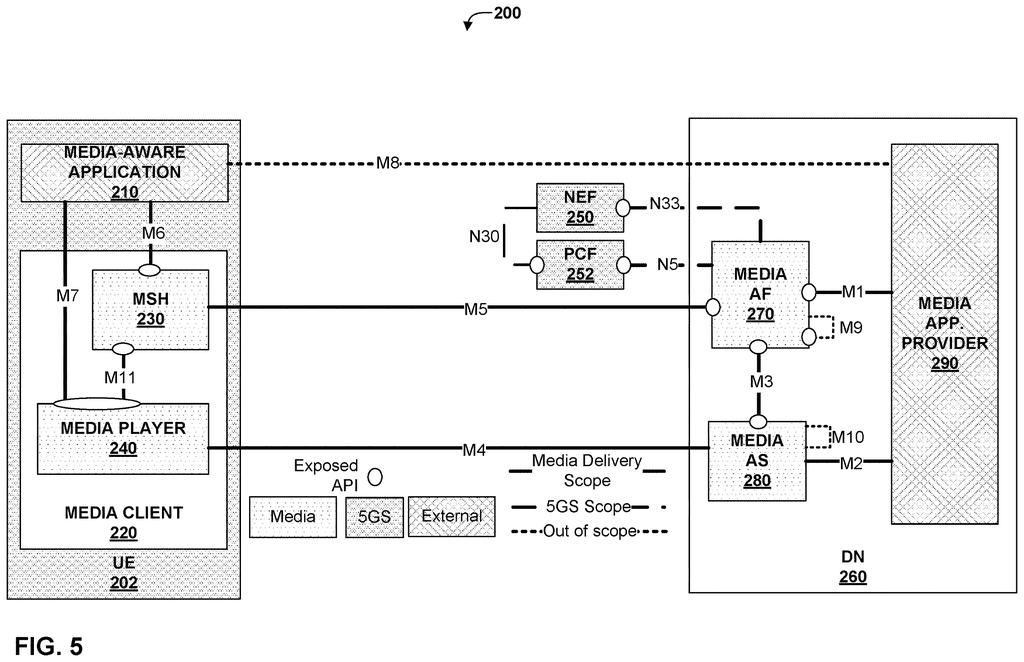
The patent describes two sides of the same system: what the media client (the app on your phone, TV, or laptop) does, and what the network function (a server-side component) does.
On the client side:
- The app syncs its local clock with a time reference provided by the network, so both sides agree on what time it is.
- When a video segment arrives, it carries a producer reference time, a timestamp stamped at the moment the video was encoded or packaged for delivery.
- The app subtracts that timestamp from the current time to calculate how long the segment took to reach the screen. This is the presentation latency.
- The app sends that latency measurement back to the network.
On the network side, a server sends those producer reference times to clients, then collects the latency reports back. That data can feed into adaptive delivery systems that decide whether to trim buffers, switch to a lower-resolution stream, or reroute traffic.
The clock-sync step is critical. Without both sides sharing the same time reference, a timestamp from the server and a reading from the phone's clock would be comparing apples to oranges. The patent's method threads that needle by explicitly aligning the two clocks before any measurement begins.
… receiving presentation latency measurement data for media data included in the media segment from the media client …
Translation: The network receives the lag measurement sent back by the user's device.
What this means for live sports and real-time streaming
Live streaming is increasingly central to sports, news, and social video, and latency is the metric that separates a good live experience from a frustrating one. Current systems often rely on rough estimates or indirect signals to gauge how delayed viewers are. Qualcomm's approach builds precise, device-level delay data directly into the streaming protocol, giving network operators something real to act on.
For consumers, the potential payoff is streams that automatically tighten their own lag based on what your specific device is actually experiencing, not a population average. Qualcomm's interest in media streaming infrastructure shows up across multiple protocol-level filings, and this one fits squarely in that pattern. Whether it translates to a tighter live-sports feed on your next phone depends on how widely streaming platforms adopt the reporting mechanism.
Qualcomm's 476th filing in our Qualcomm coverage since May extends a location theme seen in the GPS audio lock patent and the phone location honesty filing.
The shortest path from this patent to a shipped feature runs through standards bodies, not product teams. The method described here only works if both the streaming server and the client app implement the same clock-sync and reporting protocol. That's not a one-company decision.
Qualcomm has deep ties to standards work in mobile video delivery, which is probably the real venue for this filing. If the measurement approach gets folded into a future version of DASH (the streaming format most major platforms use), it could reach millions of devices without anyone ever updating a single app. That's a realistic but slow path.
As a standalone patent, this is a well-defined, narrowly scoped piece of plumbing. It doesn't require new hardware, just software changes on both ends of a stream. The engineering lift is modest; the coordination lift is large.
There are more where this came from
We read every patent application Big Tech publishes and send you the ones worth knowing. Plain English, free, every week.
The drawings
13 drawing sheets from US 2026/0303888 A1 · click any drawing to enlarge


Want this weekly breakdown for a company we don't cover? Patentlyze Pro →
Be the first to weigh in