
Nvidia Patents a Way to Speed Up Robot Training by Simplifying What It Has to Simulate
Training a robot arm to pick up objects requires simulating thousands of tiny physical collisions, and that math gets expensive fast. Nvidia's new patent describes a way to cut that calculation load without losing the accuracy that makes robots work in the real world.
How Nvidia teaches robots without endless physics crunching
Ever tried to pack a suitcase and realized you were folding the same shirt three times? Redundant effort that wastes time but changes nothing. Robot training has the same problem: when a robot's virtual hand touches a virtual object during a simulation, the computer might calculate dozens of overlapping contact points all saying roughly the same thing, burning time and computing power on information it already has.
Nvidia's patent tackles that by trimming the list of contacts down before the simulation even runs its physics calculations. It looks at which contact points are physically close together and pointing in similar directions, then collapses them into a smaller, representative set. The robot's AI still gets the information it needs, just without the repetition.
The result is a training loop that can run more simulations in less time, which means the robot's AI learns from more practice runs before anyone has to buy a single physical arm to test it on.
reducing a set of contacts between a plurality of objects based at least on spatial proximity between contacts included in the set of contacts and normals associated with the contacts to generate a reduced set of contacts …
Translation: Filtering out unnecessary physical touch points between items to make computer calculations much faster.
How the contact-reduction filter trims the simulation
The patent describes a simulation pipeline for training robot-control AI using reinforcement learning (a method where software learns by trial and error, earning rewards for good actions and penalties for bad ones).
The central technique is contact reduction. During a physics simulation, whenever a robot's virtual body touches an object, the engine generates a set of contact points, each with a position in space and a normal (a direction vector showing which way the surface faces at that spot). In complex scenes, hundreds of these contacts can cluster together, all conveying nearly identical information.
The method filters that cluster by checking two things:
- Spatial proximity: are two contact points physically very close together?
- Normal similarity: are their surface directions nearly identical?
Points that are both close and similarly oriented get merged or dropped. The surviving reduced contact set is then handed to the physics solver, cutting the math it has to do each simulation step.
Objects in the scene are represented using signed distance functions (SDFs), a mathematical way to describe a shape by storing how far any point in space is from the nearest surface. SDFs make it straightforward to detect contacts and compute those normals efficiently, which is why they pair well with the contact-reduction approach. The trimmed simulations feed into a machine learning model that, after many training runs, produces a policy a real robot can use.
… updating one or more parameters of a machine learning model based on the plurality of simulations to generate a trained machine learning model.
Translation: Training AI models by running multiple digital practice rounds and adjusting parameters based on the results.
What faster robot simulation means for real hardware
Robot training is bottlenecked by how many simulation runs you can afford to compute. Cutting redundant physics work means you can run more training episodes in the same time, or run the same number on cheaper hardware. Either way, the AI that controls the physical robot gets more experience before it ever touches anything real.
This matters most for tasks involving complex contact: grasping irregular objects, assembling parts, or manipulating things that roll or deform. Those are exactly the scenarios where simulation contact counts explode. the pattern in Nvidia's robot simulation filings points toward building a full software stack for training real-world robots, and a faster, leaner physics engine is a foundational piece of that effort.
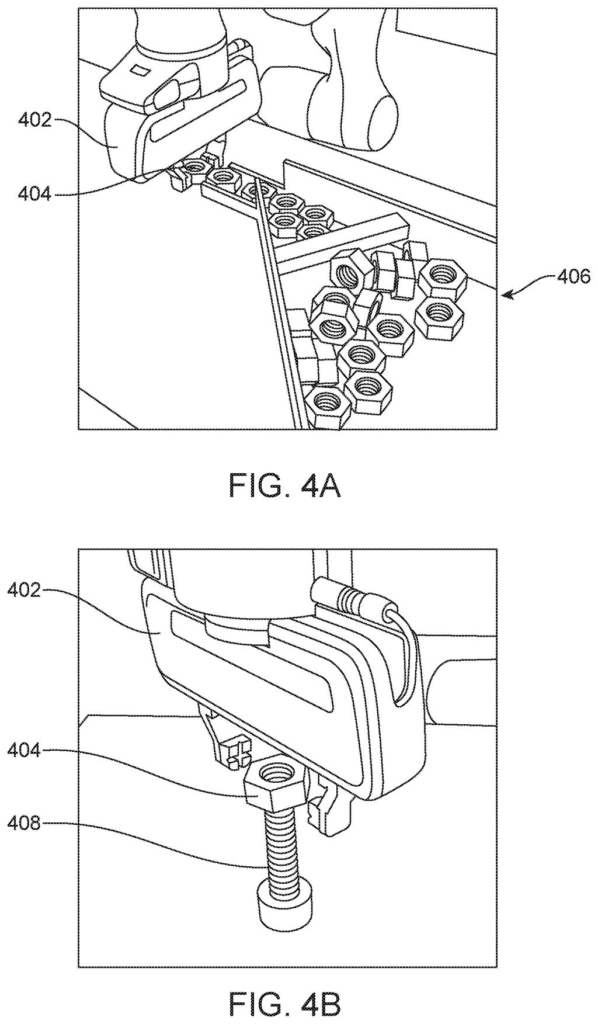
Nvidia's 34th filing we've tracked since May on teaching robots to grasp and move builds on earlier work like one on warehouse item placement and one on multiplying training videos.
The core tradeoff here is accuracy versus speed. Dropping contact points always risks losing information the physics engine actually needed, and the patent is upfront that proximity and normal similarity are the proxies it uses to decide what is redundant. That heuristic works well when contacts really are clustered on a flat surface, but on irregular or concave geometry, two nearby contacts can point in very different functional directions. The filter might discard one of them and subtly break the simulation in ways that only show up when the trained robot tries to grip something oddly shaped.
That said, the tradeoff reads as worth accepting. Perfect simulation is already a fiction: every physics engine makes approximations, and the goal is a robot policy that transfers to messy reality, not a policy that works perfectly in a flawless virtual world. Cutting computation to allow more training runs often beats squeezing more fidelity out of fewer runs.
For Nvidia, this is more infrastructure than invention. It is the kind of engineering improvement that makes a training platform commercially viable, not a conceptual leap. The filing is competent and focused; it just does not rewrite how anyone thinks about robot learning.
Get our take in your Top Stories
Liked this breakdown? Add Patentlyze as a preferred source on Google, and our plain-English take shows up more often in your Top Stories the next time Nvidia patent news breaks.
There are more where this came from
We read every patent application Big Tech publishes and send you the ones worth knowing. Plain English, free, every week.
The drawings
10 drawing sheets from US 2026/0295823 A1 · click any drawing to enlarge


Want this weekly breakdown for a company we don't cover? Patentlyze Pro →
Be the first to weigh in