
Nvidia Files Patent for Sharper Night Vision From Low-Cost Car Cameras
Cheap car cameras that capture infrared light take blurry, noisy pictures in the dark. Nvidia's patent borrows detail from the color image to sharpen them.
What Nvidia's infrared-plus-color camera trick does
A dashboard camera watches a dark road at night, and the picture it produces is soft, grainy and hard to read. That's a real problem when a driver-assistance system has to spot a pedestrian or check whether you're nodding off.
Many modern cameras capture two kinds of light at once: ordinary color and infrared, a kind of light your eyes can't see. The catch is that the infrared picture is the blurrier one, because the sensor gives it only a quarter of its tiny light-catching dots. Nvidia's patent blends the two. For every spot in the image, it decides how much to trust the infrared reading and how much to trust the color one, then mixes them into a single sharper picture.
You would never see the result yourself, but the software behind the camera does, and it gets a cleaner view to work from.
… computing a blending factor according to one or more optimization criteria and a brightness factor; and combining the IR image data and the luma image data based on the blending factor to produce the intensity image.
Translation: It figures out how to mix infrared and visible light data based on brightness and quality rules to create a clear final picture.
How the blend picks infrared or color per pixel
The patent works on images from an RGB-IR sensor, a single camera chip that records red, green and blue light plus infrared. Because of how its color filter grid is laid out, only a quarter of the pixels read infrared, so the infrared image comes out lower in resolution, blurrier and noisier than the color one. The color pixels also respond to some infrared light, which the patent treats as extra information worth using.
The method has three moves:
- Build a luma image (a brightness-only version of the color picture) and an infrared image from the same sensor.
- Compute a brightness factor, the ratio between the average brightness of sampled pixels in the luma image and in the infrared image, so the two sit on the same scale.
- Compute a blending factor for each pixel and use it to mix the two images into one intensity image.
The blending factor is tuned to an optimization goal: signal-to-noise ratio (how much real picture versus random speckle), local contrast, or modulation transfer function (how well fine detail survives). The filing describes a weighted mix of these goals, with weights a user can set. When a pixel is saturated (blown out to pure white), the blend leans away from it and toward the other source. The claims also cover doing the blending with a trained neural network.
… each IR image corresponding to the IR wavelength data is fused with a luminance (luma) image computed from corresponding the visibility wavelength data to produce IR/luma intensity images.
Translation: The system merges night vision data with standard visual light data to generate a single enhanced image.
Why cheap car cameras matter for night driving
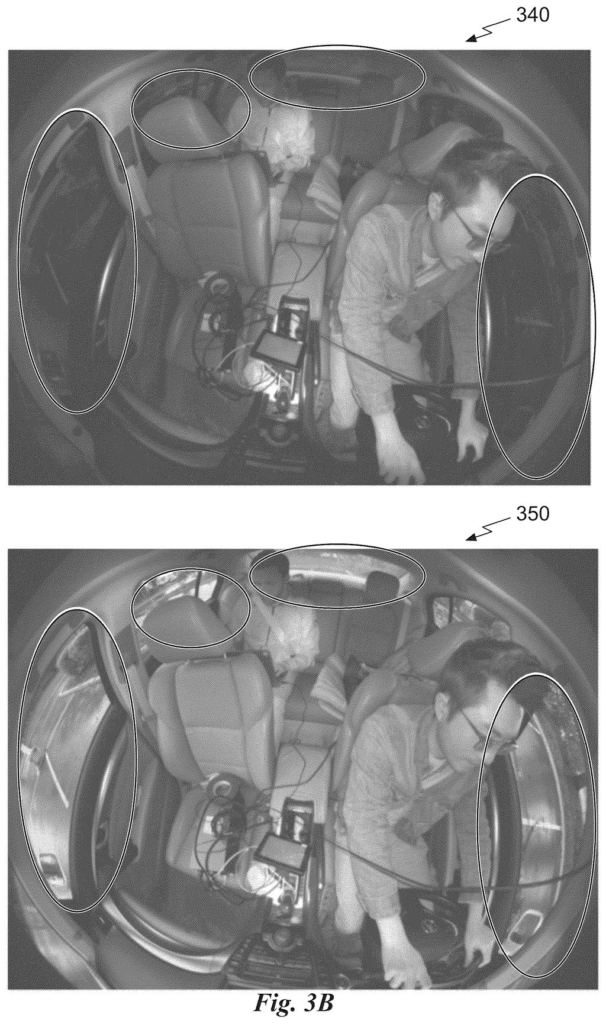
If you drive a car with lane-keeping or driver monitoring, its cameras have to work at noon and at midnight. Cleaner images from inexpensive sensors could give the software a better view without a carmaker paying for pricier camera hardware. The filing says this improves reliable detection of safety-critical information in varied lighting, and its sample comparison shows car windows that look brighter and more detailed than a conventional method produces.
The same idea applies anywhere a camera works in poor light. Robotics, security cameras, medical imaging and biometric checks all appear in the claims. The filing focuses on cleaning up image data and does not name any product that would use it.
Nvidia's 84th filing we've tracked in our self-driving sensing race watchlist since May adds to earlier work like its curving lane lines filing and its eyelid drowsy driving camera.
Night driving is where camera-based safety systems earn their keep, and a blurry, grainy picture is a real handicap there. Low-cost sensors that record infrared give up resolution to do it, so the weak image is a direct result of keeping car hardware cheap. Those sensors are increasingly common in driver-assistance systems, which makes the problem a sizable one.
The fix matches the size of the issue. Mixing two images the sensor already captures costs no extra hardware, and the core math fits in a few lines. The filing shows a single comparison image and no measured numbers, so how much better the result looks is unproven in the text we have.
I read this as routine engineering aimed at a problem that matters. Nobody will be wowed by a blending formula, but a clearer night picture is a practical gain for the cars and cameras that already depend on this kind of sensor.
Get our take in your Top Stories
Liked this breakdown? Add Patentlyze as a preferred source on Google, and our plain-English take shows up more often in your Top Stories the next time Nvidia patent news breaks.
There are more where this came from
We read every patent application Big Tech publishes and send you the ones worth knowing. Plain English, free, every week.
The drawings
11 drawing sheets from US 2026/0311373 A1 · click any drawing to enlarge


Show the other 3 sheets


Want this weekly breakdown for a company we don't cover? Patentlyze Pro →
Be the first to weigh in