
Qualcomm Files Patent for Cell Towers That Detect Moving Objects Only When Asked
Cell networks are starting to double as radar, bouncing radio signals off cars and people to see where they are and how fast they move. Qualcomm's patent says that scanning should run only when someone asks for it, and only after the tower confirms it can handle the job.
What Qualcomm's on-demand cell tower sensing does
A cell tower sends out invisible pulses across an empty parking lot all night, listening for echoes that never come. Cellular networks are starting to double as radar, spotting objects and their speed from reflected radio signals. The filing says the usual plan is to leave that scanning on around the clock, which wastes energy and network capacity whether or not anything is out there.
Qualcomm's patent switches this to on demand. When a phone, a car, or the network itself needs a reading, it asks a central server. The server proposes a setup, such as how strong the signal should be, how often to send it, and in which direction, then checks with the tower to see whether it can handle that.
The tower answers yes or no, and can suggest a close alternative. Only after that do the devices get their final instructions. If it works as described, the sensing happens when it is needed instead of draining the network all day.
responsive to obtaining an on-demand sensing request at a sensing server, sending a message from the sensing server to a base station, wherein the message includes an indication of a prospective reference signal (RS) configuration for the RF sensing …
Translation: When a server gets a request to look around, it asks a cell tower if a specific setup will work.
How the server checks with the tower first
The claims cover a three-step exchange. A sensing server (the network computer that manages sensing, called a Sensing Management Function in the filing) receives an on-demand request, either from a device or generated by the server itself. It then sends a base station a prospective reference signal configuration, which is a proposed recipe for the test signals used in sensing.
The base station replies with whether it can support that recipe. A simple ACK means yes, and a NACK means no, after which the server can send a new proposal. The filing also describes more detailed answers: a yes or no for each individual setting, or a counteroffer with the closest values the tower can support. Only then does the server send the final configuration to the sensing nodes, the devices doing the sensing, which can include the base station itself.
The recipe can include:
- Bandwidth: how wide a slice of radio spectrum the signal uses
- Periodicity: how often the signal is sent
- Sensing power: how strong it is, which affects range
- Sensing window: how long each observation lasts
- Beam: which direction it points
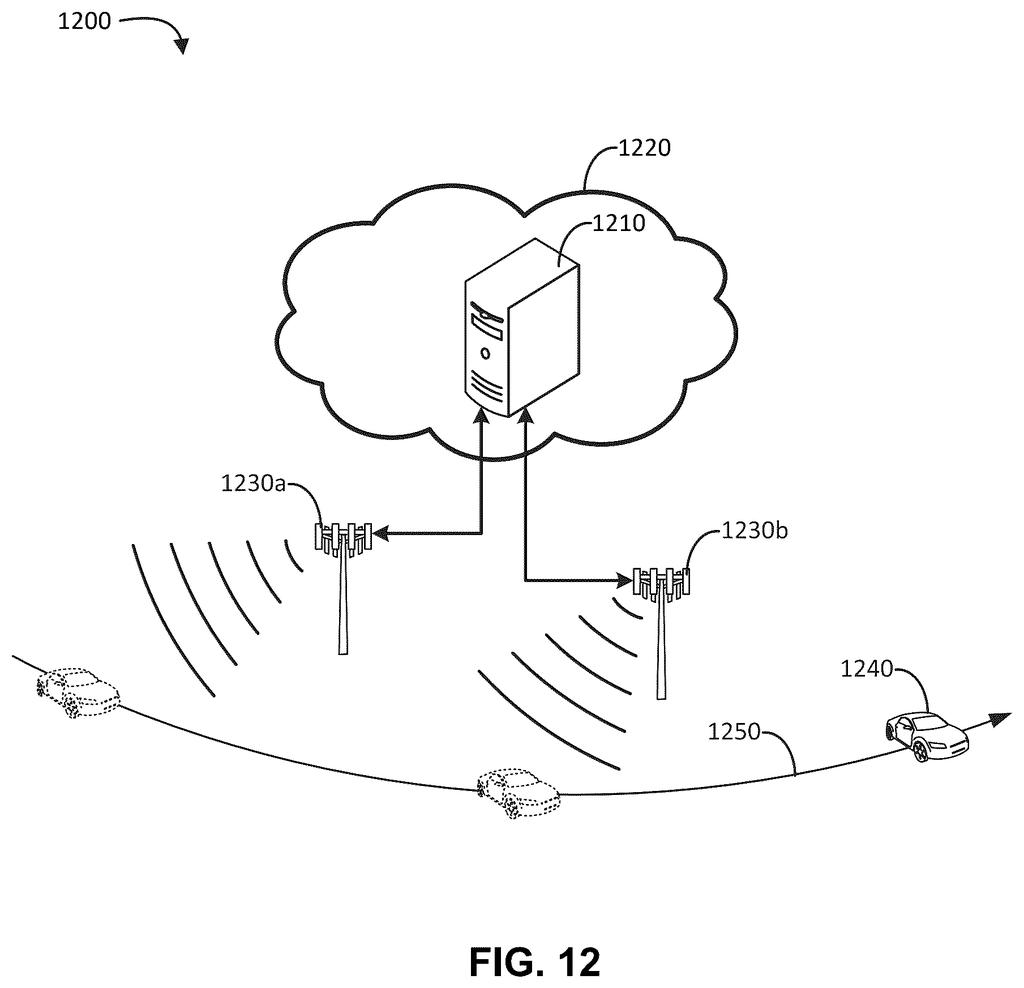
One example in the description follows a moving target across two towers. The first tower's sensing switches off as the target leaves its area, and the second tower's switches on as the target arrives.
… the response is indicative of whether the prospective RS configuration can be supported for the RF sensing …
Translation: The cell tower replies to tell the server whether it has the capacity to handle the scan.
Why always-on radar sensing is a power drain
The practical idea is a network that spends radio resources on sensing only when sensing is needed. The filing says always-on scanning wastes energy and locks in one fixed setting, so a network cannot briefly sharpen its sensing or ease off. On-demand requests would let a tower turn the dial up for a tracking job and back down afterward.
This is a network-side design, so you would probably never interact with it directly. It matters because cellular networks are expanding beyond calls and data into detecting objects, and each new job competes for the same airwaves and power. The filing is a patent application, and it says nothing about when or whether this would reach real networks.
Qualcomm's 517th filing in our Qualcomm coverage since May adds to a run that includes a self-blocking scanner and phones that grade their own AI.
You would almost never see this patent at work. It describes a polite back-and-forth between a network server and a cell tower, and the payoff is a network that spends less energy and radio capacity listening for objects that are not there.
The moment you might notice it is when something needs sharper sensing, such as a system tracking a moving vehicle. The tower can ramp up for that job and ramp back down, instead of running one fixed setting all day.
As a filing, it is routine network plumbing: a yes-or-no handshake before a setup goes live. That is fine. A good handshake keeps a tower from agreeing to a job it cannot handle, and that failure is exactly what this patent is built to prevent.
Get our take in your Top Stories
Liked this breakdown? Add Patentlyze as a preferred source on Google, and our plain-English take shows up more often in your Top Stories the next time Qualcomm patent news breaks.
There are more where this came from
We read every patent application Big Tech publishes and send you the ones worth knowing. Plain English, free, every week.
The drawings
19 drawing sheets from US 2026/0323252 A1 · click any drawing to enlarge


Show the other 11 sheets


Want this weekly breakdown for a company we don't cover? Patentlyze Pro →
Be the first to weigh in