
Waymo Files Patent for Cars That Find Their Own Stop Spot Without a Painted Line
Plenty of residential streets have a stop sign and no painted line, so Waymo's patent teaches its cars to pick a sensible stopping spot the way a careful human driver would.
What Waymo's no-stop-line patent actually does
You're riding in a self-driving car, and it rolls up to a stop sign on a residential street. There's no painted line on the pavement. A human driver would eyeball it: stop near the corner, far enough forward to see cross traffic, but not so far that you're sitting in the intersection.
Waymo's patent teaches the car to make that same judgment call. When its sensors spot a stop sign, a signal, or a crosswalk but no stop line, a trained neural network (software that learns patterns from huge piles of examples) predicts where the car should stop. It can weigh things like the curve of the curb and what other road users are doing.
The car then stops at that spot. The filing also describes saving the result to a shared map, so other cars in the fleet know about it too.
… determining, by the one or more processors, whether the sensor data includes an indicia of a requirement for the vehicle to stop or yield without a corresponding stop line at which to stop or yield; …
Translation: The car looks for signs it needs to stop even when there is no painted line on the street.
How the car guesses a stop spot from sensors
The claims cover a car that first checks its sensor data for a sign that it must stop or yield. The data comes from at least two different types of sensors, such as lidar (which bounces lasers off objects to measure distance) and cameras. The sign can be a traffic signal, stop sign, yield sign, crosswalk, or text on the road, with no stop line to go with it.
When that happens, a neural network (software trained on millions of examples to recognize patterns) predicts one or more stop locations, and the car stops at the chosen one. The filing describes the network producing three outputs:
- Classification: a yes/no heat map of whether a stop line is nearby.
- Localization: arrows from each pixel pointing to the nearest point on a stop line.
- Uncertainty: a spread of possible stop spots, wider and blurrier when no line is painted.
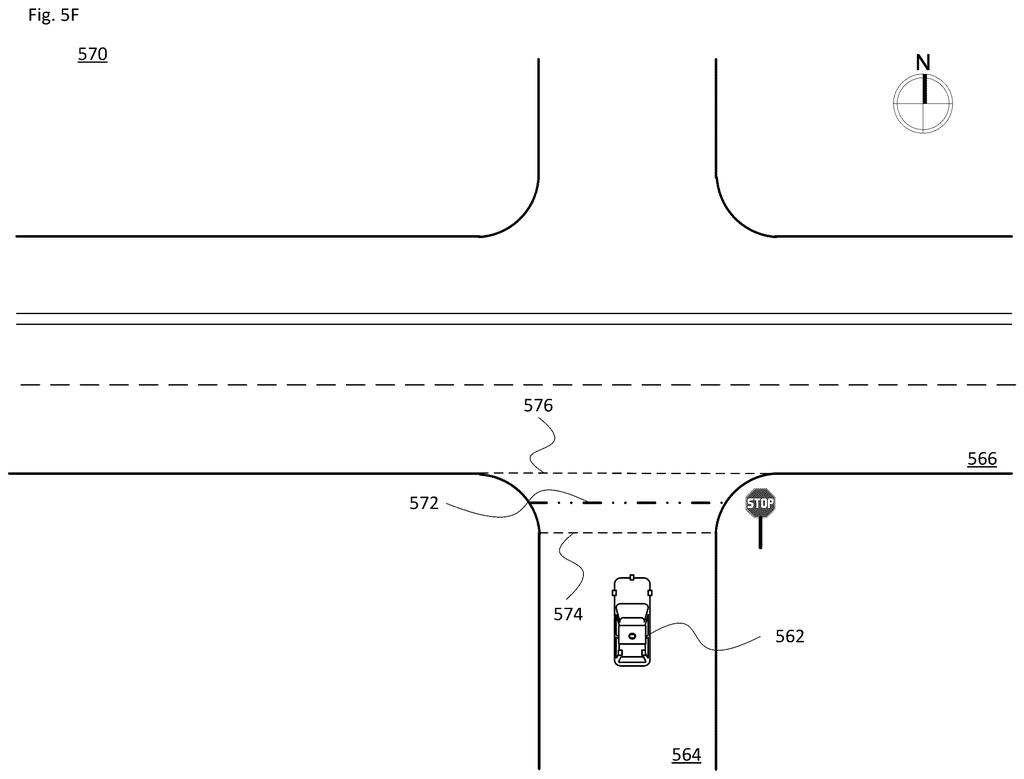
With no line, the car can use the shape of the curb or intersection, its own size, how much it can see from the spot, and what other road users do. In one example it picks a point halfway along the curve of the corner, then may edge forward to see past a tree. The check switches on when the car is roughly 4 to 15 meters from the end of its lane, depending on vehicle size.
Even if a stop line is present, the physical location may not match what is in store map data, which may be out of date due to construction or line repainting.
Translation: Painted lines often fail to match digital maps because roads change due to construction.
Why stale maps are a problem for Waymo's cars
Where a car stops matters more than it sounds. Stop too far back and it can't see cross traffic. Stop too far forward and it blocks the intersection. Maps that record the right spot go stale whenever a crew repaints a line or reshapes a corner, and plenty of streets never had a line at all.
The filing also describes writing the chosen spot back into the map and sharing it with the rest of the fleet, so one car's discovery can help every other car. The description covers passenger cars, delivery vehicles and big trucks alike. If it works, you would likely never notice it. You would just get a ride that stops where a careful driver would.
Google's 75th filing we've tracked since May in our robotaxi sensing watchlist follows one on brake glitch filtering and one on audio taxi directions.
Every choice here swaps certainty for flexibility. A map says exactly where to stop, but only until a crew repaints a line or reshapes a corner, while a neural network can handle the changed intersection by making a judgment call. The filing admits the cost: for unmarked corners its output is a wider, blurrier spread of possible spots than for a painted line.
That cost shows up in two places. A car that stops too far back may not see cross traffic, and one that stops too far forward sits in the intersection. If a bad guess is then written into a map the whole fleet reads, the mistake could travel with it. The filing's answer is to measure the car's own doubt and flag a change only when the mapped spot looks unlikely given that doubt.
The trade reads as worth it. Streets change faster than maps get redrawn, and a system that knows how unsure it is looks like a sensible price for handling corners nobody painted.
Get our take in your Top Stories
Liked this breakdown? Add Patentlyze as a preferred source on Google, and our plain-English take shows up more often in your Top Stories the next time Google patent news breaks.
There are more where this came from
We read every patent application Big Tech publishes and send you the ones worth knowing. Plain English, free, every week.
The drawings
35 drawing sheets from US 2026/0351011 A1 · click any drawing to enlarge


Show the other 27 sheets


Want this weekly breakdown for a company we don't cover? Patentlyze Pro →
Be the first to weigh in