
Waymo Files Patent for Headphone Sounds That Point You Toward Your Robotaxi
Waymo's patent skips the car horn: your headphones play a honk that seems to come from your actual car, and the sound shifts as you turn your head. The same trick could warn you about a cyclist before you open the door.
What Waymo's headphone honk actually does
Ever stood outside an airport or hotel, staring at a row of nearly identical cars and wondering which one is yours? Waymo's answer is to skip the horn and put the honk inside your head instead.
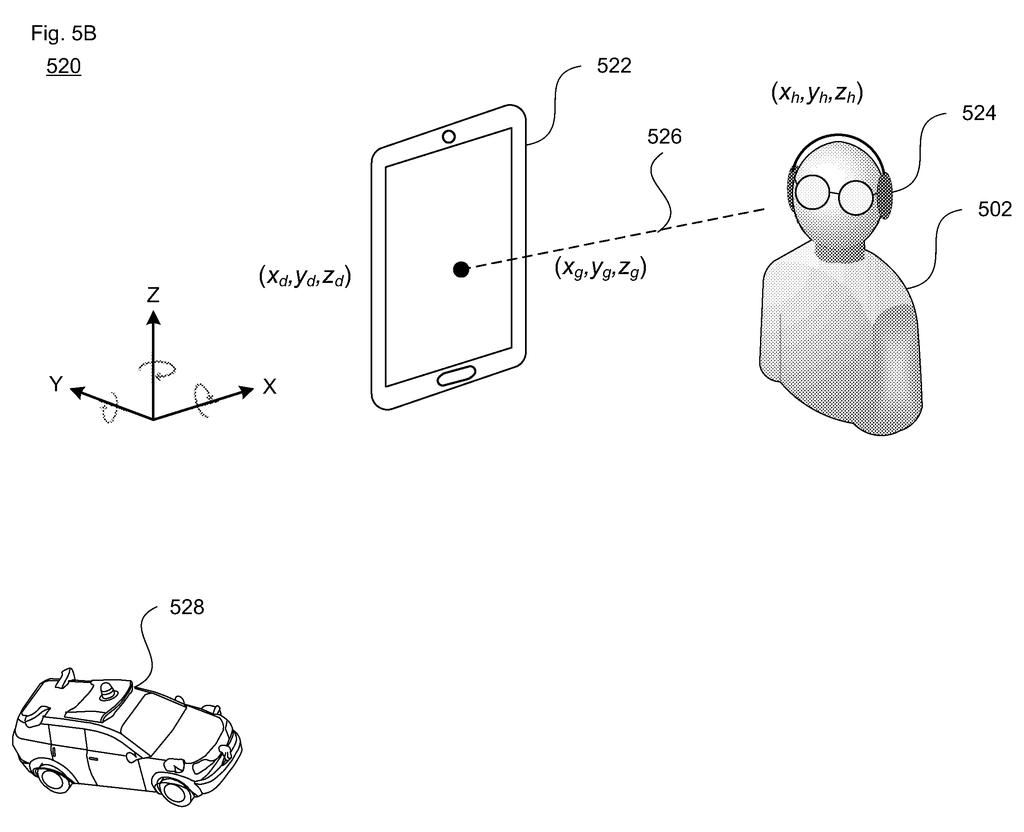
Here's the idea. Your phone knows where your ride is parked. Your headphones know which way your head is turned. Put those together and the system plays a sound that seems to come from the car's real spot. Turn your head toward it and the sound shifts to match; get closer and it gets louder.
The filing also covers the ride itself. If you're sitting inside, the car can use its sensors to spot a bicyclist coming up on the left, and play a bike bell from that side so you know to step out on the right.
… generating, by the one or more processors, a spatial audio signal, the spatial audio signal having a directional component according to the heading of the user and a heading of the vehicle, wherein the directional component of the spatial audio signal is dynamically adjusted in response to detected changes in the heading of the user …
Translation: The sound changes in real time to match whichever way you turn your body.
How the audio follows your head as you turn
The patent describes two related setups. In the first, a computer (usually your phone) estimates which way you are heading compared with where the vehicle is. It then builds a spatial audio signal, which is sound processed so it seems to come from a particular direction, like a voice off to your left. As you turn your head or walk, the direction updates on the fly.
Head tracking can come from sensors in the headphones: a gyroscope (measures rotation), a magnetometer (a digital compass), or an accelerometer (measures movement). Headphones with no sensors can still work using the phone's sensors or camera, but the direction is rougher. The filing gives example precision of 45 degrees or wider with no sensors, and about 5 to 15 degrees with a compass.
Other details the filing covers:
- Loudness can rise as you near the car, to signal distance.
- The sound can be a horn honk, an engine idle, or a sound you pick, chosen to stand out from street noise.
- It can play alongside turn-by-turn walking directions.
The second setup works inside the car. The vehicle's sensors detect a nearby object such as a bicyclist, and the system creates a sound from that direction, adjusted to where the rider's head is pointed. It can indicate which side or door to exit, and can even say aloud what type of object it is.
… spatial audio can be provided to the rider to give them contextual information about the environment outside the vehicle prior to exiting, such as whether a bicyclist is approaching on the side they will be exiting …
Translation: Headphones can warn you about hidden cyclists before you open the door.
Why quiet pickups and safer exits matter
If you've ever caught a ride from a packed curb, you know the guessing game. This patent aims to end it without a horn blaring or any hardware change to the car: the filing says it can run on the phone and earbuds you already own. It could also help riders with vision or cognitive disabilities find a car that pulled over farther down the street than expected, a problem the filing calls out directly.
The in-car piece is the more interesting half. Today, a rider reaching for the door has no idea what is coming up behind the car. A bike bell or a spoken warning from the correct side could prevent a door-into-bicyclist collision. Whether it ever shows up in a Waymo ride is unknown. This is a patent application, and nothing in it says a launch is planned.
That makes this Google's 73rd filing we've tracked since May in our robotaxi sensing work, after earlier applications on finding better pickup spots and using wash cycles as sensor checks.
You would notice this during the most annoying part of any ride: the first couple of minutes when you are hunting for the car. A sound that seems to float from the right spot, and gets louder as you walk toward it, beats squinting at license plates. It also keeps the street quiet, since nobody else hears it.
The exit warning may matter more. Opening a car door into a passing bike is a common hazard, and a rider with earbuds in is the person least likely to be checking mirrors. A bell sound from the left that says wait needs no training to understand.
The limit is that you need earbuds in and the app running, so it only helps people who choose it. For those people, the benefit is concrete and easy to picture.
Get our take in your Top Stories
Liked this breakdown? Add Patentlyze as a preferred source on Google, and our plain-English take shows up more often in your Top Stories the next time Google patent news breaks.
There are more where this came from
We read every patent application Big Tech publishes and send you the ones worth knowing. Plain English, free, every week.
The drawings
26 drawing sheets from US 2026/0338571 A1 · click any drawing to enlarge


Show the other 18 sheets


Want this weekly breakdown for a company we don't cover? Patentlyze Pro →
Be the first to weigh in