
Adobe
Adobe · AI / ML · Filed May 12, 2025 · USPTO published Nov 12, 2026 · This week's release
Adobe Wins a Patent for Two AIs That Take Turns Editing and Critiquing Your Video
Adobe has been granted a patent for a video editor where one AI assembles your clips and a second AI plays the picky critic, sending the cut back for fixes until it matches what you typed.
- Publication number
- US 2026/0360388 A1(US20260360388A1)
- Applicant
- Adobe Inc.
- Filed · Published
- May 12, 2025 · Nov 12, 2026
- Inventors
- Jose Marcelo SANDOVAL-CASTANEDA, Bryan RUSSELL, Fabian David CABA HEILBRON, Josef SIVIC
- Status when we published
- Granted
- Document
- 20 claims
- US classification
- 386/285
- Examiner
- HASAN, MAINUL (Art Unit 2485)
What Adobe's two-AI video editor actually does
Imagine you drop hours of raw footage onto your computer and type a single sentence: "Make a slow-paced, 61-second opening sequence of the main character." No hunting through clips, no dragging things around a timeline. You just wait for a finished cut.
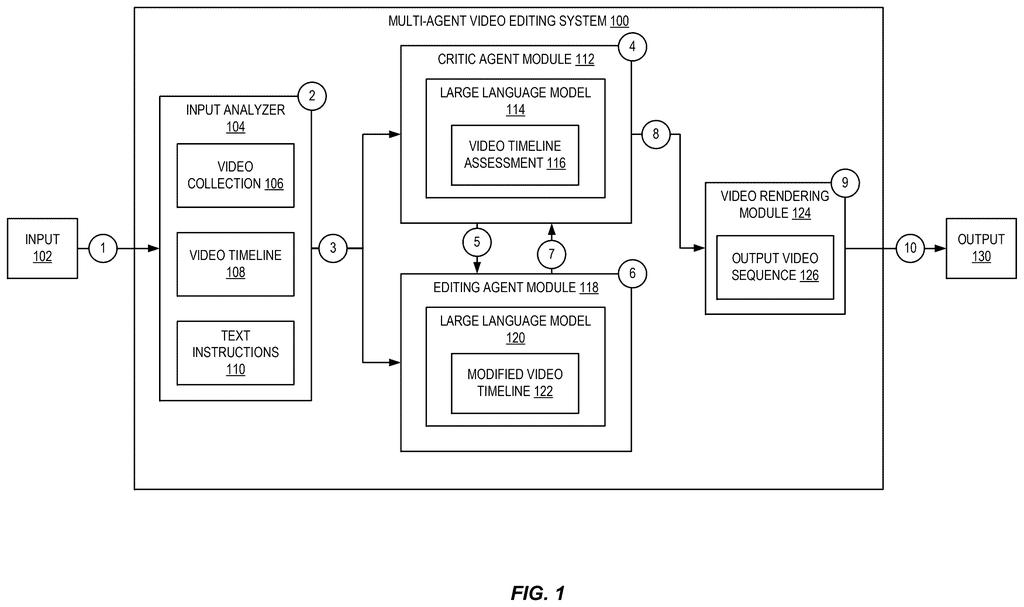
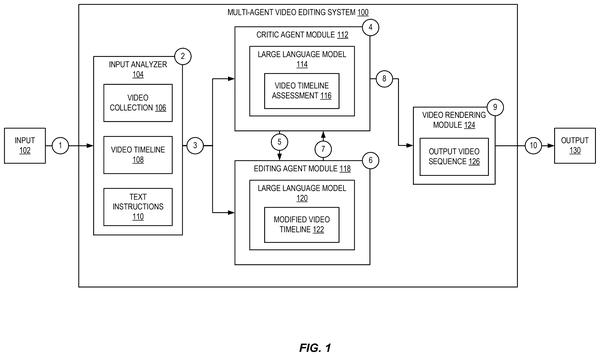
Adobe's patent, which the Patent Office has now granted, splits that job between two AI helpers. One is the editor: it searches your clips and places them on the timeline (the strip where a video gets assembled). The other is the critic: it looks at the result and says things like "This is a good start but the timeline is still too short. Add more shots of the man looking contemplative."
They go back and forth, the editor fixing and the critic checking, until the critic is satisfied. Only then does the final video get built.
… generating, by a first neural network, an assessment of a similarity between the video timeline and the natural language text instructions, the assessment including recommended modifications to the video timeline; …
Translation: One AI checks your video against your text instructions and suggests changes.
How the critic and editor trade notes on a cut
The system takes three inputs: a pile of video clips, a timeline (the ordered strip of clips that becomes the final video, which can start out empty), and a plain-English request such as "make a slow-paced, 61-second establishing sequence of the main character." Each clip can carry labels: its length, a text description, a shot type (close-up, wide, and so on) and a camera motion (handheld, drone, panning).
Two AI models then take turns. The filing describes them as large language models (the same family of software behind modern chatbots):
- The critic compares the timeline to your request and writes feedback in plain text, such as "the timeline is empty, start by adding videos of the main character."
- The editor turns that feedback into editing actions: search the clips, add one, remove one, swap two, or move one.
- The critic looks again. When it is satisfied, it calls for the video to be rendered (built into a finished file).
A second independent claim covers how to train these models. An "explorer" model is let loose in the editing software to try things on its own. A labeler then guesses what instruction would have caused each move, a scorer rates how well the two match, and the best pairs become worked examples for the editor and the critic.
… modifying, by a second neural network, the video timeline using video clips from the video collection based on the recommended modifications.
Translation: A second AI edits the video clips into the timeline using those suggestions.
Why Adobe's text-to-edit idea matters for creators
If this ever shows up in a product, the biggest change would be who can edit video. Instead of learning where every tool lives, you would describe the result you want and let the software do rounds of fixes on its own, with almost no input after your first request. That would help anyone making social posts, ads or short films out of piles of raw footage.
The filing's own pitch is that earlier tools only do the one task you name and leave you to judge whether it worked. Here the software judges its own work. One note: this is already a granted patent, and the final granted claims may read a little differently from the published application described here.
Adobe's seventh filing we've tracked since July in our AI models working together watch, following one where AI grades AI and a pre-check for database searches, adds another layer to this pattern.
Source: US 2026/0360388 A1 at the USPTO (PDF). Full patent text and figures are in the official publication.
Get our take in your Top Stories
Liked this breakdown? Add Patentlyze as a preferred source on Google, and our plain-English take shows up more often in your Top Stories the next time Adobe patent news breaks.
Add Patentlyze on Google
One click.
There are more where this came from
We read every patent application Big Tech publishes and send you the ones worth knowing. Plain English, free, every week.
The drawings · 9 sheets
9 drawing sheets from US 2026/0360388 A1 · click any drawing to enlarge


Show the other 1 sheets

More from Adobe
All 264 Adobe patents →

More in AI / ML
All 2,637 AI / ML patents →
Samsung
Samsung Files Patent for One AI Model That Handles Many Editing Jobs
IBM
IBM Files Patent to Have a Big AI Grade a Small AI's Coding Homework
Salesforce
A New Salesforce Patent Lets One AI Check Another's Work While It's Still Working
IBM
No comments yet