

Salesforce
Salesforce · AI / ML · Filed May 9, 2025 · USPTO published Nov 12, 2026 · This week's release
Salesforce Patents an AI Video Maker That Follows Your Company's Brand Rules
On the surface, Salesforce's patent application describes a video generator. The more interesting part is that an approver's comments flow straight back to the AI as new instructions, so the video gets rewritten without a human redoing the work.
- Publication number
- US 2026/0359757 A1(US20260359757A1)
- Applicant
- Salesforce, Inc.
- Filed · Published
- May 9, 2025 · Nov 12, 2026
- Inventors
- Nikhil KAPRE, Jayakrishnan Radhakrishna PILLAI, Krishna SUVARNA, Tarundeep BATRA
- Status when we published
- Examiner raised objections; the company can respond
- Document
- 20 claims
- US classification
- 705/7.27
- Examiner
- NEAL, ALLISON MICHELLE (Art Unit 3625)
What Salesforce's brand-safe video AI does
A marketing team needs a short product video for social media by Friday. Someone writes the script, someone finds pictures, someone records a voiceover, and then three departments argue about whether it sounds like the company.
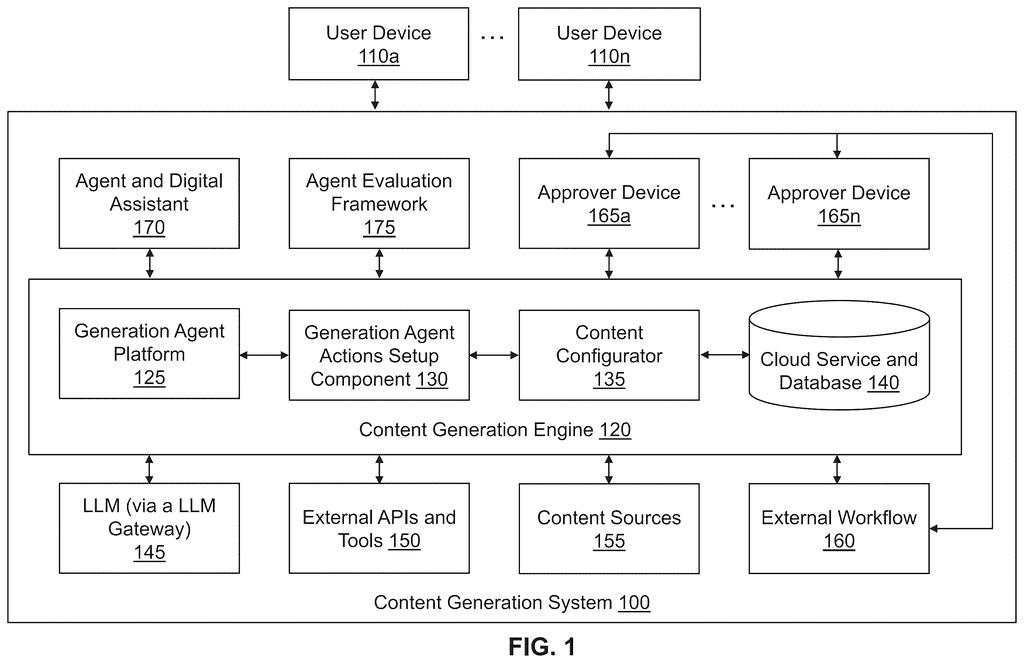
Salesforce's patent application describes software that does the first draft for you. You tell it what you want, in plain language or out loud. An AI writes the words, makes the images, and produces narration and background music, then stitches them into a video. Before anything is final, the AI checks the draft against the company's brand rules, such as its tone of voice and its look.
Then the video goes down a set chain of approvers. If one of them wants a change, that feedback becomes a new instruction for the AI, which redoes the parts that need fixing. The finished video drops into the right template for wherever it will be posted.
querying an artificial intelligence (AI) agent, using a prompt comprising a dynamic instruction and a static instruction, to generate a plurality of components associated with content specified by a user device for an output channel, the plurality of components comprising text, an image, and audio …
Translation: Asking an AI using specific instructions to create the text, pictures, and sound needed for a video.
How the AI turns approver feedback into edits
The claims cover a method in which an AI agent (software that carries out a multi-step task on its own) is asked to produce the pieces of a piece of content: text, an image, and audio. The request, called a prompt, mixes two kinds of instruction. A static instruction is fixed wording, such as "Summarize the following text." A dynamic instruction changes each time, such as a spoken request that has been transcribed into text.
The claimed steps run in this order:
- Generate: the AI makes the text, image and audio. The filing says a large language model (the AI behind chatbots) handles text, while diffusion or GAN models (two common types of image-making AI) handle images and sound.
- Refine: the AI is asked again, this time with a brand configuration, a written, visual or verbal description of the company folded into the prompt.
- Stitch: the pieces are combined into a video. The description says tools can line up image clips with the beat of the music.
- Approve: an approval workflow set up by the company reviews the video. Any change it asks for is turned into a spoken-style instruction, transcribed, and fed back to the AI.
- Package: the video is placed into a template tied to the brand and the output channel.
Dependent claims add extras. Narration can match the tone and emotion of each text snippet, and the music can follow the mood of the text. A plagiarism check can also compare the video against copyrighted videos and trigger a change.
… updates, based on an approval workflow set up in the enterprise, the video to incorporate a change determined from the approval workflow …
Translation: Automatically edits the video to match what company reviewers requested.
Why marketing teams may care about this filing
If you work anywhere near marketing, the practical pitch is fewer days lost between a draft and a posted video. The filing points to jobs like writing product descriptions for big online catalogs, which people now do largely by hand, and to emails, newsletters and social posts. The promise is a first draft that already sounds like the company, plus a record of who approved what.
For everyone else, the stakes are quieter: the ads and emails you see could be produced faster and in bulk, with the same voice every time. The examiner's first review rejected the claims as filed, which is routine at this stage and usually followed by amendments, so the final scope could shrink.
Salesforce files its second patent in the AI image and video topic we've tracked since June, following one remixing people from photos.
Source: US 2026/0359757 A1 at the USPTO (PDF). Full patent text and figures are in the official publication.
Get our take in your Top Stories
Liked this breakdown? Add Patentlyze as a preferred source on Google, and our plain-English take shows up more often in your Top Stories the next time Salesforce patent news breaks.
Add Patentlyze on Google
One click.
There are more where this came from
We read every patent application Big Tech publishes and send you the ones worth knowing. Plain English, free, every week.
The drawings · 9 sheets
9 drawing sheets from US 2026/0359757 A1 · click any drawing to enlarge


Show the other 1 sheets

More from Salesforce
All 108 Salesforce patents →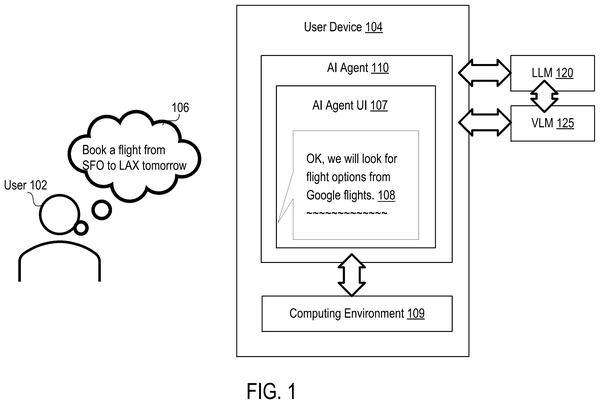
Salesforce
Salesforce Files Patent for AI Assistants That Learn to Use Websites From Flawed Examples
Salesforce
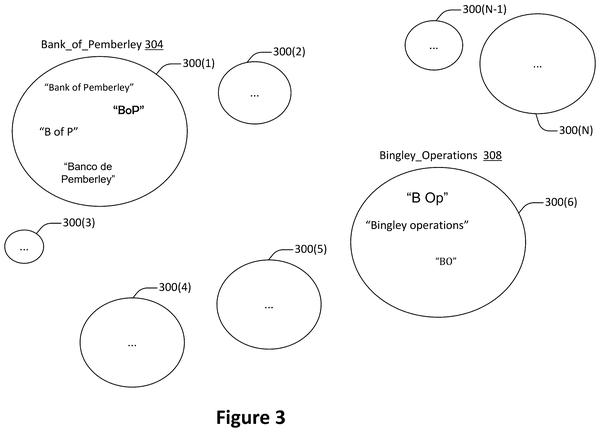
Salesforce Patents a System That Automatically Unifies Duplicate Company Names in Databases
Salesforce
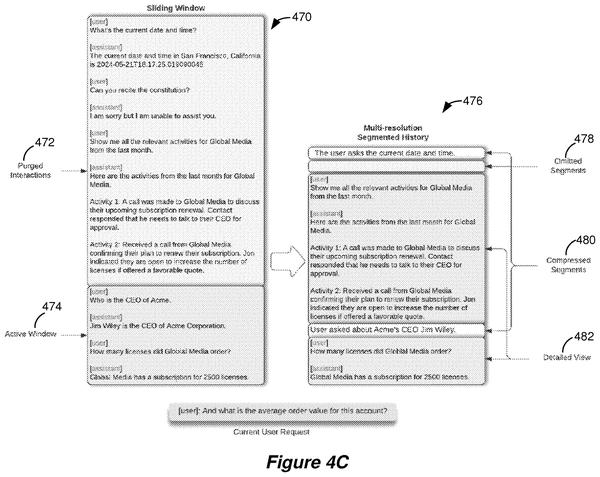
Salesforce Patents Chatbot Memory That Shrinks Old Topics and Keeps the Relevant Ones
More in AI image & video
All 223 AI image & video patents →
Microsoft
Microsoft Files Patent for Sharpening Low-Quality Video Without Lag
Microsoft
Microsoft Files Patent to Make Game Upscaling Work With HDR Visuals
Adobe
Adobe Patents an AI Image Generator That Draws Fur, Hair and Glass Without a Background
Adobe
No comments yet