
Apple
Apple · AR / VR · Filed Jul 21, 2026 · USPTO published Nov 12, 2026 · This week's release
Apple Patents Technology to Place Virtual Content at Fixed Real-World Spots on Phones and Headsets
Apple describes a single app that asks every content provider, on your device and online, which digital objects belong right where you are standing. Think of it as a search engine for the spot under your feet.
- Publication number
- US 2026/0362082 A1(US20260362082A1)
- Applicant
- APPLE INC.
- Filed · Published
- Jul 21, 2026 · Nov 12, 2026
- Inventors
- David W. Padgett, Christopher D. Fu, Scott G. Wade, Paul Ewers, Ioana Negoita, Thomas G. Salter, Dhruv Aditya Govil, Dimitris Ladopoulos
- Status when we published
- Waiting for an examiner
- Document
- 20 claims
- US classification
- 370/329
- Parent application
- Continuation of 18/978,164 (filed Dec 12, 2024)(18978164)
What Apple's location-based AR lookup does
Every time you lift your phone or put on a headset to look around, the device has to decide which digital extras belong in front of you. Today that often means a separate app for each kind of content, and the same virtual object can land in a slightly different spot for each person.
Apple's filing describes one host app that checks where you are, then asks many content providers at once: apps already on your device and services on the internet. Each one answers with what it has near you and where each item should appear in the real world. Your preferences, like language or age, can narrow what comes back.
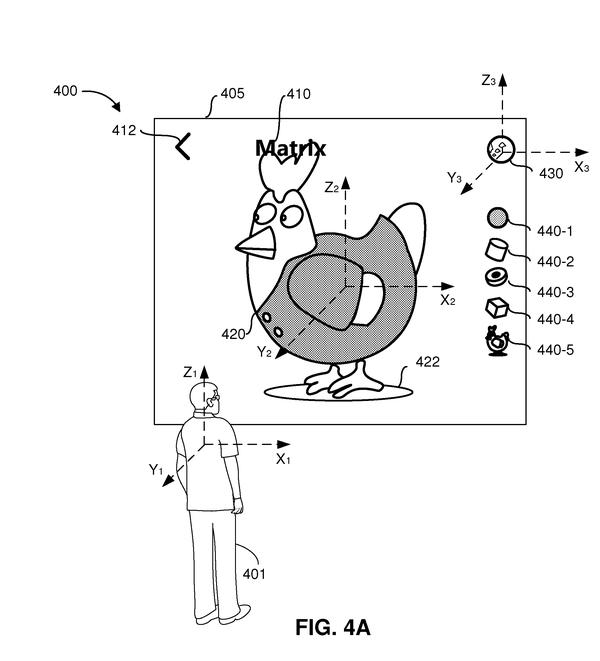
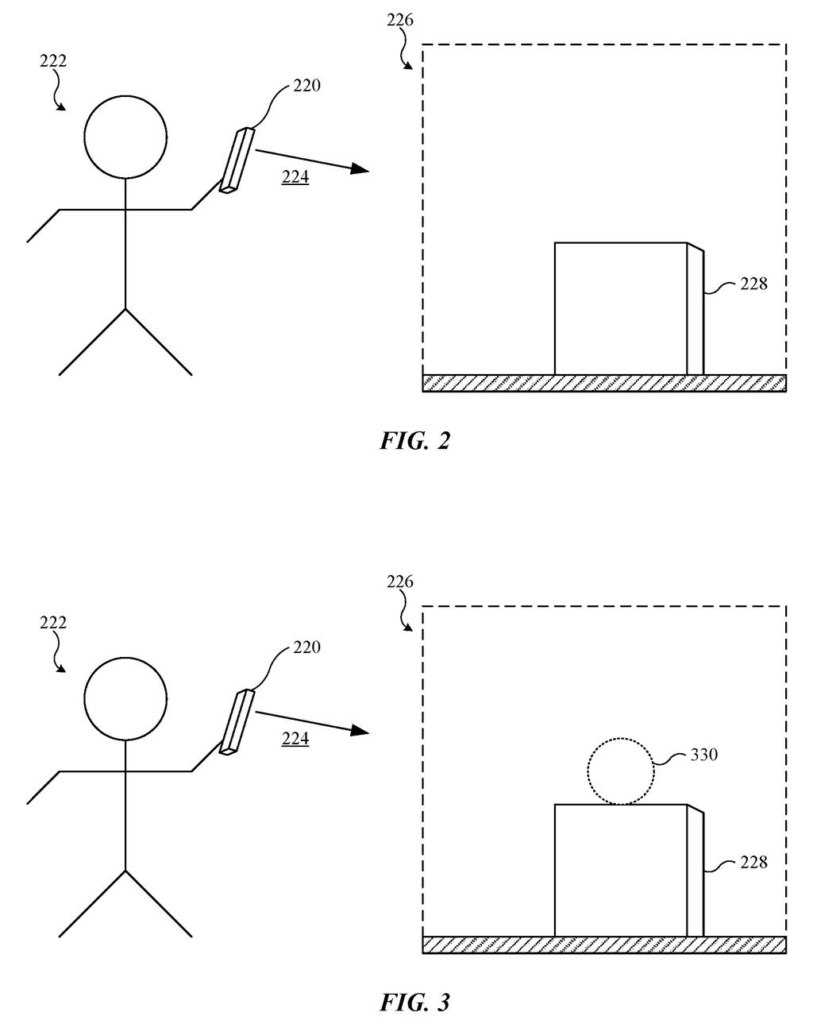
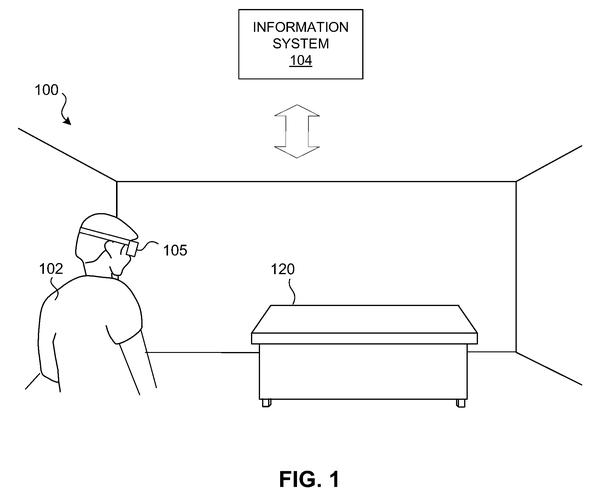
The result could be a virtual statue sitting on a real table, or a row of virtual books on your actual shelf, all pulled from different sources into one view.
… transmitting a request including the device location of the electronic device to content sources, wherein the content sources include a local content source that is located on the electronic device and a remote content source that is located remotely from the electronic device; …
Translation: The device asks nearby and distant servers for virtual items tied to its current GPS coordinates.
How the device asks local and online sources
Claim 1 covers a simple chain of steps. The device first works out where it is (the filing mentions satellite coordinates, among other methods). It then sends a request containing that location to content sources, and at least one must live on the device while at least one is remote. A local source can be reached through an API call (a built-in way for one program to ask another for something), and a remote one over a network.
Each source can reply with a content item plus display location information, meaning where in the physical world the item belongs. The item is only chosen if that position falls inside an area defined by your device's location, such as a set radius around you. The description also mentions a room in a building.
Then the device shows the item in the real environment at that position. Dependent claims and the description add optional pieces:
- Preferences: filters, your age or your preferred language can shape what is picked.
- Orientation: the item can be turned and placed relative to a physical feature, like the edge of a table, spotted by a sensor.
- Content types: 3D models, images, video, audio or code.
The description also covers scanning a barcode on an object to fetch content for it.
… receiving, from at least one of the local content source or the remote content source, a content item and display location information associated with the content item.
Translation: The device downloads the virtual object along with exact instructions on where it sits in the room.
Why one app for all nearby AR content matters
For you, the practical upside is fewer separate apps. Walk into a museum, a store or your own living room, and one app could gather virtual items from several providers and place them in view. The description gives examples: a poster in your preferred language, age-appropriate images, or virtual books lined up on your real bookshelf.
The filing's stated problem is consistency. Today's approximate positioning can put the same content in different spots for different people, or for the same person on different visits. A shared lookup plus precise placement aims to fix that, which matters for any phone or headset meant to show several people the same thing. The request carries your location, and the filing includes the usual language about letting people opt in or out of sharing personal data.
Apple's 127th filing we've tracked since May on our Apple AR glasses watchlist adds to earlier applications on a sliding forehead pad and lag-free head movement images, filling in more of the hardware design.
Source: US 2026/0362082 A1 at the USPTO (PDF). Full patent text and figures are in the official publication.
Get our take in your Top Stories
Liked this breakdown? Add Patentlyze as a preferred source on Google, and our plain-English take shows up more often in your Top Stories the next time Apple patent news breaks.
Add Patentlyze on Google
One click.
There are more where this came from
We read every patent application Big Tech publishes and send you the ones worth knowing. Plain English, free, every week.
The drawings · 8 sheets
8 drawing sheets from US 2026/0362082 A1 · click any drawing to enlarge


More from Apple
All 672 Apple patents →
More in AR / VR
All 690 AR / VR patents →
Apple
Apple Patents Per-Person Content Permissions Inside 3D Virtual Meetings
Apple
AR Patent Lets Real People Break Through Virtual Content
Apple
Apple Patents a Floating Window That Makes AR Content Look Recessed in Space
Apple
No comments yet