
Meta
Meta · AR / VR · Filed Apr 15, 2026 · USPTO published Nov 12, 2026 · This week's release
Meta Files Patent for a Headset That Shuts Down Safely When Its Cable Is Pulled
Tethered headsets have an obvious weak spot: the cable. Meta's patent application describes a headset and battery pack that notice the plug coming out and shut down in an orderly way instead of just losing power.
- Publication number
- US 2026/0358438 A1(US20260358438A1)
- Applicant
- Meta Platforms Technologies, LLC
- Filed · Published
- Apr 15, 2026 · Nov 12, 2026
- Inventors
- Deepak Gopi, Puneet Gupta, Yiwen Wu
- Status when we published
- Waiting for an examiner
- Document
- 20 claims
- US classification
- 307/116
- Parent application
- Claims priority from a provisional application 63801612 (filed May 7, 2025)
What Meta's headset cable-pull detection does
Imagine you're deep in a mixed reality game when the cable running from your headset to a separate battery pack snags on a chair and pulls loose. The filing's worry is that a sudden loss of power can damage the electronics.
Meta's patent application describes a way for the headset, the battery pack, or both to notice the cable coming out and react right away. Instead of dying abruptly, the device gets a signal and starts a controlled shutdown. If the cable's power gets cut instantly, a small backup battery can cover the gap while the shutdown finishes.
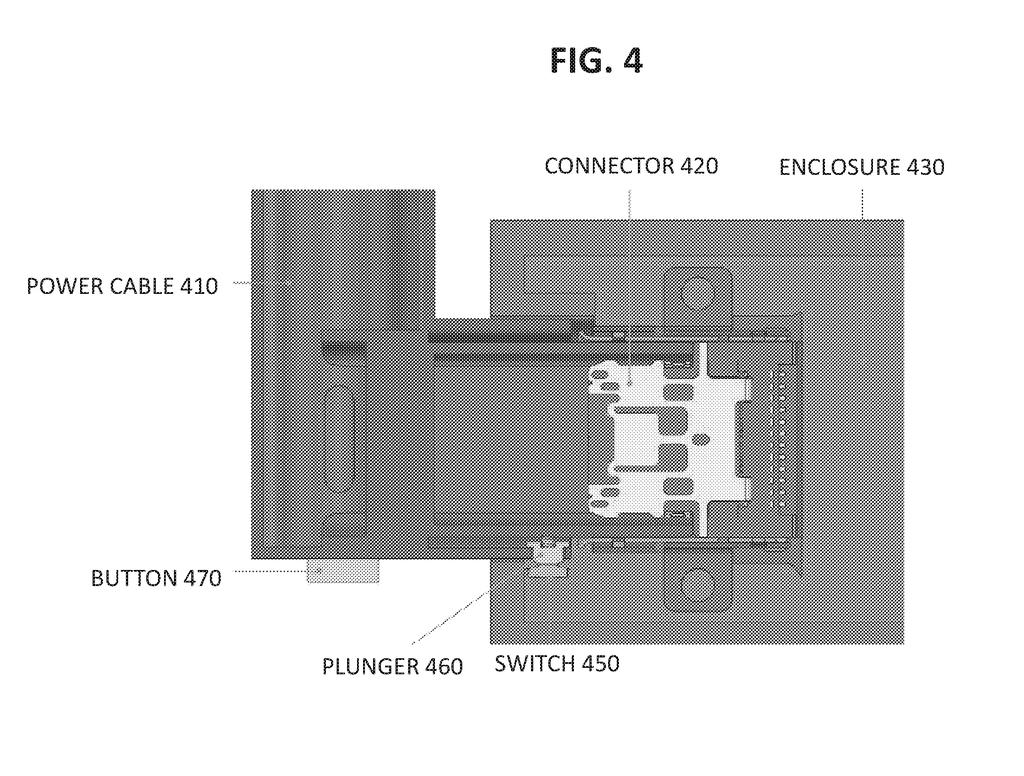
The filing lists several ways to spot the unplugging: a tiny spring-loaded switch, a magnet in the cable, a pressure sensor, or touch sensors that notice your fingers grabbing the plug.
generating a cable removal detection signal event, the cable removal detection signal event generated upon detection of removal of a power cable connecting a head-worn mixed reality device to an external compute/battery device; …
Translation: The headset notices the moment its power cord gets unplugged.
Four ways Meta's cable can sense it's unplugged
The setup is a head-worn mixed reality device linked to an external compute/battery device (a separate unit that supplies computing and power) by a removable cable. The cable can come out at either end, or both. Claim 1 covers two steps: generate a "cable removal detection signal event" when the power cable is removed, then remove power from the headset, the external unit, or both in response.
The claims and description list several ways to produce that signal:
- Mechanical switch: a spring-loaded plunger presses a switch while the plug is in. The switch releases when the plug leaves, either as you pull or as you press a release button.
- Hall effect sensor (a part that measures magnetic strength): a magnet sits in the cable, and the reading drops as the cable comes out.
- Pressure sensor or strain gauge: slower to react, but changes in pressure as you start to pull can give early warning.
- Capacitive touch surfaces (the same kind of sensing a touchscreen uses): they sit on the cable and detect your fingers grasping it. Putting them on two sides is meant to reduce false triggers.
Once the signal fires, it reaches a microcontroller (a small chip that handles simple control jobs). The microcontroller tells the power management circuit to shut down the device's power rails (the separate power lines feeding its parts) in an orderly way. In another version, the signal goes straight to the power management circuit. The external unit has a matching setup, using a microcontroller or a system-on-chip (the main processor).
… removing, responsive to generating the cable removal detection signal event, power from at least one of the head-worn mixed reality device and the external compute/battery device.
Translation: It immediately cuts off the electricity to protect the system.
Why a yanked cable matters for tethered headsets
If you use a headset that is tied to a separate battery or compute unit, the cable is part of how you move, sit and play. A tug, a snag or a mid-session unplug is easy to imagine. The filing's stated goal is to avoid damaging a device through a sudden loss of power, and a controlled shutdown is how it tries to do that.
The pressure-sensor option adds a small idea of its own. Because pressure changes as you begin pulling the plug, the system could get a head start before the cable is fully out. The filing does not name a product, so this reads as a safety detail for split-design headsets in general. You would only notice it if it failed.
Meta's 83rd filing we've tracked since May in the AR glasses race continues a pattern seen in the washed-out blacks fix and the single-light controller tracker.
Source: US 2026/0358438 A1 at the USPTO (PDF). Full patent text and figures are in the official publication.
Get our take in your Top Stories
Liked this breakdown? Add Patentlyze as a preferred source on Google, and our plain-English take shows up more often in your Top Stories the next time Meta patent news breaks.
Add Patentlyze on Google
One click.
There are more where this came from
We read every patent application Big Tech publishes and send you the ones worth knowing. Plain English, free, every week.
The drawings · 10 sheets
10 drawing sheets from US 2026/0358438 A1 · click any drawing to enlarge


Show the other 2 sheets


More from Meta
All 190 Meta patents →
More in AR / VR
All 690 AR / VR patents →
Samsung
Samsung Files Patent to Make a Headset's Camera View Match Where You Look
Apple
Apple Files Patent for a Headset That Senses When Its Own Frame Bends
Qualcomm
Qualcomm Files Patent to Let a Phone Tell a Headset How Much Video to Send
Qualcomm
No comments yet