
Samsung
Samsung · Software · Filed Jun 26, 2026 · USPTO published Nov 12, 2026 · This week's release
Samsung Files Patent for Surround Sound That Adapts to Whatever Speakers You Have
A modern movie soundtrack can hold more than 120 separate sounds, and plenty of speaker setups can't play them as intended. Samsung's filing picks the handful that matter most and sends them along twice.
- Publication number
- US 2026/0360373 A1(US20260360373A1)
- Applicant
- SAMSUNG ELECTRONICS CO., LTD.
- Filed · Published
- Jun 26, 2026 · Nov 12, 2026
- Inventors
- Kyungrae KIM, Hyunkwon CHUNG, Yongmin KWON, Woohyun NAM, Yoonjae SON, Chaebin IM
- Status when we published
- Waiting for an examiner
- Document
- 16 claims
- US classification
- 381/300
- Parent application
- Continuation of PCT/KR2024/020699 (filed Dec 19, 2024)(PCTKR2024020699)
What Samsung's key-sound audio patent does
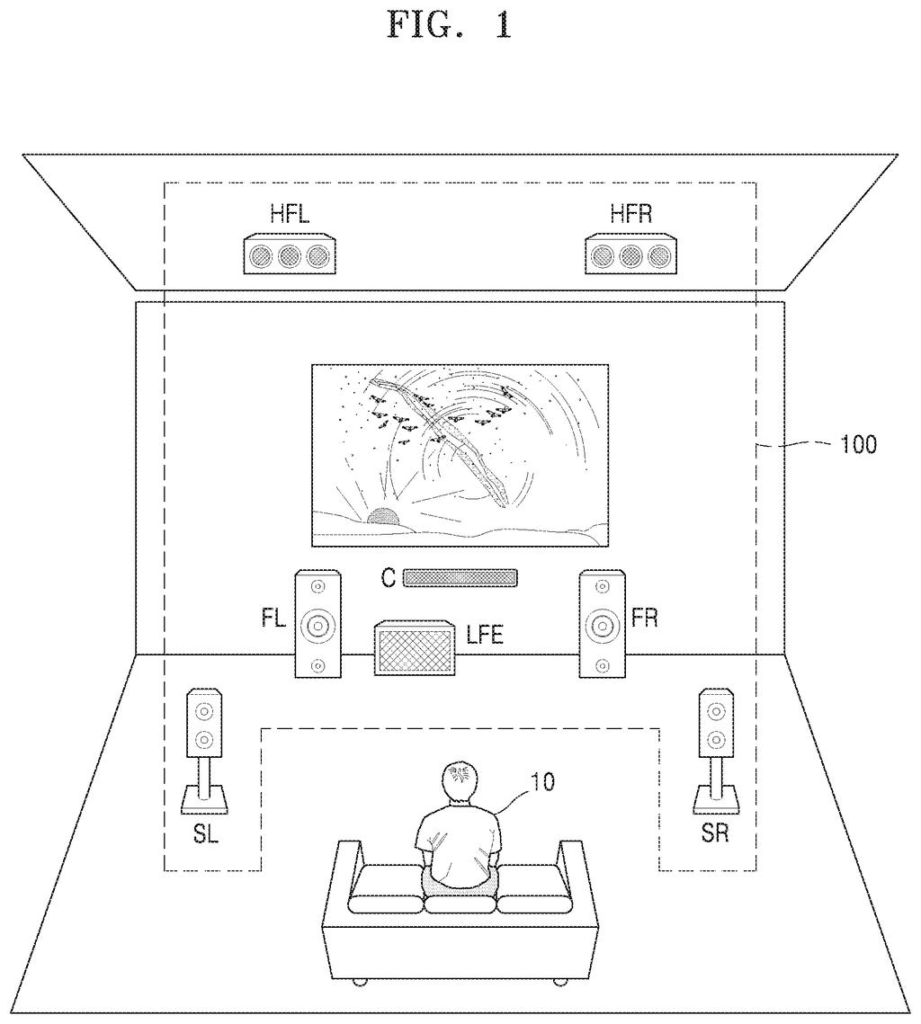
Every time you press play on a movie, the soundtrack has to squeeze through whatever speakers you happen to own. Modern 3D-style audio can track more than 120 separate sounds, like a car driving past or a bird flying overhead, and plenty of devices can't handle that.
Samsung's filing offers a workaround. Software first picks a few key sounds, the ones that move around a lot and are loud (eight out of 122 in the filing's example). Everything then gets blended into an ordinary surround mix that any device can play. The key sounds also ride along on their own track.
A basic TV just plays the surround mix. A device that handles 3D audio can use the extra tracks to place those important sounds more precisely.
determining, as a key object audio signal, at least one object audio signal among a plurality of object audio signals …
Translation: The system picks out the most important sounds from a mix to process first.
How Samsung picks the sounds that get VIP treatment
The patent covers both ends of the pipeline: the encoder that prepares the audio and the decoder in the playback device. The input is object audio (each sound is its own track, tagged with where it is: distance, height angle and left-right angle), plus bed channels, which are fixed background sounds. The filing's example has six bed channels and 122 objects.
On the encoding side, the steps look like this:
- Score each sound. The system measures how much a sound's position changes over time (a moving standard deviation, meaning how much the numbers swing) and combines that with its loudness in a weighted average.
- Pick the key sounds. A preset number of top scorers, eight in the example, become key objects. The other 114 are sub-objects.
- Blend. Everything is rendered (converted to speaker channels) and mixed into a standard multi-channel signal.
- Compress. The key sounds and the mix go into one bitstream (the compressed data stream), using codecs such as OPUS, AAC or FLAC.
The filing also describes compressing and decompressing the key sounds before mixing, so the mix accounts for the quality lost in compression. The company says this reduces compression error.
On playback, a device that can't render object audio converts the mix to its own speaker layout, for example folding a 5.1.2 mix down to 5.1. A device that can render objects separates the sub-object part out of the mix, renders the key sounds, and recombines them.
… obtaining a multi-channel audio signal by using the key object audio signal and the sub-object audio signal …
Translation: It builds a surround sound layout by combining the main audio with the background sounds.
What this means for TVs, phones and old speaker setups
The practical payoff is that one file can serve very different devices. Your older TV or basic speakers still get a complete soundtrack, and a device that handles 3D audio can place the most important sounds, like a vehicle crossing the scene, more accurately. The filing names TVs, phones, tablets, laptops and servers as devices that could run it.
The design also keeps the data load down. Instead of shipping all 122 sounds separately, it ships one mix plus a short list of key tracks. That matters for anything sent over a network or stored on a device, where size counts. You would never see this step directly. You would just hear more convincing motion on equipment that can use it.
Samsung's 1611th filing in our Samsung coverage since May adds to a run that includes an AI memory chip idea and a personalized group chat tool.
Source: US 2026/0360373 A1 at the USPTO (PDF). Full patent text and figures are in the official publication.
Get our take in your Top Stories
Liked this breakdown? Add Patentlyze as a preferred source on Google, and our plain-English take shows up more often in your Top Stories the next time Samsung patent news breaks.
Add Patentlyze on Google
One click.
There are more where this came from
We read every patent application Big Tech publishes and send you the ones worth knowing. Plain English, free, every week.
The drawings · 12 sheets
12 drawing sheets from US 2026/0360373 A1 · click any drawing to enlarge


Show the other 4 sheets


More from Samsung
All 1,629 Samsung patents →
More in Software
All 753 Software patents →
Sony
Sony Files Patent for Keeping Surround Sound in Place When Audio Changes Formats
Google
Google Patents Using Shared Tourist Photos to Pick Landmarks for Walking Directions
Google
Google Files Patent to Let Gadget Makers Add Their Own Controls to One Home App
Adobe
No comments yet