
Qualcomm
Qualcomm · Chip · Filed May 9, 2025 · USPTO published Nov 12, 2026 · This week's release
Qualcomm Files Patent for Video Recording That Adjusts When the Chip Runs Hot
Squeezing a video file smaller makes a chip work harder, and a harder-working chip gets hot. A new Qualcomm patent application would have the chip check its own temperature before deciding how hard to squeeze.
- Publication number
- US 2026/0361850 A1(US20260361850A1)
- Applicant
- QUALCOMM Incorporated
- Filed · Published
- May 9, 2025 · Nov 12, 2026
- Inventors
- Shengqi Yang
- Status when we published
- Company responded; back with the examiner
- Document
- 19 claims
- US classification
- 375/240.12
- Examiner
- HAQUE, MD NAZMUL (Art Unit 2487)
What Qualcomm's heat-aware video recording does
Ever tried to record a long video on a hot day, only to have the camera shut down because the device got too warm? This patent application goes after that overheating.
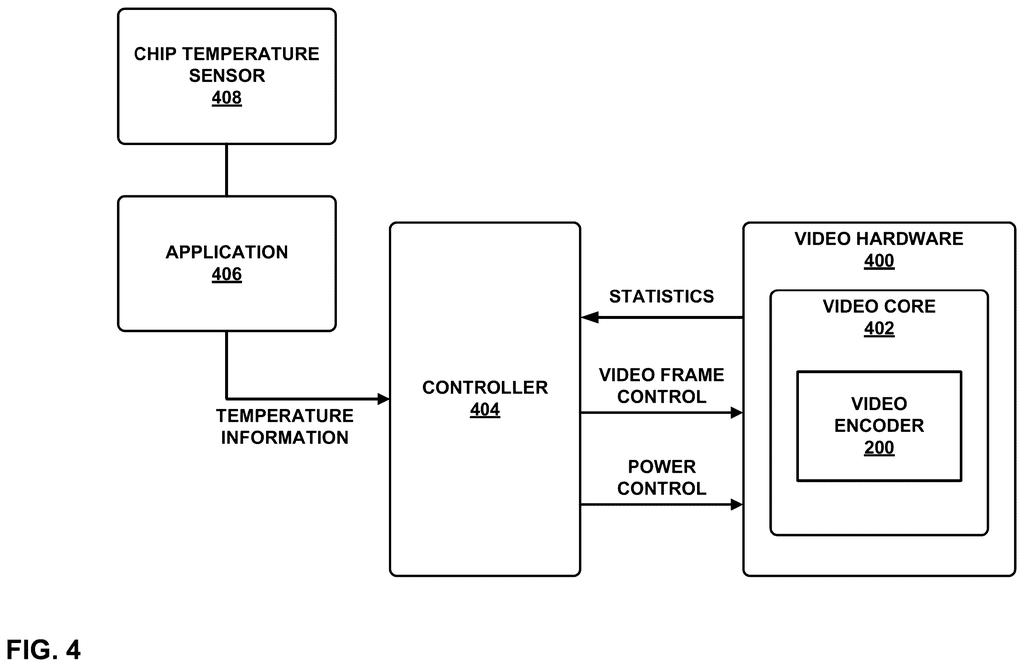
Video can be shrunk in different ways. Some methods make the file much smaller, which saves storage, but they make the chip do more work, and more work means more heat. Qualcomm's filing describes a controller that reads the chip's temperature and picks the squeezing method to match, so the chip does not hit its heat limit too soon.
One example in the filing shows how it plays out. A chip at 40 degrees Celsius with a 25-minute recording target would be kept away from the most demanding method, which would only last about 10 minutes. You still get a smaller file when the chip can afford it, just not at the cost of an early shutoff.
… control selection of the frame reference structure from the set of selectable frame reference structures based on the temperature information and based on video performance model projections of respective workload requirements …
Translation: It changes how video is encoded based on heat levels and workload forecasts.
How the controller picks a compression style
Video is a stack of still frames, and a video chip can store them in different ways. A frame reference structure is the recipe for how each frame leans on its neighbors. A unidirectional recipe (called IPP) only looks backward. Bidirectional and layered recipes look both ways, which makes the file smaller (a lower bitrate, meaning less data per second) but costs the chip more work.
More work means a higher voltage, more power draw, and faster heating. The filing's controller (hardware, firmware or software that supervises the video core) handles the tradeoff in a few steps:
- It receives the chip's temperature, either measured by a sensor or projected.
- It uses a video performance model (a math estimate of how many hardware cycles each recipe needs) to project the workload of each option. The claims require this step.
- It either picks a recipe or removes the ones that would overheat, leaving a shorter menu.
- It repeats this for each group of pictures, which is a short chunk of the video.
The filing's illustrative numbers: the simplest recipe projects 60 minutes of recording at 2000 mW, while a 7-layer recipe projects only 10 minutes at 2600 mW. With a 40 degree chip and a 25-minute target, the controller would rule out the 7-layer option. It can also weigh bitrate and a target operating time.
The video core is configured to encode one or more portions of the video data according to a frame reference structure selected from a set of selectable frame reference structures.
Translation: The system encodes video using different structures depending on the situation.
Why heat limits how long your camera records
If this idea ended up in a product, you would notice it as a camera that keeps recording on a hot day while still saving storage space. The filing lists camcorders, phones and a dual camera recording 4K video at 60 frames per second as example settings. The patent examiner has issued a final rejection of this application, and Qualcomm can still amend the claims or appeal.
Heat is a real limit on small devices, because a chip that gets too hot has to slow down or stop. Letting the chip choose a compression style from its own temperature trades file size against recording time automatically, instead of leaving you to find out when the recording cuts off.
Qualcomm's 68th filing in our chip patent coverage since May adds to a run that includes one on faster game reflections and one on skipping duplicate GPU points in the patents we've tracked.
Source: US 2026/0361850 A1 at the USPTO (PDF). Full patent text and figures are in the official publication.
Get our take in your Top Stories
Liked this breakdown? Add Patentlyze as a preferred source on Google, and our plain-English take shows up more often in your Top Stories the next time Qualcomm patent news breaks.
Add Patentlyze on Google
One click.
There are more where this came from
We read every patent application Big Tech publishes and send you the ones worth knowing. Plain English, free, every week.
The drawings · 8 sheets
8 drawing sheets from US 2026/0361850 A1 · click any drawing to enlarge


More from Qualcomm
All 624 Qualcomm patents →

More in Chip
All 645 Chip patents →
Google
Google Files Patent for Devices That Predict Their Own Overheating
Sony
Sony Files Patent for a Two-Layer Camera Chip That Is Easier to Make

Samsung
Samsung Patents a Heat-Resistant Shielding Structure for Semiconductor Packages
Nvidia
No comments yet