
Sony
Sony · AR / VR · Filed Aug 5, 2025 · USPTO published Nov 12, 2026 · This week's release
Sony Files Patent for VR Graphics That Sharpen Only Where You Look
Your eyes only see fine detail in a tiny spot at the center of your vision, and a new Sony filing wants a VR headset to draw only that spot in full. The trick is a camera that tracks your eye by reporting tiny changes in light as they happen.
- Publication number
- US 2026/0358642 A1(US20260358642A1)
- Applicant
- Sony Interactive Entertainment Inc.
- Filed · Published
- Aug 5, 2025 · Nov 12, 2026
- Inventors
- Rajeev Gupta
- Status when we published
- Examiner raised objections; the company can respond
- Document
- 20 claims
- US classification
- 348/53
- Examiner
- CHIO, TAT CHI (Art Unit 2486)
- Parent application
- Continuation of 17/340,209 (filed Jun 7, 2021)(17340209)
What Sony's gaze-tracking patent does for VR
A VR headset draws millions of pixels, many times a second, and most of them land in places you are not looking. Your eyes only pick up fine detail in a small central spot, so a lot of that work is wasted.
Sony's filing describes a way to cut the waste. The system first draws a rough, low-detail version of each frame, covering only some of the pixels. Meanwhile a special camera watches your eye and works out where you are looking. The system then fills in extra pixels around that spot so it looks fully sharp, while the rest of the picture stays rough.
The camera matters because it reports changes as they happen instead of snapping full photos 30 times a second, so the sharp patch can keep up with your eyes.
… a detector comprising a plurality of sensor elements to detect events in response to changes in light incident upon the detector from an eye of a user, processing circuitry to calculate a gaze direction of the eye of the user in dependence upon an output signal from the detector indicative of the detected events …
Translation: Special sensors watch the user's eyes to figure out exactly where they are looking.
How Sony picks which pixels to draw sharply
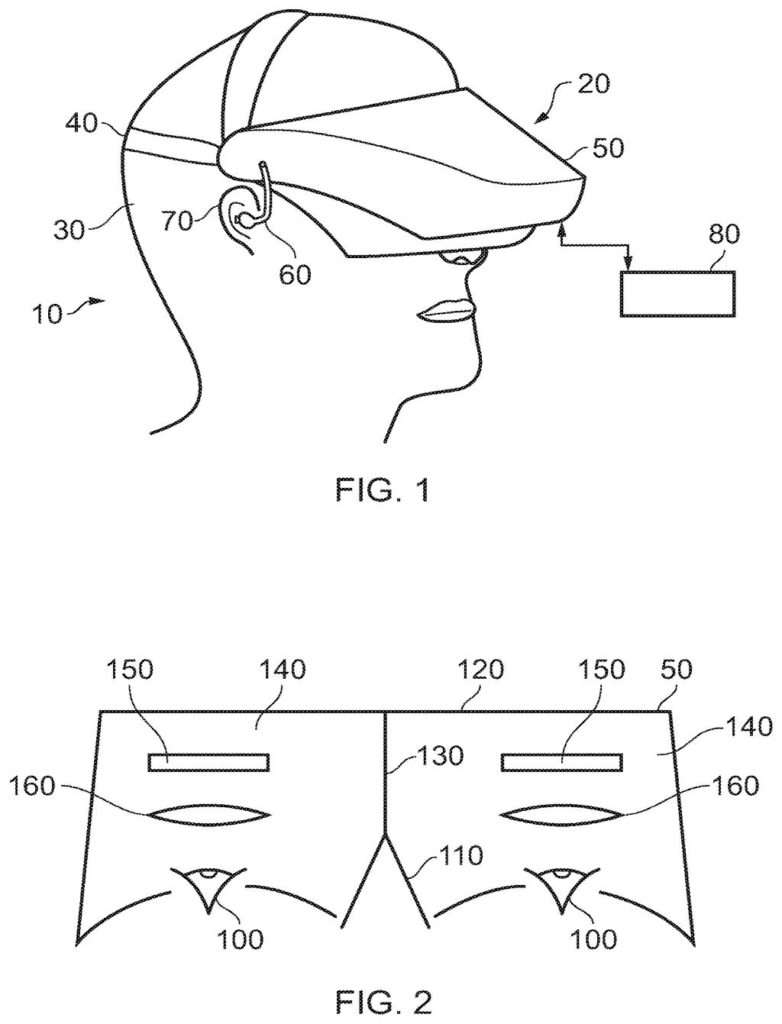
The system has three parts: a light-change sensor aimed at your eye, a processor that works out where you are looking, and graphics circuitry that decides which pixels to draw. The sensor is what the filing calls an event detector (the idea behind an event camera). Instead of taking full photos at a fixed rate, each of its sensor elements reports on its own the moment the light it sees changes past a set threshold.
Those reports trace the edge of your pupil. The processor fits a shape to them to find your gaze direction (a rounder pupil outline means you are looking more directly at the sensor). Because reports arrive continuously, a fresh gaze reading can be ready before or even during the drawing of each frame.
Rendering then happens in layers:
- First group: a sparse sample of pixels, such as one in every two or four, drawn no matter where you look.
- Second group: extra pixels picked from the leftovers based on your gaze, which fill in a sharp patch.
- Third group: pixels in a ring around the patch, filled by averaging their neighbors (interpolation).
The patch size can be set from the distance between your eye and the screen, so it covers at least 5 degrees of your vision. The sampling pattern can also alternate between frames.
Why sharpening only your gaze spot matters
If this works as described, a VR game could spend its graphics power where your eyes actually are. That could show up as smoother performance or richer detail in the spot you are looking at, while the edges of the picture stay rough without you noticing.
The filing also puts weight on timing: the sharp patch can be placed late in each frame using the freshest eye reading, so it is less likely to lag behind a quick glance. The examiner's first review rejected the claims as filed, which is routine and usually followed by amendments, so the final wording may change.
Sony's 46th filing we've tracked since July in the AR glasses race continues a pattern set by one that fades virtual hands and one boosting light to eyes.
Source: US 2026/0358642 A1 at the USPTO (PDF). Full patent text and figures are in the official publication.
Get our take in your Top Stories
Liked this breakdown? Add Patentlyze as a preferred source on Google, and our plain-English take shows up more often in your Top Stories the next time Sony patent news breaks.
Add Patentlyze on Google
One click.
There are more where this came from
We read every patent application Big Tech publishes and send you the ones worth knowing. Plain English, free, every week.
The drawings · 10 sheets
10 drawing sheets from US 2026/0358642 A1 · click any drawing to enlarge


Show the other 2 sheets


More from Sony
All 707 Sony patents →
More in AR / VR
All 690 AR / VR patents →
Apple
Apple Files Patent for Headset Graphics That Sharpen Only Where Both Eyes Look
IBM
IBM Patents a Way for AR Headsets to Share Objects Based on Where You Look
Samsung
Samsung Files Patent to Make Only What You Look At Appear 3D in VR
Samsung
No comments yet