
IBM
IBM · AI / ML · Filed Mar 6, 2024 · USPTO published Nov 12, 2026 · This week's release
IBM Patents a Voice Survey That Asks Follow-Up Questions When Your Answers Are Vague
Type "This tool is great!" into a feedback box and nobody ever asks what you meant. IBM's patent application describes a survey that answers back and presses for details when your reply is too thin.
- Publication number
- US 2026/0359848 A1(US20260359848A1)
- Applicant
- International Business Machines Corporation
- Filed · Published
- Mar 6, 2024 · Nov 12, 2026
- Inventors
- Donna Thelander, Tyler Waite, Jason Andrew Telner, Jon Gerard Temple, Mark Willard Malatesta, Peter Guzewich
- Status when we published
- Examiner raised objections; the company can respond
- Document
- 20 claims
- US classification
- 704/275
- Examiner
- FANG-WU, JOHN HONG (Art Unit 2653)
What IBM's talking survey bot actually does
Most feedback surveys are anonymous, and the answers are often too thin to use. If you type "This tool is great!" into a box, nobody can write back and ask what you actually liked. IBM's patent application tries to fix that by turning the survey into a conversation.
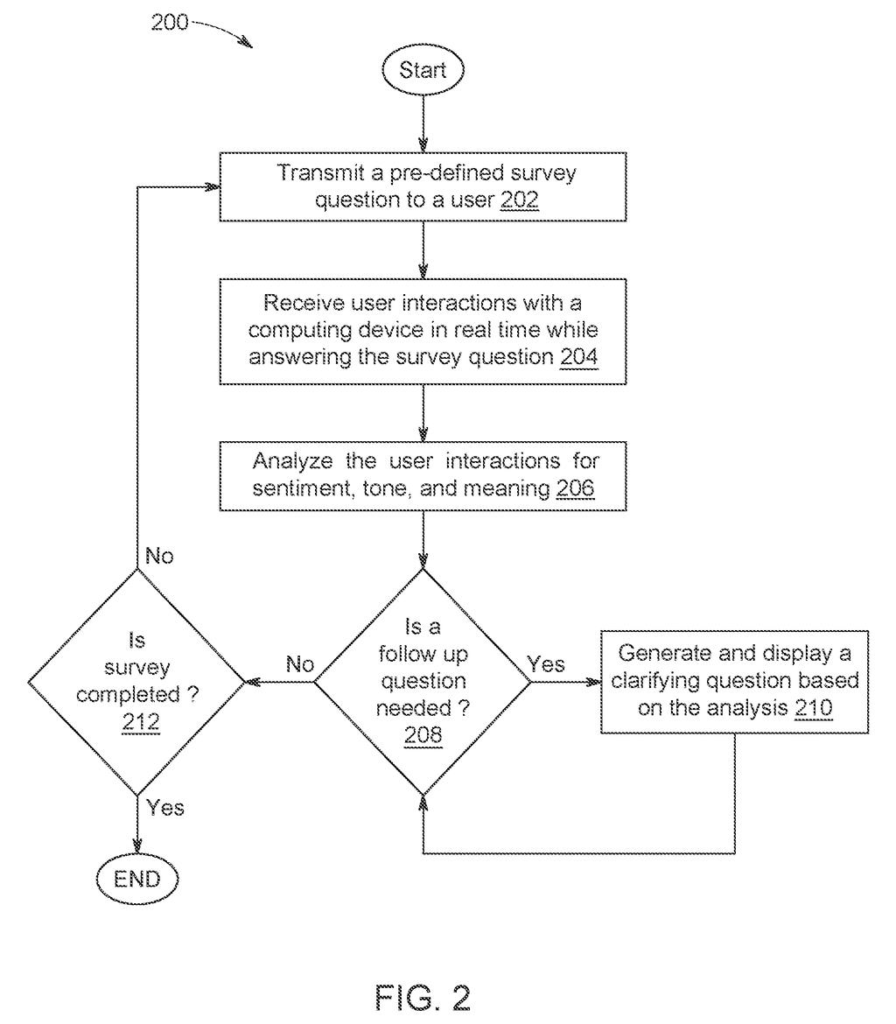
Here's how it would feel: a bot asks you a question, in text or out loud, and listens to your answer as you give it. If your reply is vague, very short or wanders off topic, the bot responds with a follow-up, such as "Can you elaborate on what is working well?" It keeps going until it has something a researcher can act on, then moves to the next question. You can also edit an earlier answer, and the bot re-checks the ones it affects.
… analyzing the user response for a sentiment, a tone, and a meaning; in response to determining a follow-up query is needed to identify the sentiment, the tone, or the meaning, generating the follow-up query …
Translation: The system checks what you said to see if your answer was unclear and automatically writes a follow up question.
How the bot scores whether your answer is thin
The core claim covers a simple loop. The system sends a pre-set question, reads your answer while you are still typing or speaking it, and judges the sentiment (the positive or negative feeling), the tone (how it is said) and the meaning. If it cannot tell which of those you intended, it writes a follow-up question and shows it on screen.
The filing's extra details describe how the judging works. The system gives each answer an answer-quality score, built from checks such as:
- Whether the reply passes a minimum word count (a four-word answer like "This tool is great!" would fail)
- Whether it mentions the tool or task being surveyed
- How vague it is
- Whether it shows a clear sentiment
- Whether it is a complete thought
Each check has its own threshold. When a score falls below it, the system generates a follow-up aimed at that gap, in a fitting tone. Meaning is worked out with intent recognition (guessing what you are trying to say), disambiguation (picking the right sense of an unclear phrase), entity extraction (spotting names of tools and tasks) and slot filling (matching details to the fields the researcher cares about).
Answers can be spoken and converted to text, and follow-ups can be read aloud by computer speech. The description also says a language model could be fine-tuned on a project's own data, and that users would see an opt-in notice first.
What this means for feedback forms you ignore
If this ever reached a product, the change you would notice is a feedback form that talks back. Instead of a thumbs-down button or an email you delete, you would get a short conversation. The filing says people give better feedback by talking than typing, partly because they tire as a survey drags on. Researchers would get fewer useless answers and, the filing says, could need fewer participants.
The filing also says a "survey" can be any exchange between an AI and a person, such as a chat session with a chatbot, so the idea could reach well beyond questionnaires. An examiner's first review rejected the claims as filed, which is routine at this stage and usually followed by amendments.
IBM's fourth filing we've tracked in voice and speech AI since September builds on earlier work like one on auto-formatted transcripts and sorting private documents blindly.
Source: US 2026/0359848 A1 at the USPTO (PDF). Full patent text and figures are in the official publication.
Get our take in your Top Stories
Liked this breakdown? Add Patentlyze as a preferred source on Google, and our plain-English take shows up more often in your Top Stories the next time IBM patent news breaks.
Add Patentlyze on Google
One click.
There are more where this came from
We read every patent application Big Tech publishes and send you the ones worth knowing. Plain English, free, every week.
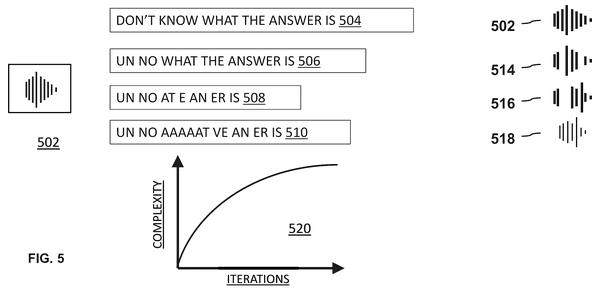
The drawings · 3 sheets
3 drawing sheets from US 2026/0359848 A1 · click any drawing to enlarge


More from IBM
All 470 IBM patents →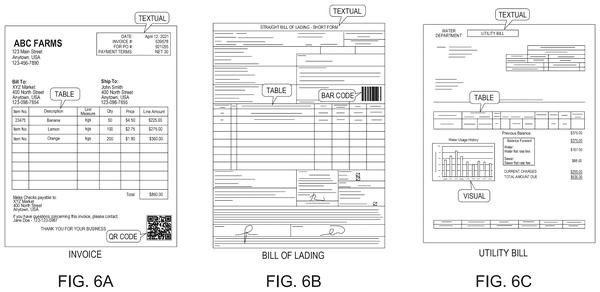
More in AI / ML
All 2,637 AI / ML patents →
Google
Google Patents a System That Learns When Its Voice Assistant's Follow-Up Questions Aren't Working
Qualcomm
Qualcomm Patents an AI System That Lets You Ask Questions About Any Audio Recording
Samsung
Samsung Files Patent for a Voice Assistant That Checks the Weather Before Cooling Your Home
Samsung
No comments yet