

Apple
Apple · Battery & power · Filed May 12, 2026 · USPTO published Nov 12, 2026 · This week's release
Apple Patents a Charger Lid Built to Draw Heat Away From Your Device
Your watch or ring gets warm on its charger, and Apple has filed a patent application for a puck top built to carry that heat away so charging doesn't have to slow down.
- Publication number
- US 2026/0361131 A1(US20260361131A1)
- Applicant
- Apple Inc.
- Filed · Published
- May 12, 2026 · Nov 12, 2026
- Inventors
- Jonathan M. Sullivan, William B. Libeer, Grant S. Haug, James C. Wu, Scott W. Slabaugh, Amy M. Cuevas, Xiaomeng Wang
- Status when we published
- Waiting for an examiner
- Document
- 20 claims
- US classification
- 320/114
- Parent application
- Claims priority from a provisional application 63804551 (filed May 12, 2025)
What Apple's cooler charging puck top does
You set your watch on its charger before bed, and in the morning it's noticeably warm. That heat is more than a nuisance. Devices slow their charging when they get too hot, and heat wears down a battery over time.
Apple's patent application goes after the top of the charging puck, the part your device actually touches. A curved device usually meets a puck in only a thin ring, so heat has little room to escape. Apple describes a soft top layer that gives way to hug the device's curve, plus a harder layer underneath that carries heat off to the puck's body.
A cooler device can keep charging at full speed instead of pausing to protect itself. For you, that means less waiting and a gadget that doesn't feel hot when you pick it up.
… a top cap, wherein the top cap forms a charging surface for engaging an electronic device being charged by the charging device, wherein the top cap comprises a thermally conductive layer covering the recess in the housing.
Translation: The charger has a special lid that touches your device to pull heat away from it.
How the soft layer and hard layer move heat
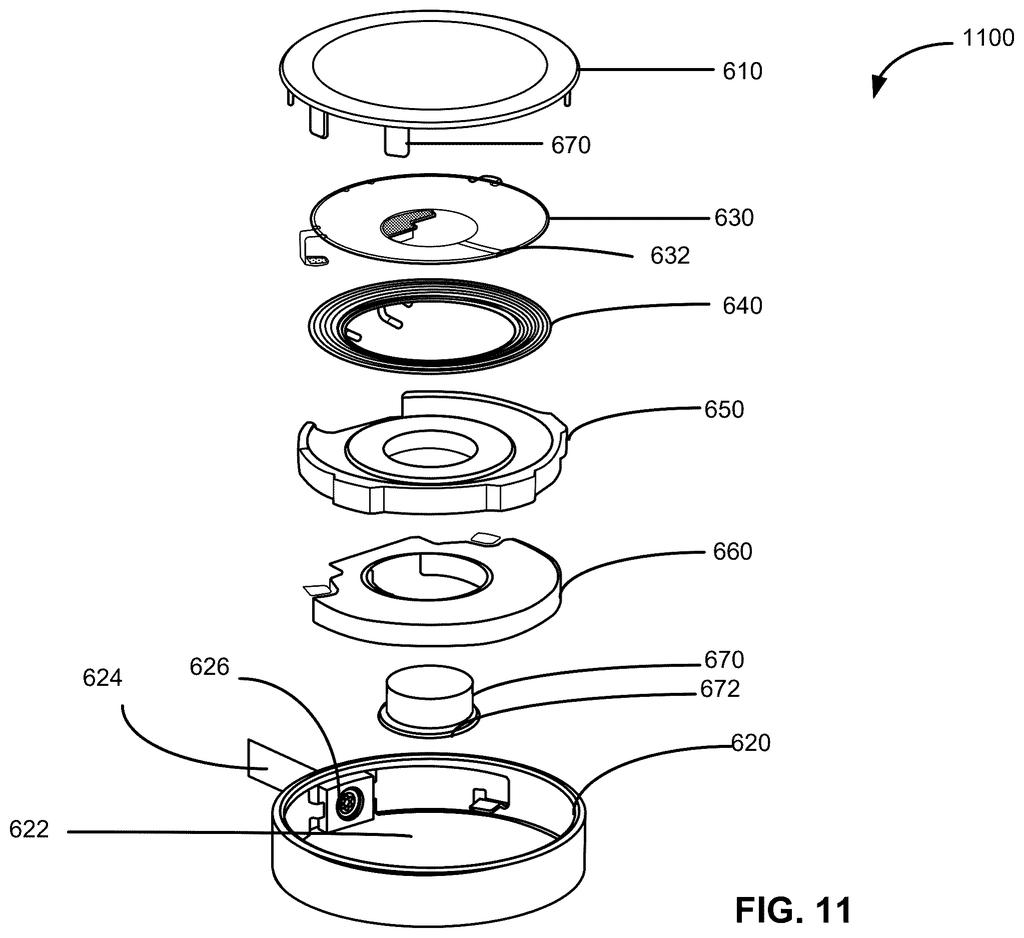
Claim 1 covers a charging device with a housing that has a hollow (a recess) and a top cap over that hollow. The top cap is the surface your device rests on, and it includes a thermally conductive layer, meaning a layer that passes heat along easily.
A second independent claim adds a compliant layer (a soft layer that gives way under pressure) that touches the device, with the conductive layer right next to it. The description names silicone as one option for the soft layer. Today a curved device touches a puck in only a thin ring, which limits how much heat can cross over. A layer that flexes to the device's shape spreads the contact over a much bigger area.
The conductive layer can be a nylon-based resin or polycarbonate mixed with heat-carrying particles:
- Boron nitride, a ceramic that moves heat well
- Carbon, which the filing says can darken the cap
- Ceramic particles in general
A third independent claim adds the working parts under the cap: a charging coil, a ferrite (a magnetic material that steers the coil's field toward your device), an alignment magnet, and control electronics. The filing also describes copper or graphene heat spreaders inside the puck, and a chart showing that a cooler device avoids the pauses charging takes when it overheats.
A top cap can include a top compliant layer that deform to contact the electronic device over an increased area. This increased contact area can help to conduct heat out of the electronic device and into the charging puck, thereby reducing the temperature of the electronic device during charging, which in turn can allow an electronic device to charged at a higher power.
Translation: A soft top layer molds to your device so heat transfers better and it charges faster.
Why a cooler device can charge at full speed
If you charge a watch, ring or earbuds on a puck, the payoff is speed and comfort. The filing says a cooler device doesn't have to slow its charging to protect itself, so the charge can finish sooner and the device feels less hot when you pick it up. Lower heat also helps battery life over the years.
The filing is open about the trade-offs. A silicone top can grip a device and make it harder to slide into alignment, and carbon can darken the cap when a white one is wanted. Those details show where the real work in a charger accessory sits: balancing cooling, looks and ease of use, all in a small round disc.
Apple's 27th filing in our battery and power coverage since May joins earlier ideas like a simpler wireless puck and separate earbud charging spots.
Source: US 2026/0361131 A1 at the USPTO (PDF). Full patent text and figures are in the official publication.
Get our take in your Top Stories
Liked this breakdown? Add Patentlyze as a preferred source on Google, and our plain-English take shows up more often in your Top Stories the next time Apple patent news breaks.
Add Patentlyze on Google
One click.
There are more where this came from
We read every patent application Big Tech publishes and send you the ones worth knowing. Plain English, free, every week.
The drawings · 11 sheets
11 drawing sheets from US 2026/0361131 A1 · click any drawing to enlarge


Show the other 3 sheets


More from Apple
All 672 Apple patents →


More in Battery & power
All 116 Battery & power patents →
Samsung
Samsung Files Patent to Keep a Crooked Phone Charging on a Wireless Pad
Sony
Sony Files Patent for Tiny Rubber Muscles That Flex on Electricity
Sony
Sony Patents a Drone That Refuses to Fly on Mismatched Batteries
Samsung
No comments yet