
Samsung
Samsung · Software · Filed Jul 20, 2026 · USPTO published Nov 12, 2026 · This week's release
Samsung Files Patent for a Phone Search Box That Suggests What to Look For
Samsung's patent would replace the blank word "Search" on your phone with a suggestion based on your messages, calendar, location and habits. Start typing a matching phrase, and your letters show up in one style while the rest of the suggestion stays in another.
- Publication number
- US 2026/0359336 A1(US20260359336A1)
- Applicant
- SAMSUNG ELECTRONICS CO., LTD.
- Filed · Published
- Jul 20, 2026 · Nov 12, 2026
- Inventors
- Maria NOH, Misung KIM, Eunbi KIM, Sunhye KIM, Yeji PARK, Jaewon JEONG, Kyoungwoon HAHM, Taehun KIM, Wonsuk YANG, Junhyuk LEE
- Status when we published
- Waiting for an examiner
- Document
- 15 claims
- US classification
- 707/769
- Parent application
- Continuation of 18/949,531 (filed Nov 15, 2024)(18949531)
What Samsung's suggestion-filled search box does
Today, when you pull up the search box on a phone, it usually shows nothing, or just a fixed word like "Search." It gives you no clue about what the phone could find for you, and it has no idea what is going on in your day.
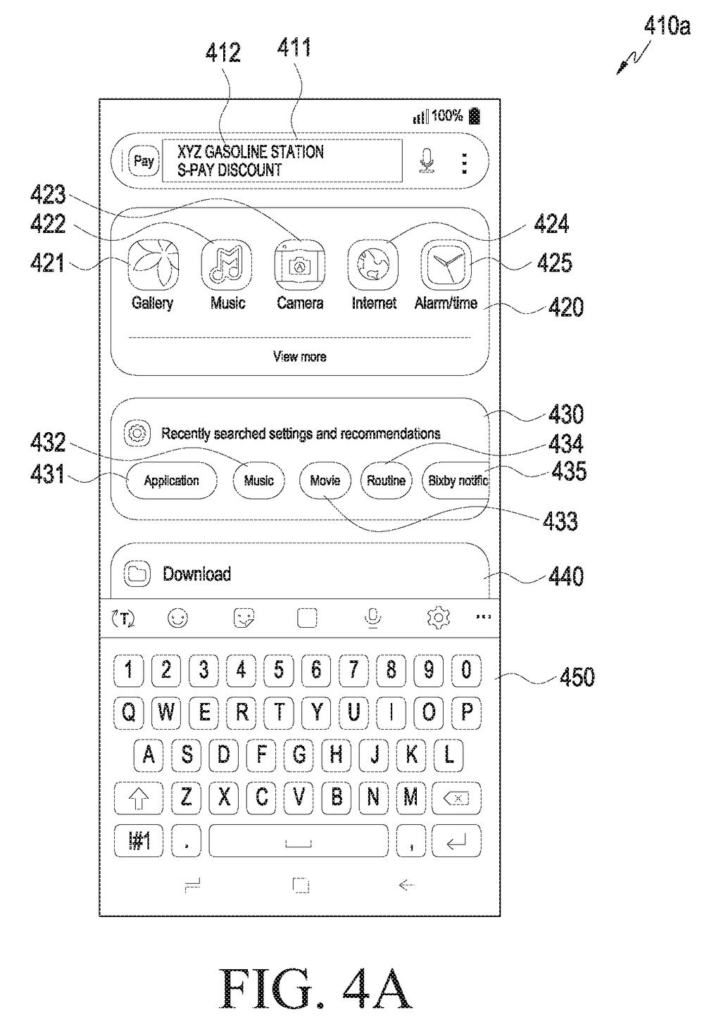
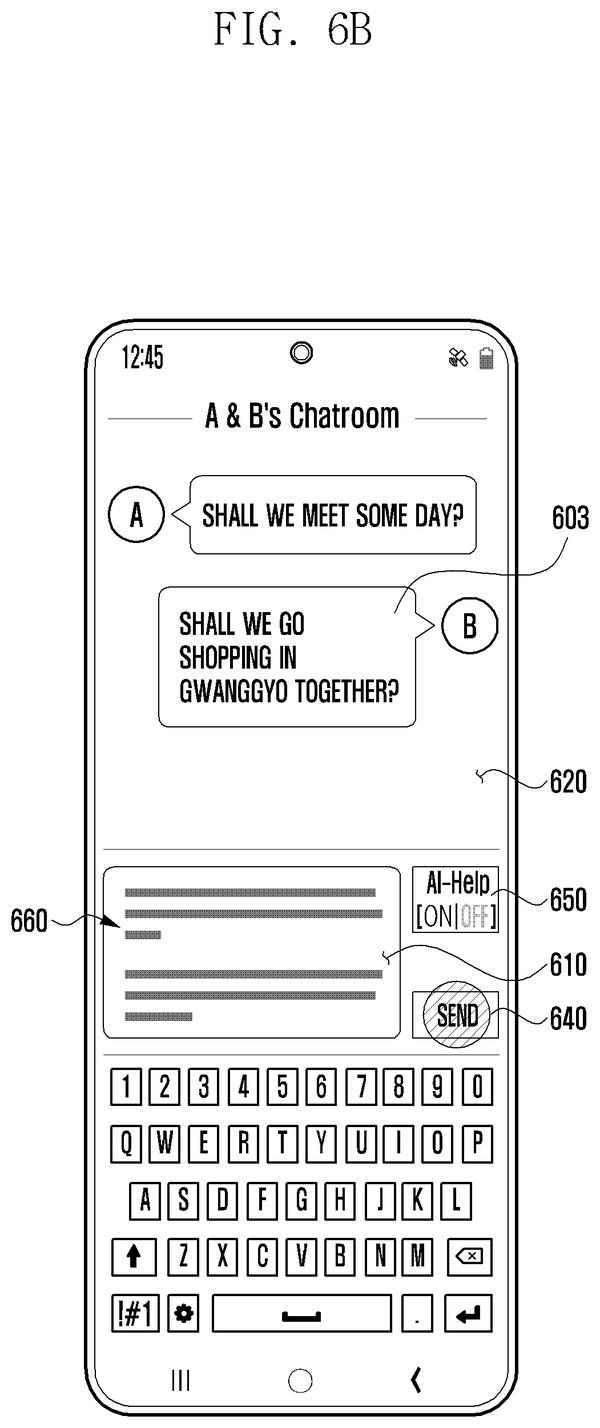
Samsung's patent describes a search box that fills itself in with a suggestion. Your phone checks its current situation (the time, where you are, which apps you have been using) against a web of facts it has built from your own data. If your mom texted that she is flying home, the box might read "When is mom returning home?"
If you start typing the same words, your letters appear in one style and the rest of the suggestion stays in another, like faded text. Type something different, and the suggestion simply disappears.
identify first context information corresponding to a state of the electronic device; display, in a search box through the display, a first reference text that is identified based on a knowledge graph associated with data stored in the electronic device, wherein the first reference text corresponds to the first context information; …
Translation: The phone figures out what you might want based on its current state and a personal knowledge graph.
How Samsung's phone matches your day to a search
The core of the filing is a search box that shows reference text (placeholder text, like a hint) chosen from your phone's current state. The phone first identifies context information, such as the time, your location, the weather, which apps are installed, or your recent activity.
It then compares that context with a knowledge graph. That is a stored map of facts (called nodes) and the links between them (called edges). The facts come from sources like your calendar, text messages, photo gallery and payment app. When the context matches certain nodes, the phone builds a suggestion from them, sometimes adding words like "when?" or "who?" to make it read as a question.
The claims cover three pieces:
- Showing the suggestion in the search box, based on the knowledge graph and context.
- When your typing matches part of it, showing your letters with one visual attribute (such as color, thickness, transparency or size) and the rest of the suggestion with a different one.
- Dropping the suggestion if your typing does not match.
Other claims describe swapping in a new suggestion when your context changes, such as when you move beyond a set distance or time gap, and showing the reason for the change. The description also says a phone could keep several knowledge graphs, score each one against your context, and use the highest scorer.
… based on the text and the at least one node of the knowledge graph, searching for a first content; and displaying, through the display, the searched first content.
Translation: It uses your input and the knowledge graph to quickly find and show what you are looking for.
Why Samsung's search box could change your phone
If you have ever stared at an empty search field and forgotten what the phone could do, this is the problem Samsung is going after. A search box that offers the likely thing you need, like a payment app discount at the gas station you are standing in, turns a passive tool into a nudge.
The design also leans on data already stored on your phone: messages, calendar entries, photos and app activity. The filing says much of the work can happen on the device, though it also allows a server to do some of it. Expect that data use to be the part readers care about most, since the suggestions only work if the phone reads a lot of your personal information.
Samsung's 30th filing we've tracked since June in our assistants that remember you, following short-term voice recall and one that self-checks suggestions, adds another application to this growing set of memory-focused patent filings.
Source: US 2026/0359336 A1 at the USPTO (PDF). Full patent text and figures are in the official publication.
Get our take in your Top Stories
Liked this breakdown? Add Patentlyze as a preferred source on Google, and our plain-English take shows up more often in your Top Stories the next time Samsung patent news breaks.
Add Patentlyze on Google
One click.
There are more where this came from
We read every patent application Big Tech publishes and send you the ones worth knowing. Plain English, free, every week.
The drawings · 21 sheets
21 drawing sheets from US 2026/0359336 A1 · click any drawing to enlarge


Show the other 13 sheets


More from Samsung
All 1,629 Samsung patents →
More in Software
All 753 Software patents →
Google
Google Files Patent to Delay Assistant Updates Until You Finish Editing Settings
Salesforce
Salesforce Patents Chatbot Memory That Shrinks Old Topics and Keeps the Relevant Ones

Google
Google Files Patent for Reusing a Chatbot's Past Work on Similar Questions
Google
No comments yet