
Qualcomm
Qualcomm · AI / ML · Filed Dec 15, 2025 · USPTO published Nov 12, 2026 · This week's release
Qualcomm Files Patent for AI That Sketches Where Everyone Stands Before Drawing a Group Photo
AI image tools often botch group photos, swapping hair between friends or drawing one person twice. Qualcomm's patent tries to fix that by sketching a floor plan of the picture before any painting starts.
- Publication number
- US 2026/0360026 A1(US20260360026A1)
- Applicant
- QUALCOMM Incorporated
- Filed · Published
- Dec 15, 2025 · Nov 12, 2026
- Inventors
- Shubhankar Mangesh Borse, Munawar Hayat, Debasmit Das, Shreya Kadambi, Hyojin Park, Fatih Murat Porikli
- Status when we published
- Waiting for an examiner
- Document
- 20 claims
- US classification
- 345/418
- Parent application
- Claims priority from a provisional application 63803098 (filed May 9, 2025)
What Qualcomm's two-step group photo AI does
Imagine typing "three hikers in a forest" and attaching a photo of each of your three friends. You hope for a trip picture that looks like them. Instead, one friend gets another friend's hair, and a third friend shows up twice.
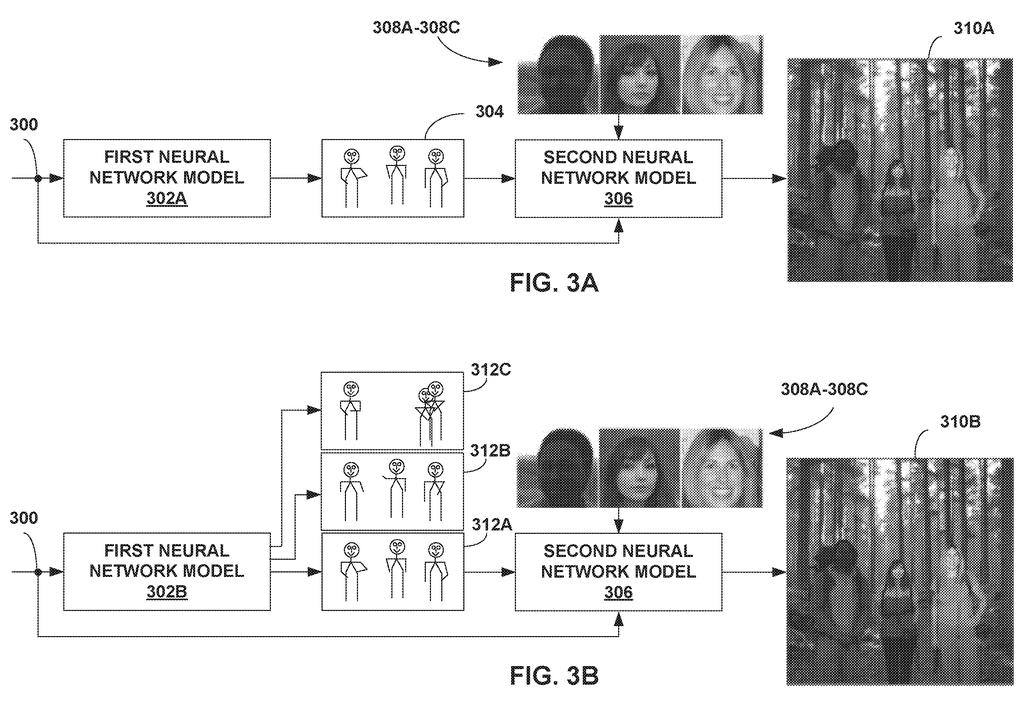
Qualcomm's patent adds a step before the picture is drawn. One AI model reads your request and makes a rough layout: stick-figure poses, outlines, or boxes showing where each person goes. A second image model then paints the final picture using that layout as a guide.
You could even pick from several layouts. In the filing's test with one image model, the right number of people appeared 53.4% of the time without the layout step, 65.5% with it running automatically, and 74.8% when a person chose the pose.
… apply a first neural network model to the input to generate subject regional information; and apply a second neural network model to the subject regional information to generate the image.
Translation: The system first maps out where everyone should go and then draws the final picture based on that layout.
How the layout sketch guides the final image
The claims cover a two-model pipeline. Your request (typed or spoken, and saying how many subjects you want) goes to a first neural network model (a trained AI program). It produces what the patent calls subject regional information. A second model, described as a large vision model (a big image-generating AI, with OmniGen and Stable Diffusion XL named as examples), uses that information to make the final image.
The regional information comes in three forms:
- Pose images: stick-figure skeletons showing how each person is standing.
- Segmentation images: outlines that separate one person from another.
- Region images: boxes marking where each person goes.
Your request can also say who goes where, such as "the person on the left is image1," and you can supply a photo of each subject. In a semi-automated version, the first model offers several layouts and you pick one. The filing says choosing is simpler than building a pose from scratch. It also notes that leaving face points out of the pose image can help, because mismatched face proportions can lower quality.
The first model is trained on stock photos tagged with captions. Existing vision tools pull poses, outlines and boxes out of each photo to serve as the answer key. The model adjusts until its layouts match. This training can happen in the cloud, with the finished model sent to a phone.
What this means for AI group photos on phones
The practical payoff is group images that come out right more often. The filing says existing methods struggle past two subjects, and that the heavy tuning some of them need is a poor fit for mobile devices. This design can work with untuned models when a device has limited computing power, which points to phones as the target. The filing names on-device personalization, amusement park and tourist-spot photo systems, and social apps as uses.
Keep the numbers in perspective. The tests asked for one to five people. Even the best result, with a human picking the pose, got the headcount right about three times in four. This is a test result from the filing, not a shipping feature.
Qualcomm's 19th filing we've tracked since July in the AI photo editing race adds to a run that includes one to cut image wait times and one hiding parts of photos.
Source: US 2026/0360026 A1 at the USPTO (PDF). Full patent text and figures are in the official publication.
Get our take in your Top Stories
Liked this breakdown? Add Patentlyze as a preferred source on Google, and our plain-English take shows up more often in your Top Stories the next time Qualcomm patent news breaks.
Add Patentlyze on Google
One click.
There are more where this came from
We read every patent application Big Tech publishes and send you the ones worth knowing. Plain English, free, every week.
The drawings · 6 sheets
6 drawing sheets from US 2026/0360026 A1 · click any drawing to enlarge


More from Qualcomm
All 624 Qualcomm patents →


More in AI image & video
All 223 AI image & video patents →
Samsung
Samsung Patents a Camera That Turns Your Viewfinder Sketches Into AI Photos
Google
Google Files Patent for Fixing Blurry Phone Photos With Less Battery Drain
Adobe
Adobe Files Patent for a Photo Editor That Suggests Fixes Based on What's in Your Picture
Adobe
No comments yet