
IBM
IBM · AR / VR · Filed May 9, 2025 · USPTO published Nov 12, 2026 · This week's release
IBM Patents a Safety Zone That Slows Forklifts Around Workers Operating Distant Machines
IBM's patent describes a forklift that slows down, goes quiet and even stops puffing exhaust the moment it nears a worker who is remotely running a crane from an AR headset.
- Publication number
- US 2026/0358818 A1(US20260358818A1)
- Applicant
- INTERNATIONAL BUSINESS MACHINES CORPORATION
- Filed · Published
- May 9, 2025 · Nov 12, 2026
- Inventors
- Sarbajit Kumar Rakshit, Sudheesh S. Kairali, Binoy Thomas
- Status when we published
- Approved; patent expected soon
- Document
- 20 claims
- US classification
- 701/300
- Examiner
- KAN, YURI (Art Unit 3662)
What IBM's remote-operator safety zone does
Every time a forklift rolls past, the people nearby glance up, flinch or step aside. Now say that person is wearing an AR headset and running a crane on a dock hundreds or thousands of miles away. One bumped elbow could mean a dropped shipping container.
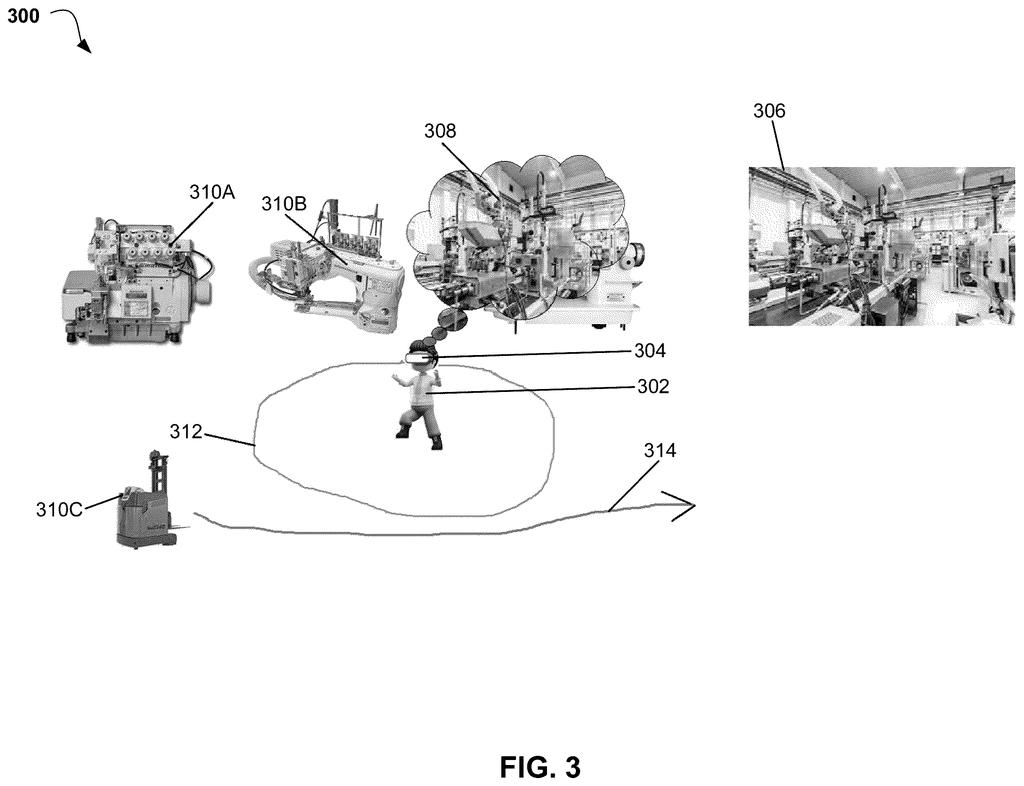
IBM's patent describes a system that draws an invisible protective zone around that worker. It learns how big the zone should be from past jobs, including how much the worker moves and how slowly the remote machine responds. When a forklift or a coworker heads toward the zone, the forklift can slow down, go quieter or steer around it.
Coworkers wearing their own AR glasses can see the zone's outline, and small robots can even push fences or cones into place around the worker.
… computing a buffer zone around a first user in the first location controlling one or more remote devices in the second location via an augmented reality (AR) device based on the context; …
Translation: The system draws a protective boundary around a worker using augmented reality to control distant equipment.
How the zone grows with delay and arm reach
The system collects live and past data about two places: the room where the worker stands, and the remote site where the machines are. From the history, it works out the context of the remote job, such as which machines are involved, the weather there, and what the operation is (for example, a crane lifting containers off a ship).
Next it computes a buffer zone, an area extending out from the worker where they can move freely while controlling the remote machines. The claims say the size can depend on how much the worker moves, or on the latency (the delay before a remote machine acts on a command). The description also mentions:
- A worker who walks 10 feet to grab tools might get a 12-foot radius.
- A control panel, which needs more side-to-side motion, might get a bigger zone than a joystick.
- A headset with a shorter tracking range might get a larger zone.
The system then picks a do not disturb action based on how risky the remote job is (safe, intermediate or dangerous). Dangerous jobs mean nothing may enter the zone. Milder jobs just mean reducing distractions. Cameras and sensors in the headset watch for machines or people on a path toward the zone.
When one is, the machine can reroute, or slow down on entry (the filing's example drops a forklift from 5 to 2 mph) and speed back up on exit. It can also cut its noise, heat and exhaust. Robots can move fences, gates or cones to the zone's edge, and a coworker heading in can see the zone through their own AR device.
… causing the at least one device to adapt one or more operational parameters according to the do not disturb action.
Translation: Vehicles or machines automatically change how they operate when they cross into the safety zone.
Why quieter, slower forklifts matter for remote work
The filing points out that the usual fix for this problem is an alert to the operator, and that an alert pulls their attention away from the job. Here the surrounding equipment does the adjusting, so the operator can keep working. It also gives a site a way to share floor space between remote work and everything else happening in the building.
The patent office has approved this application, and once IBM pays the final fee it should be issued as a granted patent. The filing describes industrial settings such as factory floors and ports, and it does not point to any consumer product.
IBM's 469th filing in our IBM coverage since May adds to a run that includes keeping company data from AI and fixing search relevance gaps.
Source: US 2026/0358818 A1 at the USPTO (PDF). Full patent text and figures are in the official publication.
Get our take in your Top Stories
Liked this breakdown? Add Patentlyze as a preferred source on Google, and our plain-English take shows up more often in your Top Stories the next time IBM patent news breaks.
Add Patentlyze on Google
One click.
There are more where this came from
We read every patent application Big Tech publishes and send you the ones worth knowing. Plain English, free, every week.
The drawings · 3 sheets
3 drawing sheets from US 2026/0358818 A1 · click any drawing to enlarge


More from IBM
All 470 IBM patents →
More in AR / VR
All 690 AR / VR patents →
Meta
Meta Patents a VR Headset Strap Knob That Stays Put Once You Set It
Google
Google's New Patent Uses Rapid Light Switching to Give Smart Glasses Deeper Darks and Finer Shades
Sony
Sony Files Patent for a VR Headset That Blows Wind at Your Face
Apple
No comments yet