
Samsung
Samsung · Display · Filed Feb 11, 2026 · USPTO published Nov 12, 2026 · This week's release
Samsung Files Patent for a Folding Screen That Shows Notifications in a Mirror
Samsung describes a screen that folds twice into a G shape, hiding itself completely, then uses a mirror on the outer fold so you can still read the time and messages.
- Publication number
- US 2026/0358861 A1(US20260358861A1)
- Applicant
- Samsung Display Co., LTD.
- Filed · Published
- Feb 11, 2026 · Nov 12, 2026
- Inventors
- Se Ja Chul HWANG
- Status when we published
- Waiting for an examiner
- Document
- 20 claims
- US classification
- 257/88
What Samsung's mirror-on-the-fold patent does
Ever wanted to check the time on a folded phone without opening it? One answer is a second, small screen on the outside. This Samsung patent describes a different route: it hides the screen completely and uses a mirror to show you what you need.
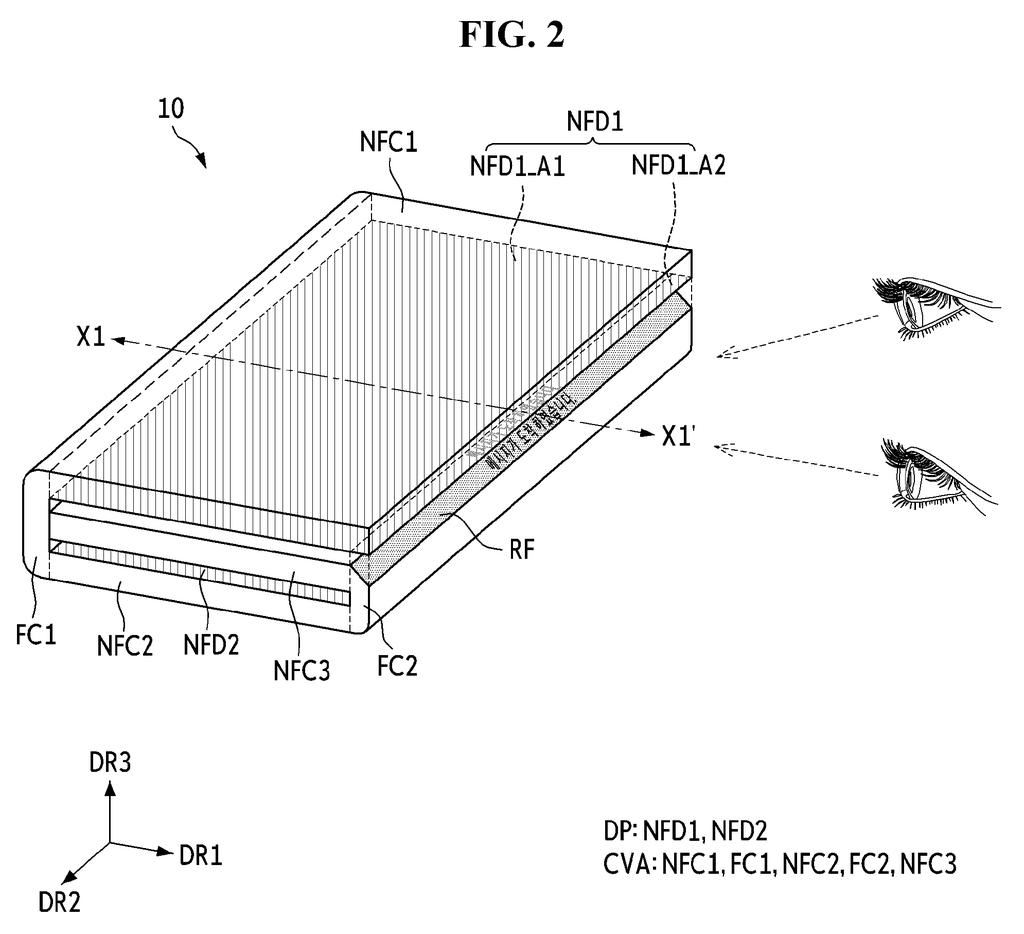
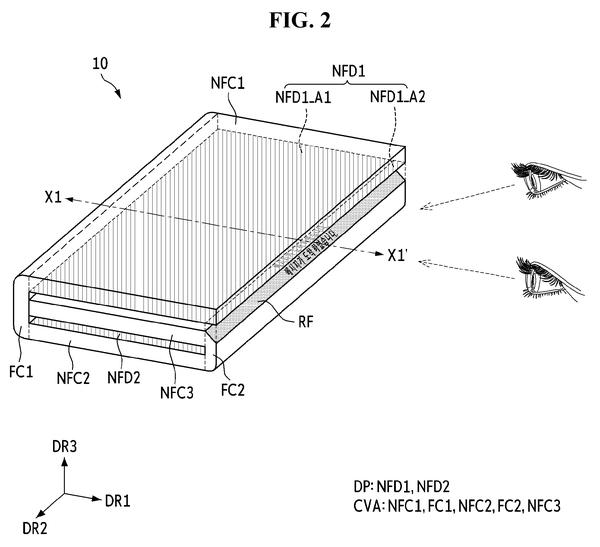
The device has a single display split into three panels that fold in on each other into a G-shaped stack, so the screen ends up tucked inside. A strip along one edge of the display stays lit. It faces a mirror on the outer fold, and you read the strip's reflection: the time, a message, or an email.
To save power, that strip refreshes at one hertz or less, meaning it redraws itself about once a second or slower. The filing also describes flat and curved mirrors, and says the angle of the fold changes where you can see the reflection from.
… a reflective member disposed on a surface of the second folding cover portion of the cover structure which is opposite to a surface of the second folding cover portion facing the display panel …
Translation: A mirror is attached to the back of one of the folding hinges.
How the folded screen bounces alerts to a mirror
The device has a cover structure (the protective frame under the screen) made of three rigid sections joined by two bendable sections. The display panel sits on top, with matching rigid and bendable zones. Folding the two bendable parts inward stacks the three sections and leaves the screen facing itself, hidden from view.
A reflective member (a mirror, a reflective film, or a metal coating such as chromium or aluminum) sits on the outer face of the second bendable section. When folded, that section is angled, from 20 to 70 degrees in the flat version, so the mirror catches the lit edge strip of the display and sends the image out to the viewer.
The filing describes several variations:
- A hinge version, where hinges inside the frame join the panels and the mirror sits on the outer face of one hinge, exposed only when folded.
- A curved mirror, which distorts the image, so the strip shows small colored dots or an image pre-adjusted to look right.
- Smaller angles, which aim the reflection in a different direction.
- A simpler two-panel version with a single fold.
The claims also cover an electronic device where a processor sends image data to this kind of display.
… a cover structure including first to third non-folding cover portions arranged in a first direction, a first folding cover portion disposed between the first and second non-folding cover portions, and a second folding cover portion disposed between the second and third non-folding cover portions …
Translation: The device uses three rigid sections connected by two flexible folding hinges.
Why a mirror could replace an outer screen
For you, the payoff would be glancing at a closed device and seeing the time or a new message while the main screen stays out of view. The filing says this works without a separate display on the outside, which means one less screen to build into the device.
The filing lists smartphones, tablets, laptops, smart watches, smart glasses and car dashboard displays as places this display could go, though the main drawings show a three-panel foldable. The tradeoff is a small, low-detail alert area: the strip refreshes at one hertz or less, which saves power but suits a clock or a notification icon better than video.
Samsung's 97th filing we've tracked since May in our foldable phone patents follows earlier applications like one on glass-and-plastic screen covers and one reducing crease touch wiring.
Source: US 2026/0358861 A1 at the USPTO (PDF). Full patent text and figures are in the official publication.
Get our take in your Top Stories
Liked this breakdown? Add Patentlyze as a preferred source on Google, and our plain-English take shows up more often in your Top Stories the next time Samsung patent news breaks.
Add Patentlyze on Google
One click.
There are more where this came from
We read every patent application Big Tech publishes and send you the ones worth knowing. Plain English, free, every week.
The drawings · 31 sheets
31 drawing sheets from US 2026/0358861 A1 · click any drawing to enlarge


Show the other 23 sheets


More from Samsung
All 1,629 Samsung patents →
More in Display
All 730 Display patents →
Samsung
Samsung's New Patent Gives Each Fold Its Own Protective Layer to Stop Cracking
Samsung
Samsung Files Patent to Shrink the Gap Around a Foldable Phone's Screen
Samsung
Samsung Patents a Battery-Switching System Built for Folding Displays
Samsung
No comments yet