
Qualcomm
Qualcomm · AI / ML · Filed May 7, 2025 · USPTO published Nov 12, 2026 · This week's release
Qualcomm Files Patent to Stop Chatbots From Rereading Your Whole Conversation
Every time a chatbot rewrites your question behind the scenes, it may have to reread your entire conversation first. Qualcomm's patent application describes a way to skip that rereading.
- Publication number
- US 2026/0359596 A1(US20260359596A1)
- Applicant
- QUALCOMM Incorporated
- Filed · Published
- May 7, 2025 · Nov 12, 2026
- Inventors
- Juntae LEE, Jihwan BANG, Seunghan YANG, Kyuhong SHIM, Minsoo KIM, Simyung CHANG
- Status when we published
- Waiting for an examiner
- Document
- 20 claims
- US classification
- 706/16
What Qualcomm's chatbot side-task patent does
Today, when you chat with an AI assistant, it often does little side jobs before it answers you, like rewriting a vague question into a clearer one. Each side job can force the AI to read your whole conversation from the top again, and the longer you chat, the more that costs in time, battery and computing power.
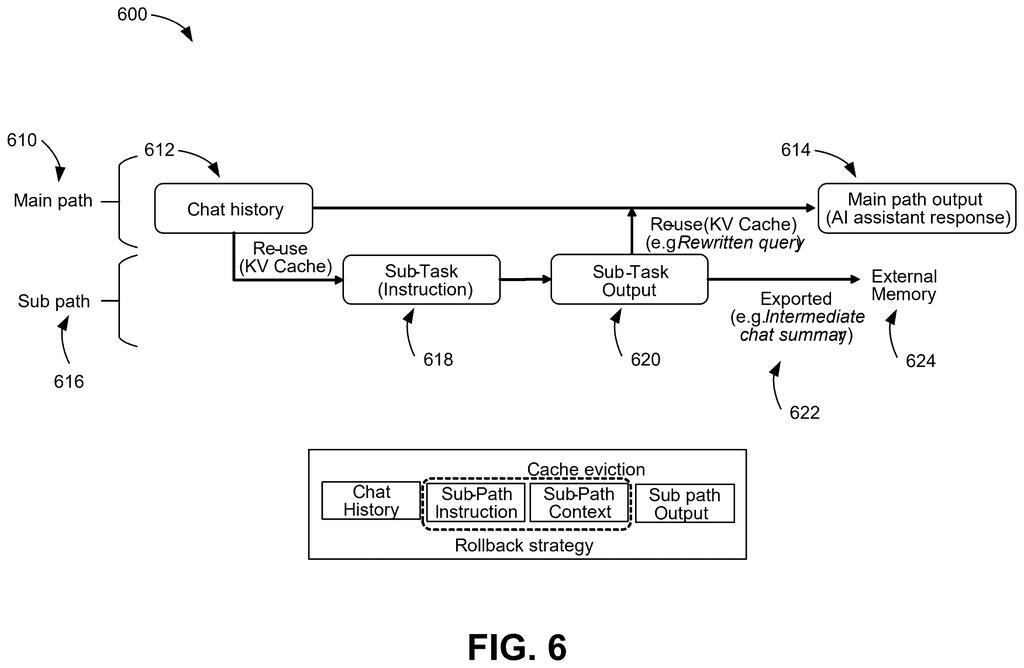
Qualcomm's patent application describes a way around that. The AI keeps its notes on your conversation in a short-term memory, does the side job on top of them, then erases only the side job's instructions. Your conversation stays put, so the AI can go straight back to answering you.
Say you tell a chatbot you watched Inception, then ask, 'Who is the director of the movie?' The side job turns that into 'What is the director of the movie Inception?' so a database lookup gets it right.
… remove at least part of the second data from the cache; and process, using the machine learning model, the first data and the sub-task output from the cache to perform the first task and to generate a task output.
Translation: It deletes temporary data and reuses saved results so the AI does not have to reread everything from the start.
How the chat history stays put in memory
The patent covers a way to run a main task and a side task on one machine learning model, usually a large language model (the type of AI behind chatbots). The main task might be answering your question. The side task might be rewriting it, summarizing the chat, or handling a call to another service.
The claims describe this sequence:
- Take in the data for the main task, such as chat history stored as keys and values (numeric notes the model keeps about text it has already read).
- Create extra data for the side task, meaning an instruction, some context, or both.
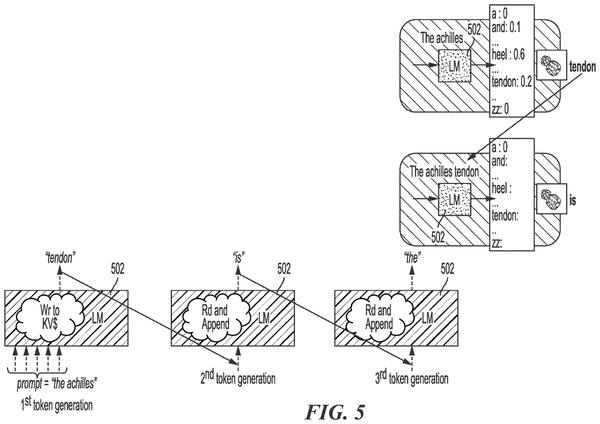
- Run the model on both to get a side-task result, saving everything in a cache (a fast short-term memory).
- Remove some of the side-task data from the cache.
- Run the model again on the chat history plus the side-task result to produce the final answer.
The filing calls this a checkpoint and rollback. Without it, switching back to the main task means reloading the whole chat history, which gets costly as conversations grow. Here the history stays in place and only the side task's instructions come and go.
It also describes picking side tasks with a priority list of yes-or-no checks, ranked ahead of time by a larger model, so a small on-device model never has to choose among many options at once.
What this could mean for on-device assistants
If you use an AI assistant on a phone, the cost of rereading a long chat shows up as slower answers and a device that works harder than it should. Saving that work could mean quicker replies late in a long conversation, when the history is longest. The filing says the gain comes from less recomputation, which lowers the computing resources needed. It gives no measured figures.
The filing frames this around a model running on the device itself, and lists phones, laptops, headsets and vehicles as places it could run. It also fits assistants that rephrase your question before a database lookup. This is a patent application, so nothing here says it will ship in any product.
Qualcomm's 67th filing we've tracked in the AI chip wars since July follows work on sending key update parts first and shrinking models for phones.
Source: US 2026/0359596 A1 at the USPTO (PDF). Full patent text and figures are in the official publication.
Get our take in your Top Stories
Liked this breakdown? Add Patentlyze as a preferred source on Google, and our plain-English take shows up more often in your Top Stories the next time Qualcomm patent news breaks.
Add Patentlyze on Google
One click.
There are more where this came from
We read every patent application Big Tech publishes and send you the ones worth knowing. Plain English, free, every week.
The drawings · 10 sheets
10 drawing sheets from US 2026/0359596 A1 · click any drawing to enlarge


Show the other 2 sheets


More from Qualcomm
All 624 Qualcomm patents →
More in AI assistant & agent
All 413 AI assistant & agent patents →
Nvidia
Nvidia Files Patent for Running Big AI Models on Graphics Cards With Little Memory
Nvidia
A New Nvidia Patent Spreads a Chatbot's Long Memory Across Many Chips
Nvidia
A New Nvidia Patent Reworks How Many Chips Share One Chatbot's Workload
Nvidia
No comments yet