
Google
Google · AI / ML · Filed Jul 20, 2026 · USPTO published Nov 12, 2026 · This week's release
Google Files Patent for AI Models That Unpack Only the Data They Need
Big language models carry giant lookup tables that normally have to be fully unpacked in memory before the model can run. Google's patent application compresses every entry on its own, so a device can open just the one it needs.
- Publication number
- US 2026/0359282 A1(US20260359282A1)
- Applicant
- Google LLC
- Filed · Published
- Jul 20, 2026 · Nov 12, 2026
- Inventors
- Gaurav Menghani
- Status when we published
- Waiting for an examiner
- Document
- 13 claims
- US classification
- 707/693
- Parent application
- Continuation of 19/029,909 (filed Jan 17, 2025)(19029909)
What Google's row-by-row compression does
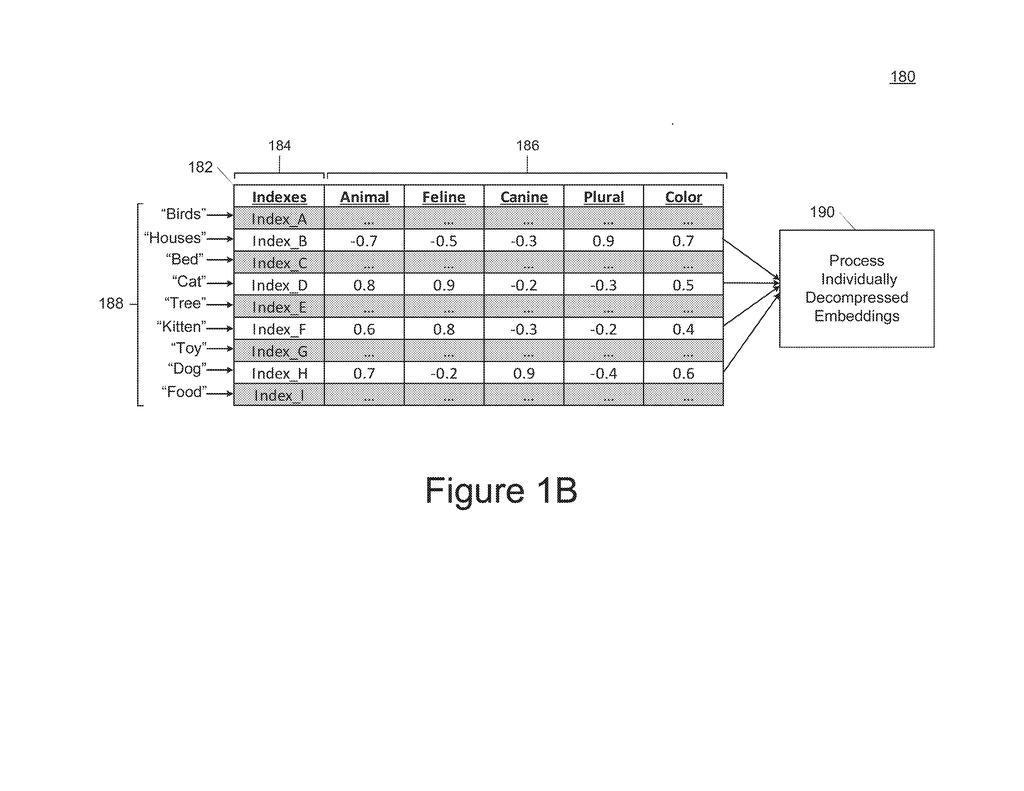
Today, many AI models that handle language carry a giant lookup table, with an entry for every word or word fragment they know. That table can make up most of the model's size, and the usual way of shrinking it means unpacking the whole thing in memory before the model can run. A phone or smartwatch often does not have room for that.
Google's patent application compresses each entry separately, like vacuum-sealing every sweater in a drawer on its own instead of stuffing the whole drawer into one bag. When the model sees a word like "hello," it works out which entry it needs, opens only that one, and leaves the rest sealed.
The shrunken table is bundled with the model, so a phone, watch or other small device can run it with far less memory and power.
… each respective embedding to be decompressed independent of any other embedding in the embedding table …
Translation: Each piece of data can be unpacked separately without touching the rest of the database.
How the model finds and unpacks one entry
The filing starts with an embedding table. An embedding is a short list of numbers that describes where a word (or an image, song or other item) sits in relation to others, so related things get similar numbers. The table stores one list per entry, each tagged with an index (a unique key used to find it).
Instead of compressing the whole table as one block, the system compresses each entry individually, then packs the table together with the model. At run time the model takes an input and turns it into a lookup value, usually by hashing (a fixed scramble that always sends the same input to the same index). It searches the indexes and decompresses only the matching entry.
The description walks through the word "hello." The model pulls out single letters, letter pairs and letter triples, looks each up in its own table, unpacks just those rows, then averages or joins the results. The filing lists several ways to compress rows:
- Quantization: storing each number with fewer digits.
- K-means: grouping similar values together.
- Pruning: dropping values that barely matter.
The lookup and unpacking live inside the model itself, so they work even when the underlying AI software (such as TensorFlow or PyTorch) does not support that compression.
… packing the embedding table comprising individually compressed embeddings with a machine-learning model …
Translation: The compressed data table is bundled directly together with the AI model.
Why phones are the real audience here
If you type on a phone keyboard, dictate a message or translate text, language models are doing the work, and they have to fit in your phone's memory. The filing lists text messaging, email, dictation and virtual keyboard apps as examples. Opening one entry at a time means a model with a huge vocabulary could run on a device with far less memory, power and storage.
It could also cut costs on the server side, since the filing says big models are expensive to serve at scale. And because the lookup and unpacking live inside the model, teams can use their own compression even when the AI software they build on does not support it. That flexibility matters for models that cover many languages, since the filing describes a separate table for each one.
Google's 27th patent application we've tracked since July in AI chip competition adds to a run that includes one on phone heat throttling and one on rewriting chip instructions.
Source: US 2026/0359282 A1 at the USPTO (PDF). Full patent text and figures are in the official publication.
Get our take in your Top Stories
Liked this breakdown? Add Patentlyze as a preferred source on Google, and our plain-English take shows up more often in your Top Stories the next time Google patent news breaks.
Add Patentlyze on Google
One click.
There are more where this came from
We read every patent application Big Tech publishes and send you the ones worth knowing. Plain English, free, every week.
The drawings · 9 sheets
9 drawing sheets from US 2026/0359282 A1 · click any drawing to enlarge


Show the other 1 sheets

More from Google
All 1,079 Google patents →
More in AI assistant & agent
All 413 AI assistant & agent patents →
Qualcomm
Qualcomm Files Patent for Chatbot Chips That Skip the Work They Don't Need
Qualcomm
Qualcomm Files Patent for Storing Giant AI Models as Small Edits to a Shared Copy
Nvidia
Nvidia Patents a System That Reserves AI Resources Before Agents Actually Need Them
Nvidia
No comments yet