
Adobe
Adobe · AI / ML · Filed May 13, 2025 · USPTO published Nov 19, 2026 · This week's release
Adobe Patents a Test That Checks Whether AI Videos Move Like Real Things
Ask an AI for a swinging pendulum and you may get one that never swings back. Adobe's patent application describes a physics check that grades whether the motion in an AI-made clip behaves the way the real thing does.
- Publication number
- US 2026/0368979 A1(US20260368979A1)
- Applicant
- Adobe Inc.
- Filed · Published
- May 13, 2025 · Nov 19, 2026
- Inventors
- Kuldeep KULKARNI, Balaji Vasan SRINIVASAN, Aishwarya AGARWAL, Prateksha UDHAYANAN
- Status when we published
- Examiner raised objections; the company can respond
- Document
- 20 claims
- US classification
- 345/473
- Examiner
- LIU, ZHENGXI (Art Unit 2611)
What Adobe's motion-scoring patent actually checks
Imagine you ask an AI tool for a clip of a child on a swing. The video looks great for a second, then the swing stops moving back and forth, or the seat drifts off in one direction. You would spot the problem instantly, but the software has no idea anything went wrong.
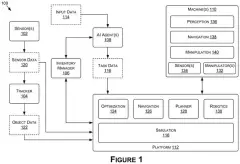
Adobe's patent application describes a way to catch that automatically. It starts with a real video, say a pendulum or a ceiling fan, and gives the AI the first frame plus a short written description: the object, which way it moves and how fast. Then it measures how the object moves in the AI's version and grades smoothness, direction and speed.
If the grade is high, the clip goes out. The scores can also be used to compare several AI models on the same request, pick the best clip, or send feedback that helps a model improve.
obtaining an input pair including a text prompt and an initial image frame extracted from a ground truth video sequence; generating, by a video generation model, a video sequence depicting motion of at least one object based on the text prompt and the initial image frame; determining motion data representing the motion of the at least one object in the generated video sequence …
Translation: The system starts with a text prompt and a real image, then generates a moving video to analyze.
How the system grades speed, direction, smoothness
The filing covers a method for grading image-to-video models (AI that turns a still picture plus a written description into a short clip). The input is a text prompt and a first frame taken from a real recording, called the "ground truth" video because it is the reference for what real motion looks like.
To measure motion, the system runs optical flow (a technique that tracks how fast each pixel moves between neighboring frames) and a segmentation model (software that outlines the moving object so background pixels don't count). It then scores three things:
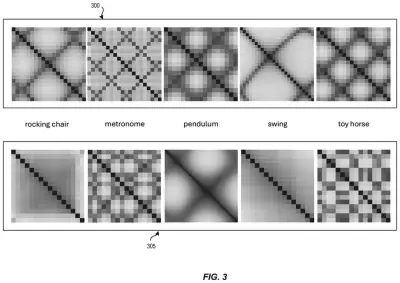
- Smoothness: checked differently by motion type. Rivers and smoke should keep a steady flow, a rigid object like an escalator should move all its points at about the same speed, and a pendulum's frames should repeat in a pattern.
- Direction: whether the pixels move the way the prompt asked, such as left to right or upward. Back-and-forth motion skips this score.
- Speed: prompts for slow, moderate and fast should produce clips whose motion grows in that order.
The filing also describes a test set of 5,200 prompt and frame pairs built from real clips of 20 object types, from waterfalls and conveyor belts to ceiling fans and metronomes. Clips use a still camera, one main object, and run about two seconds. A high score lets the clip through as the output.
… scoring the video generation model in one or more motion categories based on the motion data. The disclosed systems and methods further comprise determining the scoring of the video generation model indicates high motion accuracy …
Translation: It grades the AI model on how realistically its generated objects move compared to real life.
Why AI video makers could care about motion tests
If you make videos with AI, you have seen things move wrong: a wheel that wobbles, a swing that stalls. A scoring step like this could let a tool check its own clips, or run several models and show you only the best one, before you waste time on a bad result. The scores could also show developers where a model is weak so they can retrain it.
Adobe sells creative software, so a built-in quality check fits its business, though the filing names no product. The test set is also simple: one object, a still camera, short clips. That says little about crowded scenes. The examiner's first review rejected the claims as filed, which is routine at this stage and usually followed by amendments.
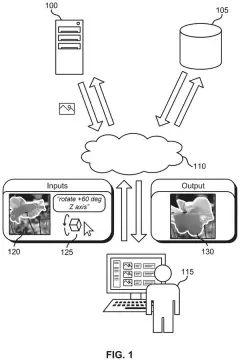
This is the 21st Adobe filing in our AI simulation coverage we've tracked since May, building on ideas like rotating objects in photos and moving objects in generated images.
Source: US 2026/0368979 A1 at the USPTO (PDF). Full patent text and figures are in the official publication.
Get our take in your Top Stories
Liked this breakdown? Add Patentlyze as a preferred source on Google, and our plain-English take shows up more often in your Top Stories the next time Adobe patent news breaks.
Add Patentlyze on Google
One click.
There are more where this came from
We read every patent application Big Tech publishes and send you the ones worth knowing. Plain English, free, every week.
The drawings · 14 sheets
14 drawing sheets from US 2026/0368979 A1 · click any drawing to enlarge


Show the other 6 sheets


More from Adobe
All 270 Adobe patents →
More in AI simulation
All 192 AI simulation patents →
Nvidia
Nvidia Patents AI That Generates Fake Medical Scan Images From Text Descriptions
Nvidia
Nvidia Files Patent for Turning Shaky Phone Videos Into Explorable 3D Scenes
Google
Google Patents Real-Time View Synthesis for Streaming 3D Video
Nvidia
No comments yet