
Airbus
Airbus · Flight & Space · Filed Apr 20, 2026 · USPTO published Nov 19, 2026 · This week's release
Airbus Patents Wingtips That Tilt in Flight to Fix a Plane's Nose Angle
As a jet burns fuel, its nose angle drifts and drag creeps up. Airbus's patent application answers by tilting the wingtips mid-flight, with no fuel pumping required.
- Publication number
- US 2026/0367631 A1(US20260367631A1)
- Applicant
- AIRBUS OPERATIONS LIMITED
- Filed · Published
- Apr 20, 2026 · Nov 19, 2026
- Inventors
- Alexis Anthony LIBERSON
- Status when we published
- Waiting for an examiner
- Document
- 15 claims
- US classification
- 701/6
- Parent application
- Continuation of 18/454,552 (filed Aug 23, 2023)(18454552)
What Airbus's moving wingtip actually does
A passenger jet gets lighter every minute of a long flight as it burns fuel, and that shifts both how much lift it needs and where its balance point sits. The plane's nose angle drifts away from the ideal, more of the body catches the wind, and drag goes up. Today, some planes correct this by pumping fuel back and forth between tanks, which takes pumps, pipes and extra weight.
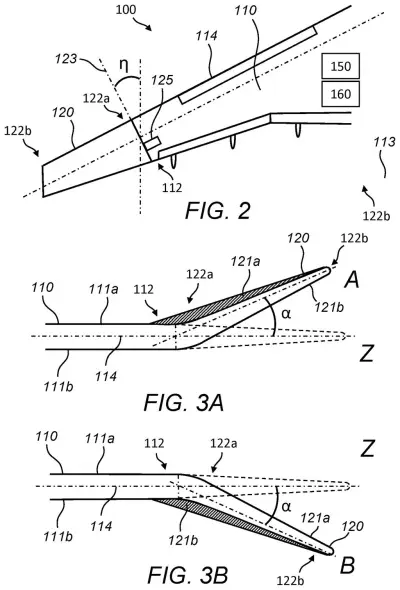
This Airbus patent application goes at it differently. The tip of each wing is a separate piece that can swivel on a motor. Tilt it up or down and it changes how hard that tip pushes the plane upward, which nudges the nose angle back toward the efficient setting. No fuel has to move.
The same hinge has a second job on the ground: fold the tips straight up so the plane fits at tight airports.
… actively controlling a position of a winglet at a distal end of a wing portion of a wing of the aircraft, relative to the wing portion, thereby to control an angle of incidence of the winglet …
Translation: Moving the very tip of the wing during flight to change how it catches the air.
How the angled hinge changes wingtip lift
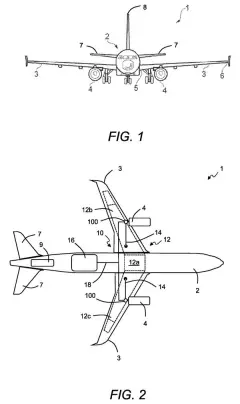
The patent covers a controller, a wing system and a method, all built around one idea: the outer tip of each wing (the winglet) is a separate piece that swivels. The controller reads sensor data such as pitch (the nose angle), angle of attack (how the wing meets the air), speed, drag, mass, center of gravity, and fuel level or burn rate. It then works out a target attitude, meaning the nose angle it wants, and moves the winglet to bring the plane toward it.
The hinge line is deliberately angled. Its axis sits at a non-zero toe angle to the plane's centerline (30 degrees in the main example, matching the wing sweep). So swinging the tip up or down also changes its angle of incidence, the angle at which it meets the oncoming air. On a swept-back wing, the tip's lift acts toward the rear, so less lift there moves the plane's center of lift forward, and more lift moves it back. That shifts the nose angle without touching fuel tanks or other control surfaces.
The filing also describes extras:
- Actuator: an electric motor in the main example, with hydraulic options.
- Restrictor: a slot-and-pin limit that holds the tip to 10 degrees either way in flight, then releases on the ground.
- Stowed position: the tip folds upright on the ground. With a tip about 25% of the span, wingspan could shrink by up to 25%. The claims allow tips from 10% to 50% of the span.
An aircraft attitude controller configured to obtain information representative of an attitude of an aircraft is disclosed.
Translation: The system reads data about how the plane is positioned and tilted in the sky.
What this means for fuel burn and tight gates
The practical pitch is fuel. A plane spends most of a trip in cruise, and that is also when it burns much of its fuel, so even a small drag cut can add up over a long flight. The filing says this approach could remove the need for a fuel-shifting ballast system, which would mean fewer pumps, less piping and less weight.
There is a gate-side payoff too. Longer wings help in flight, but airports limit how wide a plane can be on the ground. Folding the tips upright after landing could let a long-winged jet fit tight spaces. The patent also says tip adjustments during takeoff and landing could allow slower speeds and shorter runways. This is a patent application, and it names no specific aircraft, so treat it as a design idea, not a product plan.
Airbus brings its second filing we've tracked since November, following its taxi-routing timetable patent.
Source: US 2026/0367631 A1 at the USPTO (PDF). Full patent text and figures are in the official publication.
Get our take in your Top Stories
Liked this breakdown? Add Patentlyze as a preferred source on Google, and our plain-English take shows up more often in your Top Stories the next time Airbus patent news breaks.
Add Patentlyze on Google
One click.
There are more where this came from
We read the new patents from Big Tech, carmakers and more and send you the ones worth knowing. Plain English, free, every week.
The drawings · 4 sheets
4 drawing sheets from US 2026/0367631 A1 · click any drawing to enlarge


More from Airbus
All 5 Airbus patents →
More in Flight & Space
All 10 Flight & Space patents →
SpaceX
SpaceX Files Patent for Internet Dishes That Hop Satellites Before a Tree Blocks Them
Boeing
Boeing Files Patent for a Fold-Down Cabin Shelf That Also Parks the Trash Cart
Boeing
Boeing Patents a Silicone Seal to Keep Bathroom Water Out of Airplane Floors
Boeing
No comments yet