
Airbus
Airbus · Flight & Space · Filed May 13, 2026 · USPTO published Nov 19, 2026 · This week's release
Airbus Patents a Recycling Pressure System That Keeps Hydrogen Flowing to Aircraft Engines
Getting liquid hydrogen from a tank to a jet engine is surprisingly tricky, and Airbus has filed a patent for a clever plumbing trick that reuses pressurized hydrogen to help pull more fuel through the system rather than venting it overboard.
- Publication number
- US 2026/0365320 A1(US20260365320A1)
- Applicant
- Airbus Operations SAS
- Filed · Published
- May 13, 2026 · Nov 19, 2026
- Inventors
- Mathieu BELLEVILLE
- Status when we published
- Waiting for an examiner
- Document
- 4 claims
- US classification
- 244/135R
- Examiner
- BONZELL, PHILIP J (Art Unit 3642)
How Airbus recycles pressurized hydrogen instead of wasting it
Imagine a hydrogen-powered aircraft cruising at altitude. Deep in the fuselage, a pump is trying to push super-cold liquid hydrogen from a storage tank to the engines. If the pump is working too hard or not hard enough, it can overheat the fuel or simply stop working properly. That's a serious problem when hydrogen is your only fuel.
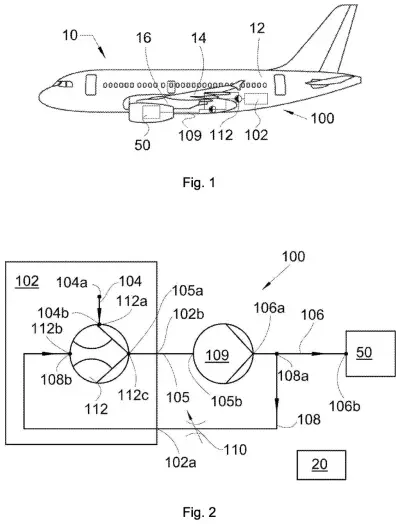
Airbus's patent describes a system that solves this by looping a portion of the pressurized hydrogen coming out of the main pump back into a small device called a jet pump. A jet pump has no moving parts: it uses a fast-moving jet of fluid to drag more fluid along with it, like a nozzle in a garden sprinkler pulling extra water through. Here, that returning high-pressure hydrogen pulls fresh cold hydrogen up from the tank and mixes the two together before sending the combined flow into the main pump.
A control valve on the return loop adjusts automatically, guided by temperature and pressure sensors, so the main pump always receives fuel at exactly the right conditions. The result is a fuel system that can handle a wider range of engine demands without wasting hydrogen or stressing the pump.
An aircraft tank system with a hydrogen tank, a first feed line submerged in the tank, a second feed line, a third feed line fluidically connected to a consumer system of the aircraft, a centrifugal pump mounted between the second feed line and the third feed line, …
Translation: The system feeds liquid hydrogen from the main tank directly into the aircraft engine.
How the jet pump and control valve protect the centrifugal pump
The patent covers a fuel delivery system for a hydrogen aircraft with five main elements working together:
- A centrifugal pump moves liquid hydrogen from the tank to the engine. It needs the fluid arriving at its inlet to be at the right pressure and temperature, described in the filing as "net positive suction pressure" (NPSP), basically the cushion of pressure that stops the hydrogen from boiling inside the pump and causing damage similar to cavitation in water pumps.
- A return line taps off some of the pressurized hydrogen after the pump and sends it back toward the tank, rather than venting it or dumping it back into the tank directly (both of which waste energy or heat the stored fuel).
- A jet pump (also called an ejector) uses that returning high-pressure hydrogen as a driving jet. The fast flow creates a low-pressure zone that draws cold hydrogen up from the bottom of the tank through a submerged pickup line. The two streams mix and exit at an intermediate pressure, feeding the centrifugal pump's inlet.
- A variable control valve on the return line adjusts how much hydrogen is recirculated. A control unit reads temperature and pressure at the pump inlet and tweaks the valve to keep NPSP in a safe range.
The filing notes that the jet pump can be placed inside the tank itself, submerged in liquid hydrogen. That placement cools the warm returning gas before it mixes with the cold tank supply, which further protects against two-phase flow problems (gas bubbles mixed with liquid that can destabilize a pump).
What this means for hydrogen-powered aircraft fuel systems
For aircraft makers betting on hydrogen propulsion, fuel system reliability is one of the hardest engineering problems to solve. Liquid hydrogen sits close to its boiling point at all times, so any added heat in the delivery loop risks turning it partly to gas, which pumps handle badly. This system addresses that directly by keeping recirculated hydrogen cold and by giving the main pump a continuously tuned inlet condition.
The design also avoids venting hydrogen overboard, which would be both wasteful and a safety concern. For engineers working on next-generation hydrogen turbofans or fuel-cell aircraft, the pattern in Airbus's hydrogen propulsion filings suggests the company is building out a detailed toolkit for managing cryogenic fuel at every stage of the delivery chain.
Airbus's fifth filing we've tracked since November adds to our Airbus coverage that already includes the in-flight fuel blend swap and the lever-operated firefighting door.
Source: US 2026/0365320 A1 at the USPTO (PDF). Full patent text and figures are in the official publication.
Get our take in your Top Stories
Liked this breakdown? Add Patentlyze as a preferred source on Google, and our plain-English take shows up more often in your Top Stories the next time Airbus patent news breaks.
Add Patentlyze on Google
One click.
There are more where this came from
We read the new patents from Big Tech, carmakers and more and send you the ones worth knowing. Plain English, free, every week.
The drawings · 2 sheets
2 drawing sheets from US 2026/0365320 A1 · click any drawing to enlarge


More from Airbus
All 5 Airbus patents →
More in Flight & Space
All 10 Flight & Space patents →
Archer
Archer Files Patent for a Cockpit Display That Counts Down to Battery and Engine Limits
Boeing
Boeing Patents a Drone That Flies Ahead to Mark the Landing Spot
SpaceX
SpaceX Files Patent for Internet Dishes That Hop Satellites Before a Tree Blocks Them
Boeing
No comments yet