
Amazon Patents Technology to Make AI Systems Run Faster on Its Own Hardware
Running a large AI model is expensive, partly because the model's internal settings take up enormous amounts of memory. Amazon has filed a patent for a chip-level system that compresses those settings on the fly, so the hardware never has to store or move the full data in the first place.
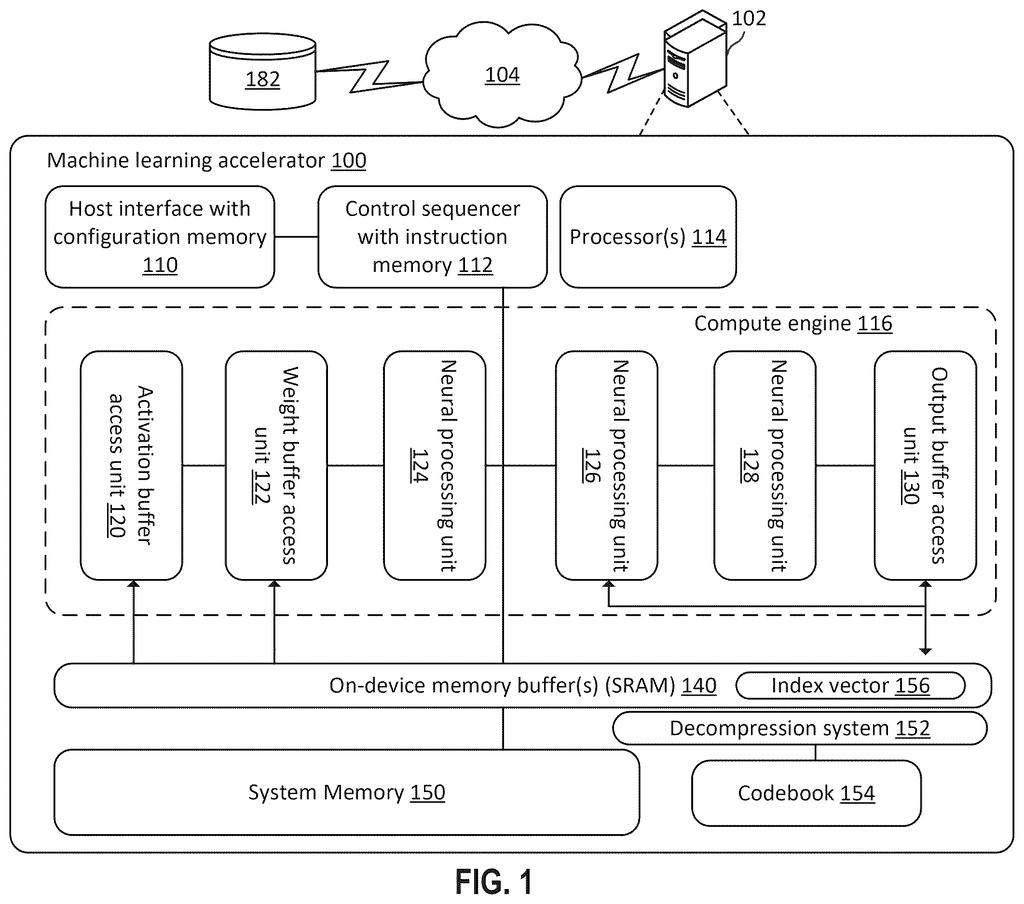
How Amazon shrinks AI models without losing accuracy
An AI model sits at the center of almost every Amazon product today, from Alexa to product recommendations to cloud services. But behind those features are millions of numerical settings, called weights, that the model consults every time it thinks. Storing and reading all those numbers is slow and expensive.
Amazon's patent describes a system that keeps a compressed version of those weights in fast on-chip memory. When the AI chip needs a weight, it looks up a short code, decodes it into the full number right there on the chip, and uses it immediately. You get the accuracy of a full-size model without paying the memory bill for storing every number in its largest form.
The key is a small lookup table called a codebook. Instead of storing thousands of individual weight values, the chip stores short codes that point to entries in that table. A dedicated part of the chip decodes each code back into a usable number in real time, keeping the whole process fast.
… programming, by the input selector, the ALU to decode the first code data using the first decoding algorithm; generating, by the ALU, a first full-precision weight vector by decoding the first code data, …
Translation: The hardware is configured to decode compressed neural network data back into useful values.
How the codebook lookup and ALU decoding actually work
The patent describes a neural network accelerator, a specialized chip designed to run AI models faster than a general-purpose processor can.
Inside that chip, the system works in four steps:
- Index vector lookup: For each layer of the neural network, the chip reads a small set of short codes (stored as hexadecimal values, essentially compact numeric shorthand) from fast on-chip SRAM memory.
- Codebook reference: Those short codes are used as pointers into a codebook, a pre-built table that maps each code to a richer block of data called code data.
- Decoding: An input selector component picks the right decoding algorithm for that particular index vector, then programs the chip's arithmetic logic unit (ALU, the part that does math) to reconstruct a full-precision weight vector, meaning a set of weight values at full numerical detail.
- Inference: A compute engine uses those reconstructed weights to calculate the layer's output, exactly as it would with uncompressed weights.
The claim is specific about the hardware: a dedicated input selector, a programmable ALU, and a compute engine all working together on a single accelerator chip. That hardware specificity is what distinguishes this from a software-only compression scheme.
Devices and techniques are generally described for vectorwise weight quantization for neural networks. In some examples, a first index vector stored in volatile memory may be determined for a first layer of a neural network.
Translation: The system compresses neural network weights to make processing more efficient.
What this means for Amazon's custom AI chip ambitions
Memory bandwidth is one of the biggest bottlenecks in running large AI models. Every time a model processes something, it has to read millions of weight values from memory. Compressing those weights into codebook codes and decoding them on the chip means less data has to travel across the memory bus, which translates to faster responses and lower power draw on Amazon's own infrastructure.
Amazon builds its own AI chips under the Trainium and Inferentia product lines, and the pattern in Amazon's custom-chip filings points squarely at reducing dependence on third-party silicon for AI workloads. A patent like this, covering on-chip weight decoding at the hardware level, fits that effort directly.
Amazon's 11th filing we've tracked since May in the AI chip wars follows one on compressing AI math and one on surviving server crashes during training.
Claim 1 covers a specific chip design that retrieves compressed weight data from a lookup table, selects a decoding method on the fly, and reconstructs the actual numbers a neural network needs, all inside dedicated on-chip memory. That is a narrow description of a particular hardware arrangement, not a broad lock on the idea of compressing AI model weights.
In practice, the claim would block a competitor from building that exact combination of components following that exact sequence. But because the claim is tied to named parts and a named order of operations, a different chip that achieves the same result by skipping one component or reordering the steps could plausibly stay clear of it.
The value here is real but bounded. Amazon is protecting a specific engineering solution for running large neural networks efficiently on its own hardware, not staking a claim over compressed AI models as a category.
There are more where this came from
We read every patent application Big Tech publishes and send you the ones worth knowing. Plain English, free, every week.
The drawings
7 drawing sheets from US 2026/0300680 A1 · click any drawing to enlarge


Want this weekly breakdown for a company we don't cover? Patentlyze Pro →
Be the first to weigh in