
Apple
Apple · AI / ML · Filed Feb 26, 2026 · USPTO published Nov 19, 2026 · This week's release
Apple Files Patent for Making Custom Emoji From Your Photos and a Few Words
Apple's filing describes a way to blend a picture of a cactus and a picture of a bicycle into a cactus riding a bike, and to keep editing your own face the same way.
- Publication number
- US 2026/0368949 A1(US20260368949A1)
- Applicant
- Apple Inc.
- Filed · Published
- Feb 26, 2026 · Nov 19, 2026
- Inventors
- Ron C. SANTOS, Alexandre R. MOHA, David GUERA COBO, Grant R. PAUL, Max-Olivier C. VAN BASTELAER, Ohil K. MANYAM, Sean C. STEWART, Zhile REN, Elizabeth J. BOARD
- Status when we published
- Waiting for an examiner
- Document
- 20 claims
- US classification
- 345/418
- Parent application
- Claims priority from a provisional application 63808611 (filed May 19, 2025)
What Apple's custom emoji maker actually does
Ever scrolled through your emoji keyboard looking for the exact right one and come up empty? Say you want a cactus riding a bicycle. No such sticker exists, so you settle for something close.
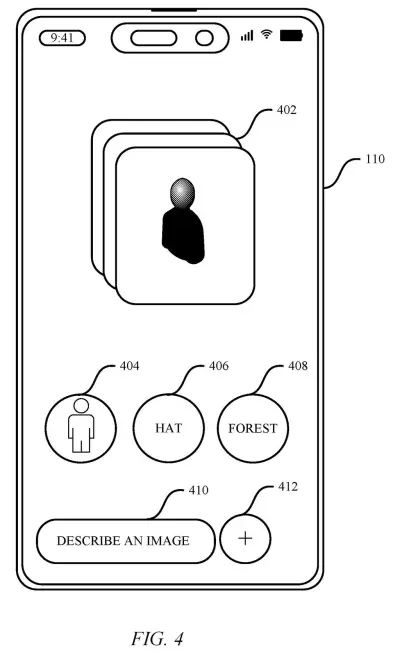
This Apple patent application describes a way to make it on the spot. You tap a picture of a cactus and a picture of a bicycle, maybe type a few words, and an AI model draws a brand-new image that combines them. You can also pull in a photo of a friend from your contacts or something from your photo gallery.
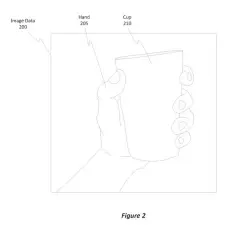
The filing goes a step further with people. Start with a selfie and the word smile, and you get a batch of pictures of you smiling. Pick one, then change the hairstyle to curly, or take off the sunglasses, and you get another batch. You can keep going until it looks right.
receiving, by a system process and from an application, an input comprising a first image and at least one of a second image or a text input, wherein the text input describes an output image; …
Translation: The system takes in your photos and descriptive words from an app.
How the photos and text become one request
The core idea is a system process, meaning a background service run by the operating system rather than by any one app. A creative app hands it a first image plus either a second image or a text description. The service runs them through a machine learning model and sends a finished picture back to the app to display.
Inside, the filing breaks the work into steps:
- An image encoder turns each picture into a feature vector (a list of numbers capturing colors, shapes, objects and scene).
- A text encoder does the same for your typed words.
- An image captioning model can write its own description of each picture, such as a green cactus with two branches in a desert, and that gets encoded too.
- Saved labels like outdoor or vacation can be added as well.
All of those number lists are packed into one structured query using a template, and a generative neural network (an AI that creates images) turns it into the output. Pictures can be reduced to a lower resolution first. The model is trained on samples that pair input images and descriptions with a target image.
The filing also describes, as an extra, making a set of images of one person or object, then regenerating them with changed attributes like hairstyle, clothing or eyewear while keeping the rest of the look.
The methods further provide for generating a set of images depicting an entity and having a set of modifiable attributes.
Translation: It creates multiple versions of a person or object that you can easily change later.
Why your keyboard stickers could get personal
If you have ever wished a message could say something no emoji covers, this targets that gap. The filing says emoji and sticker menus are narrow, with a few used constantly and the rest ignored, and that keyboards do not read your conversation for context. Generating the image on demand skips the fixed menu entirely.
Because the work sits in a system process that apps call, the same feature could serve messaging, social media and other creative apps instead of living inside one. The filing also lists marketing, teaching and digital art as uses, and says the model can run on your device or on a server. It also mentions GIFs and video as later possibilities.
This is the sixth Apple filing in our AI vision coverage since July, which already includes fake-mask face recognition and custom hand gestures.
Source: US 2026/0368949 A1 at the USPTO (PDF). Full patent text and figures are in the official publication.
Get our take in your Top Stories
Liked this breakdown? Add Patentlyze as a preferred source on Google, and our plain-English take shows up more often in your Top Stories the next time Apple patent news breaks.
Add Patentlyze on Google
One click.
There are more where this came from
We read every patent application Big Tech publishes and send you the ones worth knowing. Plain English, free, every week.
The drawings · 7 sheets
7 drawing sheets from US 2026/0368949 A1 · click any drawing to enlarge


More from Apple
All 748 Apple patents →
More in AI vision
All 351 AI vision patents →
Google
Google Files Patent for Fixing Group Photos by Borrowing Faces From Other Shots
Microsoft
Microsoft Patents an AI That Reads Your Emoji Reactions to Summarize Meetings
Adobe
Adobe Files Patent for AI Videos That Run Longer Without Losing the Plot
Microsoft
No comments yet