
Apple
Apple · AI / ML · Filed Nov 19, 2025 · USPTO published Nov 19, 2026 · This week's release
A New Apple Patent Lets Its On-Device AI Call Other Apps to Answer You
Ask your device's AI for your mom's phone number and it could reach into your contacts on its own, read what comes back, then answer you. A new Apple patent application describes that loop in very broad terms.
- Publication number
- US 2026/0368254 A1(US20260368254A1)
- Applicant
- Apple Inc.
- Filed · Published
- Nov 19, 2025 · Nov 19, 2026
- Inventors
- Erik D. Hornberger, Louis D'hauwe, Alexander D. Palmer, Yifei He, Bowen Huang, Xinran "Richard" Wei, John Dennison, Zhen Li
- Status when we published
- Waiting for an examiner
- Document
- 20 claims
- US classification
- 719/313
- Parent application
- Claims priority from a provisional application 63805668 (filed May 14, 2025)
What Apple's tool-calling on-device AI does
You ask your phone, What's my mom's number? An AI model on its own has no idea. It only knows what it was trained on, and your contacts weren't part of that.
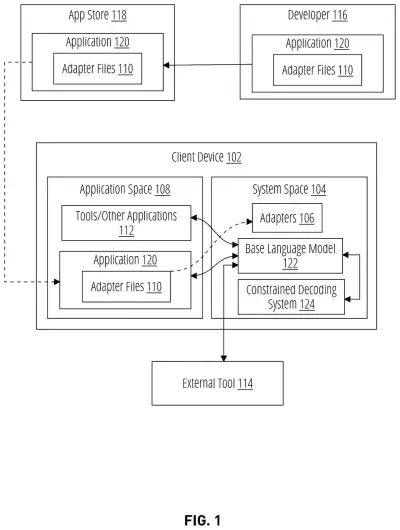
Apple's filing describes a fix. The AI model that runs on the device is handed a short list of tools, such as a contacts lookup, each with a plain description of when to use it. When your question arrives, the model decides a tool is needed, calls it, and reads the answer. That answer is added to the running conversation, so the model can write a reply that uses it.
The tools can be other apps or system services on the device, or sources on the internet. The filing also describes helping outside app developers set all this up, with the AI model running on the device rather than in a data center.
… calling, by the language model, a first tool based on the first prompt; receiving, by the language model, a response from the first tool; copying the response from the first tool into a context window for the first session …
Translation: The AI uses other apps to find answers and remembers the results for your chat.
How the AI asks an app and reads the reply
The core claim is a loop. A language model (the AI that writes text replies) gets a prompt during a session, meaning one running conversation. It decides to call a tool, receives the tool's response, and copies that response into its context window (the working memory that holds the conversation so far). Then it writes its answer using that response.
The other claims add pieces around that loop:
- Before the prompt, the model gets an instruction that includes a description of the circumstance in which to call a tool. The filing's example reads, Use this tool to look up contact information.
- A session start message can hand the model a whole set of tools, and the model decides which one fits.
- The model can call a second tool afterward, passing along information from the first tool's response.
- A tool can be reached through a system API (a defined way for programs to talk to each other) supported by the operating system's developer kit, or through an internet API called with structured JSON code (a rigid text format).
The description explains one practical wrinkle. Tool calls must be written in exact syntax. Apple describes letting a developer supply a data type in Swift (Apple's programming language) and having a compiler generate a grammar, a set of rules that restricts which words the model can output. The filing also describes bundling custom add-ons and smaller, faster models with apps, but those are extras beyond the claims.
… an adapter management system that bridges the gap between application and system spaces, enabling seamless integration of fine-tuned models.
Translation: A special system helps customized AI models work smoothly with your phone and apps.
Why third-party apps get a way into Apple's AI
The practical change is who gets to use the AI. The filing's own background says the benefits of an on-device model have mostly stayed with the operating system and the company's own apps. Letting outside apps plug in as tools means an assistant could pull from them when you ask a question, while the model still runs on your device.
Permissions stay in the loop too. The filing says a tool that wants your data needs the operating system's permission, which can mean you have to say yes. It also covers making the model's output follow strict formats so an app's code can read what the AI sends. For developers, that is the dull but necessary part of making AI features work reliably.
That makes this the tenth Apple filing we've tracked since July on our AI agents acting for you watchlist, joining earlier applications like one that suggests photo actions and hold-waiting patent.
Source: US 2026/0368254 A1 at the USPTO (PDF). Full patent text and figures are in the official publication.
Get our take in your Top Stories
Liked this breakdown? Add Patentlyze as a preferred source on Google, and our plain-English take shows up more often in your Top Stories the next time Apple patent news breaks.
Add Patentlyze on Google
One click.
There are more where this came from
We read every patent application Big Tech publishes and send you the ones worth knowing. Plain English, free, every week.
The drawings · 17 sheets
17 drawing sheets from US 2026/0368254 A1 · click any drawing to enlarge


Show the other 9 sheets


More from Apple
All 748 Apple patents →
More in AI / ML
All 2,738 AI / ML patents →
Microsoft
Microsoft Patents an AI That Builds Apps From a Written Description
Microsoft
Microsoft Files Patent for an AI That Suggests Your Next Move in Work Apps
Adobe
Adobe Files Patent for AI That Rebuilds Your Marketing Automations in a Different App
Microsoft
No comments yet