
Qualcomm
Qualcomm · Networking · Filed Jun 29, 2026 · USPTO published Nov 12, 2026 · This week's release
Qualcomm Files Patent for Letting Carriers Pick Which AI Version Runs on Your Phone
When a phone and a carrier's network both run pieces of the same AI system, they have to be using matching versions. Qualcomm's filing sets up a short handshake where your phone lists what it has and the network picks.
- Publication number
- US 2026/0362121 A1(US20260362121A1)
- Applicant
- QUALCOMM Incorporated
- Filed · Published
- Jun 29, 2026 · Nov 12, 2026
- Inventors
- Yuwei REN, Ruiming ZHENG, Hao XU, Yin HUANG
- Status when we published
- Waiting for an examiner
- Document
- 20 claims
- US classification
- 455/418
- Parent application
- Continuation of 18/024,263 (filed Mar 1, 2023)(18024263)
What Qualcomm's carrier-specific phone AI does
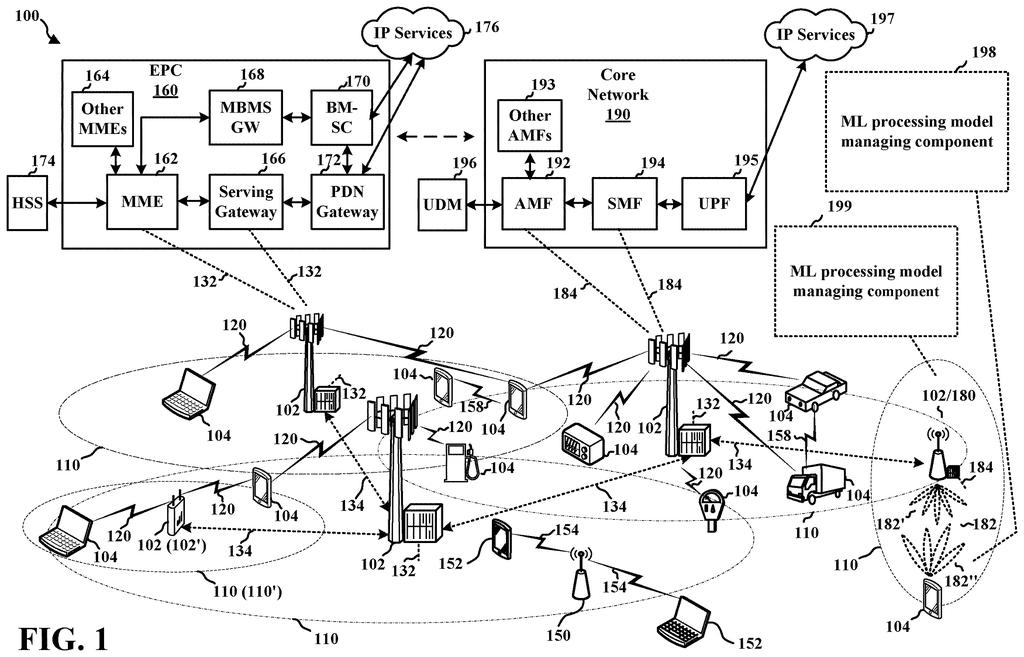
Ever wondered how your phone gets handed from one cell tower to the next while you ride a fast train? That job is one a phone's built-in AI could help with.
The catch is that every carrier builds its network differently. A generic AI model works okay everywhere but is tuned for nowhere. Qualcomm's filing sets up a simple conversation. Your phone tells the network which versions of an AI model it can run: a common one that works across carriers, and any carrier-specific ones. The network then picks one the phone supports and tells it to use that.
If your phone only knows the common version, it gets the common version. If it also knows your carrier's, the network can switch it to that one.
receive an indication of a capability for a user equipment (UE) to support one or more versions of a machine learning (ML) processing model, wherein the indication indicates the capability to support one or more of a first version of the ML processing model that is common across multiple wireless networks and at least one alternative version of the ML processing model …
Translation: Your phone tells the carrier whether it can run standard AI or a custom version built for that specific network.
How the phone and network agree on a model
The filing covers a handshake between a phone (the patent calls it a user equipment, or UE) and a network entity such as a base station. The phone sends a capability message saying which versions of a machine learning (ML) model it supports. The network then sends back a configuration telling the phone which one to apply.
The phone can report two kinds of support:
- A common version that works across multiple wireless networks.
- Alternate versions built for one network, each with its own algorithm structure (the model's layout) or weights (the numbers it learned during training).
The dependent claims add detail. The phone tags each alternate version with a version number and a PLMN ID (a code that identifies a particular carrier's network). If the phone lacks the alternate version, the network configures the common one. If the phone has it, the network can configure the alternate, and it can also send the structure or weights themselves.
The claims name three uses: handover (passing the phone from one tower to the next), awareness of surroundings based on the phone's sensors, and data compression. The description's main example is a phone on a high-speed train, where a carrier-specific model can improve handover on that carrier's network. The phone can also say which scenario each model version covers.
The wireless network entity may configure at least one of a network specific algorithm structure or one or more weights for an network specific machine learning model that is supported by the UE.
Translation: The carrier sends instructions to set up its own custom AI rules and settings directly on your device.
What this means for handovers on a fast train
For you, the effect would be invisible if it works: a phone that handles tower-to-tower handoffs on a fast train using a model tuned to your carrier's network, rather than a generic one. The filing says carriers deploy networks differently, so the same stretch of track can call for different handover behavior depending on who you pay.
For Qualcomm and carriers, the value is coordination. In the filing's examples, one model runs on the phone and a second on the network side, so both halves have to match. A shared way to say "I run version 2 for this carrier" keeps phone makers and carriers from guessing. The filing only describes the signaling, and it names no product.
Qualcomm's 593rd filing we cover since May adds to a body of work that includes towers shaping phone AI and location shifts by area, all part of our Qualcomm coverage.
Source: US 2026/0362121 A1 at the USPTO (PDF). Full patent text and figures are in the official publication.
Get our take in your Top Stories
Liked this breakdown? Add Patentlyze as a preferred source on Google, and our plain-English take shows up more often in your Top Stories the next time Qualcomm patent news breaks.
Add Patentlyze on Google
One click.
There are more where this came from
We read every patent application Big Tech publishes and send you the ones worth knowing. Plain English, free, every week.
The drawings · 11 sheets
11 drawing sheets from US 2026/0362121 A1 · click any drawing to enlarge


Show the other 3 sheets


More from Qualcomm
All 624 Qualcomm patents →

More in Networking
All 498 Networking patents →
Apple
Apple Files Patent to Let Carriers Choose the Security Questions Before You Switch Phones
Samsung
Samsung Files Patent for Tracking Your Phone's Location Using the Radio Wave Itself
Apple
Apple Files Patent for Letting Your Phone Decide What Apps' Servers Can See
Samsung
No comments yet