
Apple
Apple · Software · Filed Jan 15, 2026 · USPTO published Nov 19, 2026 · This week's release
Apple Patents Earphone Taps That Start Live Translation of a Conversation
Apple's patent application describes a translation mode you switch on with a touch on each earphone. It then speaks both sides of a two-language conversation aloud while your phone, even locked, shows a running transcript.
- Publication number
- US 2026/0368455 A1(US20260368455A1)
- Applicant
- Apple Inc.
- Filed · Published
- Jan 15, 2026 · Nov 19, 2026
- Inventors
- Eunice Y. LEE, Taylor G. CARRIGAN
- Status when we published
- Waiting for an examiner
- Document
- 48 claims
- US classification
- 704/3
- Parent application
- Claims priority from a provisional application 63807266 (filed May 16, 2025)
What Apple's earphone translation mode does
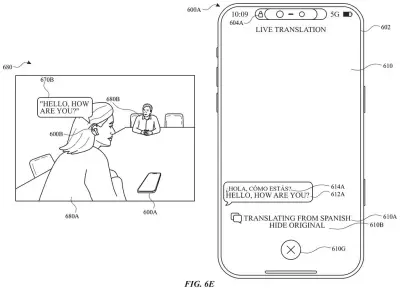
You're sitting at a table across from someone who speaks only Spanish, and you speak only English. You tap both earphones, and the conversation starts to flow. You hear their words in English in your ear, while your phone, still locked, shows a written transcript of what both of you said.
That's the scenario in this Apple patent application. Once you switch on a translation mode, the system listens on its own for both languages, speaks translations through your earphones, and keeps a written record on screen. You don't have to press anything between sentences.
The filing also covers some practical touches. It can tell you which language it's listening for, warn you when the room is too loud and the phone should be moved closer to the speaker, and let you tap a line in the transcript to blow it up to large text.
The present disclosure generally relates to user interfaces for audio processing, including detecting audio, translating speech, and outputting audio.
Translation: Apple describes a system for listening to, translating, and playing back spoken words.
How the transcript and spoken audio run together
The claims describe a phone (or similar computer system) connected to audio devices such as earphones. It starts out not translating. When it detects a set of inputs to enable translation mode, it switches on. One dependent claim describes that input as a touch on one earphone plus a touch on the other. The description also mentions a button press or touch on the phone.
After that, without further user input, the system listens to a conversation among two or more people speaking different languages. It plays audio translations of what each person says and, at the same moment, displays a transcript of both people's speech.
The dependent claims add details:
- Audio tells you which language the system will translate.
- Each speaker's words are translated into the other speaker's language.
- The phone can be locked, and the transcript still shows on the lock screen.
- The transcript can show every line in both languages.
- The second language is either picked by you or chosen automatically.
- If background noise passes a set level, the system tells you to move the device closer to a speaker.
You can also tap one person's line to open an enlarged view. In that view, the screen updates only for speech that meets certain conditions, and the skipped speech reappears when you go back to the full transcript. The description also covers a separate idea: inserting punctuation mid-sentence so the system can start speaking before the speaker finishes.
Why a locked phone and two taps matter
The practical payoff is less fiddling. Starting a translated conversation takes a tap on each earphone, so you aren't hunting through an app while the other person waits. Because the transcript shows alongside the spoken translation, you can check the text if you miss a word or the room is loud. The noise warning is a small touch that matches how these conversations go wrong in real life.
The filing is about the interface and the flow of a conversation, not about how good the translations are. It says nothing here about accuracy or which languages are supported. It does describe an iPhone-style phone paired with wireless earphones, so any real version would depend on how well the speech and translation tools underneath perform.
This is the 713th Apple filing in our Apple coverage since May, adding to a translation thread that includes live phone call translation and theater audio translation.
Source: US 2026/0368455 A1 at the USPTO (PDF). Full patent text and figures are in the official publication.
Get our take in your Top Stories
Liked this breakdown? Add Patentlyze as a preferred source on Google, and our plain-English take shows up more often in your Top Stories the next time Apple patent news breaks.
Add Patentlyze on Google
One click.
There are more where this came from
We read every patent application Big Tech publishes and send you the ones worth knowing. Plain English, free, every week.
The drawings · 38 sheets
38 drawing sheets from US 2026/0368455 A1 · click any drawing to enlarge


Show the other 30 sheets


More from Apple
All 748 Apple patents →
More in Software
All 814 Software patents →
Google
Google Files Patent for Video Call Alerts That Show a Translation Is Still Playing
Samsung
Samsung Files Patent for One Volume Button That Handles a Call and Its Translation
Samsung
Samsung Patents a Live Screen Translator That Updates as You Scroll
Salesforce
No comments yet