
Apple
Apple · Software · Filed May 15, 2026 · USPTO published Nov 19, 2026 · This week's release
Apple Files Patent for Phone Calls That Translate Languages as You Talk
Apple has filed a patent application for translating a phone or video call as it happens, with a short notice that tells the other person before it starts.
- Publication number
- US 2026/0368458 A1(US20260368458A1)
- Applicant
- Apple Inc.
- Filed · Published
- May 15, 2026 · Nov 19, 2026
- Inventors
- Jingyao ZHANG, Adam Y. SYED, Akshatha NAGESH, Benjamin H. ROOS, Daniel B. POLLACK, Gregory KELLUM, Imran AHMED, Joris B. KLUIVERS, Justin R. ETZINE, Karthick SANTHANAM, Nicolas WAGNER, Shao Hua KAO, Sri Ranjan SRIKANTAM, Eunice Y. LEE, Grant R. PAUL, Lauren E. TAPPANA, Christopher M. GARRIDO, Alan BITHELL, Luyang LI
- Status when we published
- Waiting for an examiner
- Document
- 32 claims
- US classification
- 704/2
- Parent application
- Claims priority from a provisional application 63808617 (filed May 19, 2025)
What Apple's translate-during-a-call button does
Imagine you call a hotel in Lisbon and the person who answers speaks a language you don't. Normally you hang up and hunt for a translation app. This Apple patent describes a button you tap in the middle of the call, so the phone translates what each of you says as you go.
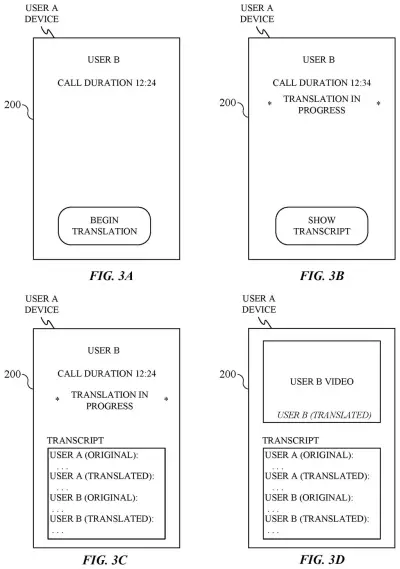
Your phone can also offer first. If it hears a language that isn't one of your preferred languages, or sees that the number comes from another country, a prompt asks whether you want translation. The other person hears a short announcement that the call is about to be translated, and they can decline.
Translation can arrive as a computer-generated voice, as live text, or both. The work happens on the phones rather than on a faraway server, which Apple says cuts delay and helps keep your voice data private.
… initiating a language translation session corresponding to a voice or video call with a second device, wherein the language translation session comprises a translation process to translate a first audio capture containing first speech received at the first device from a first language into a second language; …
Translation: Starting a translation mode for a phone or video call that converts spoken words from one language to another.
How the phones chain voice, text and translation
The claims cover a translation session tied to a voice or video call. After a user request on a first device, that device translates speech from one language into another and sends the result to itself, the second device, or both. Other claims let either phone do the translating.
The description calls the translator a pipeline (a chain of steps that each handle small chunks of audio): speech recognition turns voice into text, a translation engine converts it, and a voice generator reads it aloud. The steps overlap to cut delay, and timing data keeps the translated audio lined up with the original.
The claims and description also add these details:
- A prompt can appear when a new language is detected, or from an area code or contact location, even before the call connects.
- The other person's device plays an announcement that translation is about to start, then a set waiting period passes.
- Someone on an older phone can request translation with keypad tones.
- The original voice can play under a louder translation, in a voice style you pick, with a live transcript and a full one after the call.
- Once one device translates, the translate option on the others is switched off, though a device can ask to take over.
Translation output can include audio output in another language and/or transcript output in another language.
Translation: The translated conversation can be heard out loud or read as text on a screen.
Why Apple's call translation could matter to you
If this became a feature, you could take a call from a clinic, a landlord, or a relative abroad and keep talking without switching apps. The filing argues that translating on a phone, instead of on a server, cuts delay and keeps voice data more private.
Consent gets real attention. The other person is told translation is starting and can decline, and the filing notes that rules and customs on this differ by region. The keypad option means someone on an older landline could ask for translation with no app at all. Nothing in the filing says when, or whether, a product will follow.
That makes this Apple's 712th filing in our Apple coverage since May, a corpus that spans everything from real-time theater translation earbuds to description-based emoji mixing.
Source: US 2026/0368458 A1 at the USPTO (PDF). Full patent text and figures are in the official publication.
Get our take in your Top Stories
Liked this breakdown? Add Patentlyze as a preferred source on Google, and our plain-English take shows up more often in your Top Stories the next time Apple patent news breaks.
Add Patentlyze on Google
One click.
There are more where this came from
We read every patent application Big Tech publishes and send you the ones worth knowing. Plain English, free, every week.
The drawings · 10 sheets
10 drawing sheets from US 2026/0368458 A1 · click any drawing to enlarge


Show the other 2 sheets


More from Apple
All 748 Apple patents →
More in Software
All 814 Software patents →
IBM
IBM Patents a System That Delays Video Calls to Sync Translated Captions
Google
Google Patents a Self-View Window in Video Calls That Moves Out of Your Way
Google
Google Files Patent for Video Call Alerts That Show a Translation Is Still Playing
Google
No comments yet