
Apple
Apple · Display · Filed May 1, 2026 · USPTO published Nov 19, 2026 · This week's release
Apple Patents a Folding Screen Hinge That Props Up the Display While You Type
Fold a screen into a teardrop and you need room for the bend, but pull the support away too early and the glass flexes under your fingers. Apple's patent handles that trade-off with support floors that sink away only once the fold passes a set angle.
- Publication number
- US 2026/0371506 A1(US20260371506A1)
- Applicant
- Apple Inc.
- Filed · Published
- May 1, 2026 · Nov 19, 2026
- Inventors
- Tatsuya Sano, Bradley J. Hamel, Scott J. Krahn, Peng Peng, Colin M. Wang, Yu-Chieh Lee, Michael B. Wittenberg, Macey E. Dade
- Status when we published
- Waiting for an examiner
- Document
- 20 claims
- US classification
- 361/807
- Parent application
- Claims priority from a provisional application 63805215 (filed May 13, 2025)
What Apple's foldable hinge actually does
Ever tried tapping on a folding screen that's propped open like a laptop and felt the glass give a little near the crease? That is the spot Apple is trying to fix.
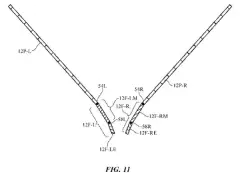
A foldable screen curls into a teardrop shape when it closes, which means the hinge needs extra room inside. Apple's design uses small support floors on each side of the fold. They sit under the back of the screen while it's open, then sink into the housing as the device closes.
The key is when they sink. They stay up, holding the screen firm, until the fold drops below a set angle. The first claim describes them still in place at 135°, and the description gives examples like 100° and 90°. So when you're typing at a laptop angle, the screen still has something solid behind it.
The hinge may include a torque module that has two sets of springs and three cams. Linkages may include portions with non-circular curvature to provide additional clearance between the flexible display and the housing.
Translation: Special springs and curved parts inside the hinge make room so the folding screen does not get damaged.
How the hinge drops its support floors
The patent covers a foldable device whose screen bends along a line called the bend axis, with a hinge sitting right over that line. On each side of the hinge are retractable support structures (the filing also calls them sink floors). When the device is open, they hold up the back of the screen. When it closes, they drop into the housing so the screen can curl into a teardrop shape.
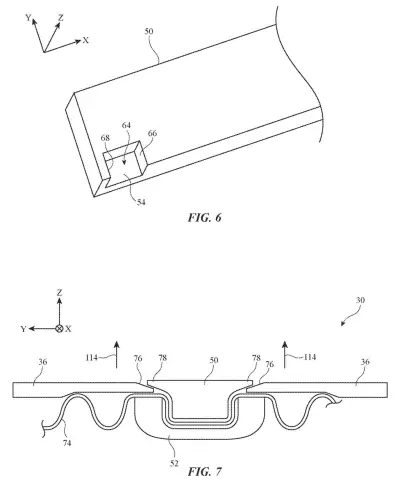
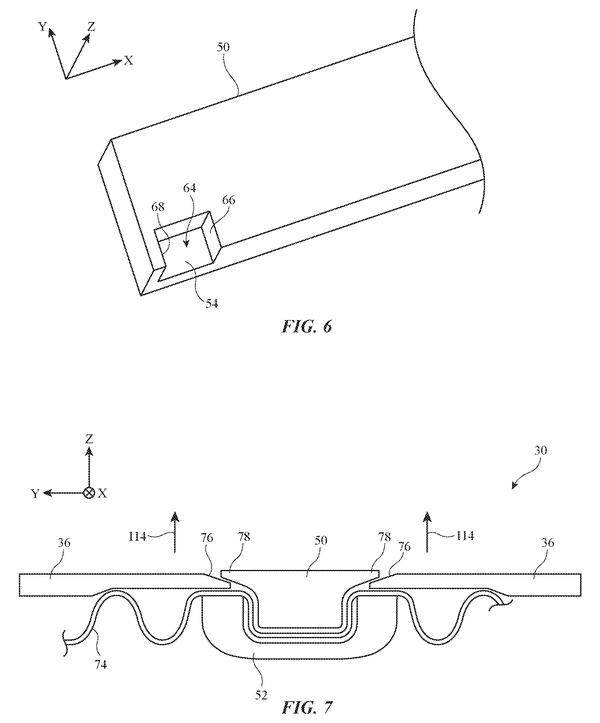
Hinge arms (linkages) control the timing. Each arm has a pin that slides in a slot in a support. The slot has a flatter outer stretch and a more sharply curved inner stretch, so the support stays put until the pin reaches the curve and then gets pulled down.
Other parts do supporting work:
- A center support with a shelf that catches tabs on the supports and holds them in place while open.
- Tapered tips that slide under the center support, so a thin ribbon of wiring (a flexible printed circuit) running through the hinge can't push them up into the screen.
- A torque module (the part that holds the hinge at the angle you leave it) with two sets of springs and three cams, which are shaped parts that turn spring pressure into twisting force.
The filing also describes a version with one spring set, two cams and extra springs placed off to the sides, plus hinge arms with oval-style curves that give the screen more clearance when closed.
Why a firm hinge matters for typing on a foldable
If you've used a foldable, you know the area around the crease is the weak point. Keeping the supports up until the device is nearly closed means the screen stays firm when you prop it like a laptop and tap an on-screen keyboard. The filing says retracting too early can leave visible deformations in the display near the hinge.
The spring and cam details matter for thin designs. The filing notes that narrow products have little room and may only fit two torque modules, so the extra spring set and third cam add holding force without adding modules. The patent doesn't name a product, so treat it as a look at how Apple thinks about foldable hardware.
This is the 11th Apple filing we've tracked in the foldable phone race since May, building on the bending frame patent and the self-flattening hinge.
Source: US 2026/0371506 A1 at the USPTO (PDF). Full patent text and figures are in the official publication.
Get our take in your Top Stories
Liked this breakdown? Add Patentlyze as a preferred source on Google, and our plain-English take shows up more often in your Top Stories the next time Apple patent news breaks.
Add Patentlyze on Google
One click.
There are more where this came from
We read every patent application Big Tech publishes and send you the ones worth knowing. Plain English, free, every week.
The drawings · 8 sheets
8 drawing sheets from US 2026/0371506 A1 · click any drawing to enlarge


More from Apple
All 748 Apple patents →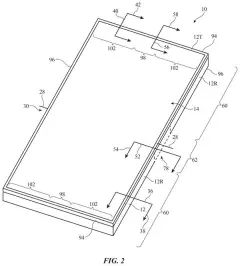
More in Display
All 741 Display patents →
Apple
Apple Patents a Fix for Subtle Pixel Crosstalk in Electronic Displays
Google
Google Files Patent for a Foldable Screen Hinge Built Around Magnets
Samsung
Samsung Files Patent for a Folding Screen That Shows Notifications in a Mirror
Samsung
No comments yet