
Apple
Apple · AR / VR · Filed Apr 14, 2026 · USPTO published Nov 19, 2026 · This week's release
Apple Patents Springs That Help Headset Lenses Change Shape With Less Power
Apple's filing describes a headset lens that can reshape itself, with springs that are already under tension doing most of the pushing. The motors and wires only have to nudge things into place.
- Publication number
- US 2026/0367292 A1(US20260367292A1)
- Applicant
- Apple Inc.
- Filed · Published
- Apr 14, 2026 · Nov 19, 2026
- Inventors
- David Kuan Wei Ooi, Daniel J Burbridge, Oliver Hart
- Status when we published
- Waiting for an examiner
- Document
- 24 claims
- US classification
- 359/666
- Parent application
- Claims priority from a provisional application 63805791 (filed May 14, 2025)
What Apple's spring-assisted headset lens does
Most lenses inside a headset have a fixed shape, which makes them hard to fit to each wearer's eyes. Apple's filing describes a lens that can change its shape instead, so the same headset could suit people with different eyeglass prescriptions.
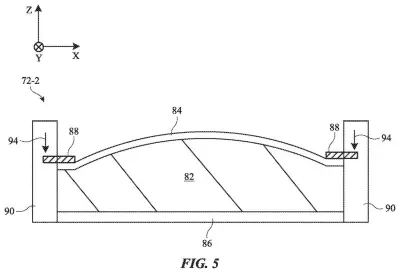
The tricky part is the power bill. Bending a lens takes parts pushing and pulling around its edge, and that uses battery. Apple's idea is to pre-load the effort: a spring is already squeezed or stretched, holding energy the way a drawn bow does. A small motor or wire only has to nudge a lever, and the spring does the heavy lifting.
The filing says this means less energy is needed to adjust the lens. It also describes a brake that can hold the lens in place once it is set.
a lens shaping element; and an indirect actuator coupled to the lens shaping element, wherein the indirect actuator comprises: a preloaded force component, an adjustment mechanism coupled to the preloaded force component, and an actuating component coupled to the adjustment mechanism …
Translation: The system uses a spring-assisted indirect actuator to reshape the lens.
How a lever and a wire reshape the lens
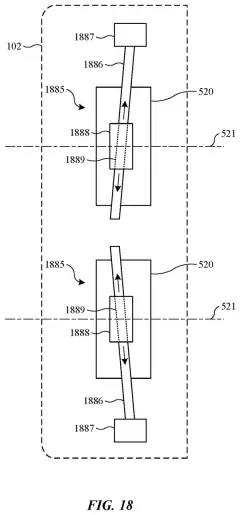
The lens in the filing has a flexible surface with a ring-shaped lens shaping element around its edge. The ring has tabs sticking out (eight in the main example), and each tab connects to its own actuator (a part that creates movement). Each actuator moves its tab up and down, which changes the curve of the lens and therefore its focusing power.
The actuators are called indirect because the part that is powered does not push the tab directly. Each one has three pieces:
- A preloaded force component: usually a spring, though the filing also lists a fluid-filled part or a magnet.
- An adjustment mechanism: a lever, a beam fixed at one end, a flexure (a bendable joint), or a ball-and-socket joint.
- An actuating component: a motor or a shape memory alloy wire (a metal wire that shortens when heated).
The actuating part shifts the mechanism, such as moving a lever's pivot, and the stored spring force then moves the tab. One version puts a compression spring and a tension spring on either side of the mechanism. Another uses one "global" actuator linked to several of these units to change how much force is stored in their springs.
The filing also admits a catch: a wire can become hard to control when the spring force and the load balance out. It describes fixes such as damping, extra inertia, or a second opposing wire, plus a piezoelectric brake (a part that moves when voltage is applied) to hold a tab in place.
The actuating component may adjust the adjustment mechanism to adjust the lens shaping element using a preloaded force from the preloaded force component, reducing the energy needed to adjust the lens shaping element.
Translation: Stored spring energy does the heavy lifting to reshape the lens, which saves battery power.
Why lower power matters for Apple's headsets
The filing frames the lens as a way to fit one headset to different wearers. It says the lens could be adjusted for a user's eyeglass prescription, and again if that prescription changes, without replacing other parts. Anyone who wears glasses knows how awkward it is to fit them around a headset, so a lens that adjusts itself is a practical goal.
Power is the other half. A headset sits on your face and runs on a small battery, so every bit of energy spent holding or changing a lens shape counts. Apple's patent says the preloaded spring approach reduces that energy. The document does not name a product, and a patent application does not mean a product is coming. It does show how Apple is thinking about adjustable optics for head-worn devices.
This is the 142nd Apple filing we've tracked since May on Apple's AR glasses, building on work like stabilizing floating screens and sending 3D objects to a headset.
Source: US 2026/0367292 A1 at the USPTO (PDF). Full patent text and figures are in the official publication.
Get our take in your Top Stories
Liked this breakdown? Add Patentlyze as a preferred source on Google, and our plain-English take shows up more often in your Top Stories the next time Apple patent news breaks.
Add Patentlyze on Google
One click.
There are more where this came from
We read every patent application Big Tech publishes and send you the ones worth knowing. Plain English, free, every week.
The drawings · 19 sheets
19 drawing sheets from US 2026/0367292 A1 · click any drawing to enlarge


Show the other 11 sheets


More from Apple
All 748 Apple patents →
More in AR / VR
All 713 AR / VR patents →
Apple
A New Apple Patent Has a Headset Notice When It Doesn't Fit Your Head
Apple
Apple Files Patent to Brighten Headset Displays With Two Overlapping Patterns in the Lens
Apple
Apple Files Patent to Stop Headset Video From Stuttering Under Office Lights
Apple
No comments yet