
Apple
Apple · AR / VR · Filed Jul 23, 2026 · USPTO published Nov 19, 2026 · This week's release
Apple Patents Miniature Virtual Rooms Where a Friend's Avatar Moves as They Do
Apple describes a small, rotatable copy of a virtual room that floats in your own living room. A friend's avatar inside it moves whenever the real friend does.
- Publication number
- US 2026/0367753 A1(US20260367753A1)
- Applicant
- Apple Inc.
- Filed · Published
- Jul 23, 2026 · Nov 19, 2026
- Inventors
- Bruno M. Sommer, Tucker Bull Morgan, Shih Sang Chiu, Connor Alexander Smith
- Status when we published
- Waiting for an examiner
- Document
- 20 claims
- US classification
- 345/156
- Parent application
- Continuation of 18/750,769 (filed Jun 21, 2024)(18750769)
What Apple's miniature-room preview actually does
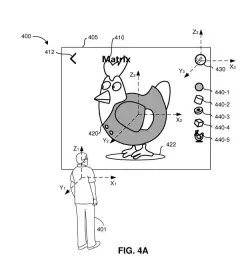
Ever wished you could peek through a door before walking into a room? Apple's patent applies that idea to virtual spaces. Instead of jumping in blind, you would see a miniature model of a friend's virtual room floating in your own space, like a tabletop display.
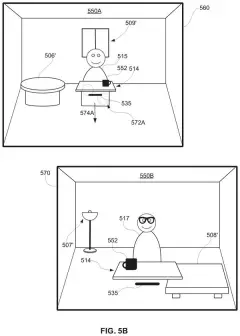
Inside the model you would see the furniture, a TV, and a small avatar of your friend. When your friend gets up and sits on the couch in real life, the avatar does the same. You can walk around the model or turn it to see it from another side. The filing also describes hearing your friend and talking back to them.
If you like what you see, one more input pulls you in. The room either grows to full size inside your space or replaces your surroundings entirely.
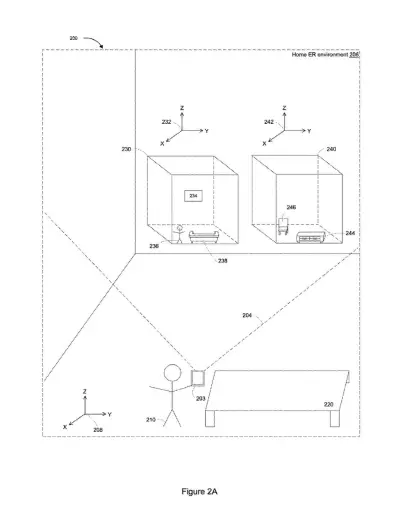
displaying, via the display device, a home enhanced reality (ER) environment corresponding to the home physical environment and characterized by a three-dimensional home ER coordinate system, wherein the home ER environment includes a first diorama-view representation of a first ER environment …
Translation: The device shows a miniature 3D model representing another space inside your own room.
How the avatar follows a real person's moves
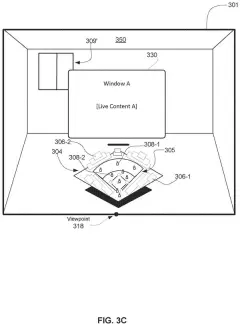
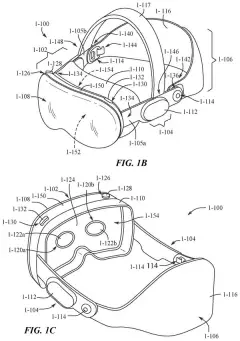
The claims cover a device, such as a headset, that displays a "home" environment matching the physical room you are in. Apple calls these enhanced reality (ER) environments, its umbrella term for augmented and virtual reality. Inside the home environment sits a diorama-view representation, a shrunken 3D model of a different ER environment. The model has its own coordinate system (a set of x, y, z positions that says where every object sits).
The core claim is about people. The model includes an avatar of a real person who is in a separate physical location. When the device detects that person moving, it redraws the avatar at a new position in the model. Dependent claims add an animation of the avatar moving, objects like a TV that change appearance based on a real object in the person's room, and two-way speech between you and them.
Other claimed pieces:
- Changing the viewing vector (the angle and position you see the model from) while every object keeps its arrangement.
- Showing several models at once, each adjustable on its own.
- An input to enter the environment, which either adds its objects to your room or replaces your room with it.
The description adds optional details. A model you look at can render sharper, while ones you ignore stop updating. A model can show a recording of recent activity, such as five people entering a room and three drawing on a whiteboard. When a model expands to full size, you can slide it so virtual furniture does not sit inside a real table.
… changing display of the first diorama-view representation from the first viewing vector to a second viewing vector while maintaining the first one or more ER objects arranged according to the first set of ER world coordinates …
Translation: You can look at the miniature room from different angles without moving the items inside it.
Why a preview beats jumping in blind
If you spend time with other people in a headset, this removes some guesswork. You could see who is in a room and what they are doing before you step in. You would also get a say in where the room lands, so a virtual couch does not clip through your real coffee table. The filing says blocked or overlapping real and virtual objects are a problem with current devices.
The description also covers privacy and battery life. Someone with no relationship to the people in a room cannot see its model, and the device can skip drawing walls or freeze models you are not looking at to save power. This is a patent application, so it shows a design direction and not a product. The filing names headsets, phones and tablets as possible devices.
That makes this Apple's 138th filing we've tracked in our AR glasses watch since May, adding to earlier applications like pulling a private screen copy and a floating 3D assistant.
Source: US 2026/0367753 A1 at the USPTO (PDF). Full patent text and figures are in the official publication.
Get our take in your Top Stories
Liked this breakdown? Add Patentlyze as a preferred source on Google, and our plain-English take shows up more often in your Top Stories the next time Apple patent news breaks.
Add Patentlyze on Google
One click.
There are more where this came from
We read every patent application Big Tech publishes and send you the ones worth knowing. Plain English, free, every week.
The drawings · 25 sheets
25 drawing sheets from US 2026/0367753 A1 · click any drawing to enlarge


Show the other 17 sheets


More from Apple
All 748 Apple patents →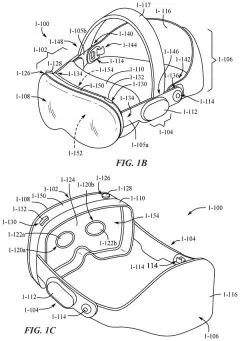
More in AR / VR
All 713 AR / VR patents →
Apple
Apple Patents Per-Person Content Permissions Inside 3D Virtual Meetings
Apple
Apple Files Patent for Virtual TVs That Cast Colored Light on Your Real Walls
Apple
Apple Patents a Fix for Virtual Hands That Jump Between Headset Cameras
Apple
No comments yet