
Apple
Apple · Networking · Filed Feb 26, 2026 · USPTO published Nov 19, 2026 · This week's release
Apple Files Patent for Voice Messages That Rebuild Your Voice From Text
Apple's patent application describes sending a voice message over a signal so weak it can barely carry text. Your phone sends a second or two of your real voice, mails the rest as words, and lets the other phone rebuild it in a copy of your voice.
- Publication number
- US 2026/0369287 A1(US20260369287A1)
- Applicant
- Apple Inc.
- Filed · Published
- Feb 26, 2026 · Nov 19, 2026
- Inventors
- Jonathan D. SHEAFFER, Andrew P. BRIGHT, Brian P. HAMILTON, Matthew M. O'CONNOR, Peter KROON, Sivanand ACHANTA
- Status when we published
- Waiting for an examiner
- Document
- 21 claims
- US classification
- 704/201
- Parent application
- Claims priority from a provisional application 63805977 (filed May 14, 2025)
What Apple's voice-from-text patent actually does
A hiker stands on a ridge with a phone that can just barely reach a satellite. A normal voice recording is too big to squeeze through that thin connection, a bit like pushing a bucket of water through a straw.
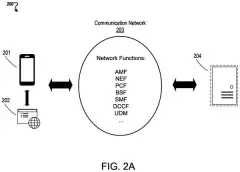
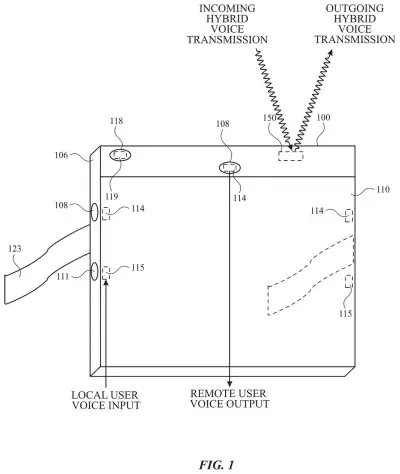
Apple's patent application describes a workaround. Your phone sends only a second or two of your real voice. The rest of your message gets turned into text, which takes far less data to send. On the other end, the receiving phone reads that text aloud, but not in a flat robot voice. It studies the short clip and speaks the words in a computer-generated copy of your voice.
The whole message can travel at an average of under 500 bits per second, a sliver of the 10 to 30 kilobits per second a good connection carries. Your friend still hears something that sounds like you.
… generating, at the first electronic device using the audio data, the transcription data, and a voice model at the first electronic device, a reconstructed-audio version of the second portion of the voice input.
Translation: The receiving device uses a voice model, text, and an audio sample to recreate the missing spoken parts.
How a snippet and text rebuild your voice
Two things happen, one on each phone. On the sending phone, the microphone signal is split into two parts. A short audio snippet is compressed as normal audio. The filing's example is a one or two second clip from a 20 to 30 second message, and one claim puts it under ten percent of the message. A speech-to-text step turns the rest into plain words.
On the receiving phone, a voice model (a neural network trained to generate speech) takes the text and the snippet and produces audio for the missing part. In one version it does an on-the-fly enrollment, meaning it briefly trains itself on the snippet before speaking. In another, it picks a model already trained on that person's voice, using an identifier sent with the message and the person's explicit permission.
A second version drops the audio entirely. The sender instead transmits small encodings, which are numeric summaries of how the voice sounds: prosody (the rise, fall and pacing of speech), tone, stress, rhythm, timbre (the texture of a voice) and ambience (background noise, such as a dog barking). The phone can choose which ones to send based on the available bandwidth.
The filing's numbers: audio bursts at 800 to 1,200 bits per second, text as low as 200, and an average under 500. When the signal improves, the phone can go back to sending full audio.
A voice model may reconstruct a portion of a voice input received at another device, in the voice of the user that spoke the voice input at the other device, using a transcription of that portion of the voice input.
Translation: A voice model can rebuild spoken words in the original speaker's voice using only the written text.
What this means for voice over satellite
The practical payoff is reaching someone when your signal is at its worst. The filing points to satellite links and to spots where trees, buildings or mountains block a direct connection. Typed text is the usual fallback on a weak connection, so a voice that sounds like yours could make a message feel more personal when a real call is impossible.
It also touches a sensitive area: a phone that can speak in someone else's voice. The filing says voice models of specific people are trained with that person's explicit permission, and it describes friends and family storing models of each other's voices. Whether Apple ever ships anything like this is unknown, since a patent application only describes an idea.
This is the 21st Apple filing we've tracked since July in our on-device AI privacy watch, following work on cell tower AI swaps and fake mask face training.
Source: US 2026/0369287 A1 at the USPTO (PDF). Full patent text and figures are in the official publication.
Get our take in your Top Stories
Liked this breakdown? Add Patentlyze as a preferred source on Google, and our plain-English take shows up more often in your Top Stories the next time Apple patent news breaks.
Add Patentlyze on Google
One click.
There are more where this came from
We read every patent application Big Tech publishes and send you the ones worth knowing. Plain English, free, every week.
The drawings · 9 sheets
9 drawing sheets from US 2026/0369287 A1 · click any drawing to enlarge


Show the other 1 sheets

More from Apple
All 748 Apple patents →
More in Networking
All 516 Networking patents →
Qualcomm
Qualcomm Patents a Phone Radio That Guesses When Your Data Is Coming
Intel
Intel Files Patent to Control Who Joins the AI Training Inside a 5G Network
Qualcomm
Qualcomm Files Patent to Catch Garbled Data When Phones Teach an AI Together
Qualcomm
No comments yet