
Apple
Apple · Software · Filed May 8, 2026 · USPTO published Nov 12, 2026 · This week's release
Apple Patents a Virtual Bass That Decides Which Notes Cut Each Other Off
On a real upright bass, a quick finger flick cuts off a note that is still ringing, while a chord lets several strings sing at once. Apple's patent application teaches a virtual bass to tell the difference from how you play.
- Publication number
- US 2026/0360341 A1(US20260360341A1)
- Applicant
- Apple Inc.
- Filed · Published
- May 8, 2026 · Nov 12, 2026
- Inventors
- Patchen L. Preston, Ari Brown, Andrew R. Barrett
- Status when we published
- Waiting for an examiner
- Document
- 20 claims
- US classification
- 84/626
- Parent application
- Claims priority from a provisional application 63803508 (filed May 9, 2025)
What Apple's virtual bass decides mid-note
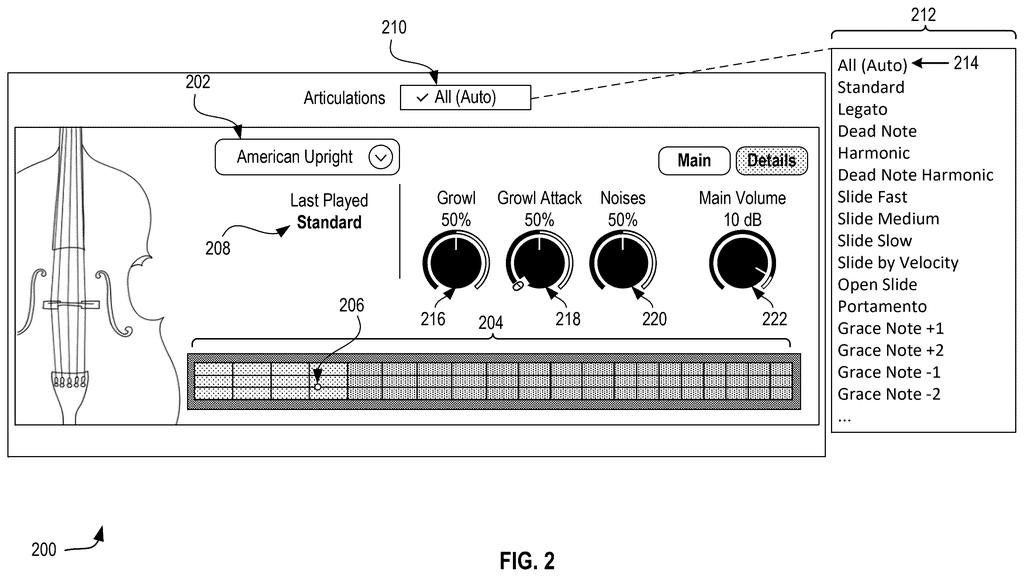
You're playing a bass line on a keyboard in GarageBand, and two notes land close together. On a real upright bass, a quick finger flick would cut the first note off. Press two keys for a chord, and both should ring. The software has to guess which one you meant.
Virtual instruments usually offer a mode where one note plays at a time, and another where everything rings together. Apple's patent describes a third path. The software looks at how hard you hit the second note, how far apart the two notes are, and how much time passed between them. Then it decides on the spot whether the old note keeps ringing or gets cut off.
The filing uses an upright bass as its example, where flicking a finger up or down to the next note is a common move. The goal is playback that sounds like a person played it, with no mode switching for you to do.
… identifying, by the computing device and based at least in part on the first MIDI data and the second MIDI data, a velocity of the second note, a pitch interval between the first note and the second note, and a difference between a first time corresponding to the first note and a second time corresponding to the second note; …
Translation: The system looks at how hard a new note is hit, how far apart the notes are, and the timing between them.
How the three note checks pick a mode
The claim covers a method for choosing between two playing modes each time a new note arrives. The software reads MIDI data (the digital note messages a keyboard sends, which describe pitch, timing and how hard a key was struck) for the previous note and the new one. In the first mode, polyphonic, the new note rings while the old one is still sounding. In the second, monophonic, the new note interrupts the old one.
Three measurements drive the choice: the new note's velocity (how hard it was struck, on a scale of 0 to 127), the pitch interval between the notes (counted in half steps, the distance between neighboring piano keys), and the time gap between the two note starts. Polyphonic is the default, and picking the second mode overrides it.
The filing gives two example rule sets for forcing the cut-off:
- A soft note (velocity below 70) within seven half steps of the last one, arriving after the short window that counts as a chord, and while the gap is under a set share of the first note's length (the description gives 30 percent as an example).
- A harder note (velocity 70 or above) tested against a two-half-step interval threshold, also arriving after the chord window.
Notes that start inside the chord window sound together. The description ties all this to bass moves like hammer-ons (a finger pressed down to sound a higher note), pull-offs (a finger flicked away to sound a lower one) and slides.
… a first playing mode during which the second note sounds while the first note is sounding or 2) a second playing mode during which the first note is interrupted with the second note.
Translation: It chooses whether the new note rings out alongside the old one or cuts the old one off completely.
Why bass lines on a keyboard may sound human
If you write music on a keyboard or iPad, this is about making a software bass respond to your hands. Today, a smooth bass run often means picking playing styles note by note or editing afterward, which the filing calls tedious and hard for newer players. Letting the software read your touch and timing could save that work.
The filing names Logic Pro and GarageBand as example music apps, and it bundles this idea with others. One recombines 20 recorded notes with 20 bright-sounding layers to make 400 variations in about 150 megabytes. Another slips in finger and handling noises by looking about 200 milliseconds ahead. It is a patent application, so nothing here says any of it will ship.
Apple's 658th filing in our Apple coverage since May continues a thread on wireless charging, following applications on a dual-standard charging case and a heat-drawing charger lid.
Source: US 2026/0360341 A1 at the USPTO (PDF). Full patent text and figures are in the official publication.
Get our take in your Top Stories
Liked this breakdown? Add Patentlyze as a preferred source on Google, and our plain-English take shows up more often in your Top Stories the next time Apple patent news breaks.
Add Patentlyze on Google
One click.
There are more where this came from
We read every patent application Big Tech publishes and send you the ones worth knowing. Plain English, free, every week.
The drawings · 19 sheets
19 drawing sheets from US 2026/0360341 A1 · click any drawing to enlarge


Show the other 11 sheets


More from Apple
All 672 Apple patents →
More in Software
All 753 Software patents →
Adobe
Adobe Files Patent for Wrapping Images Around Smooth 3D Shapes in Real Time
Adobe
A New Adobe Patent Finds the Repeating Tile in Photos of Fabric and Brick
Sony
Sony Files Patent for Keeping Surround Sound in Place When Audio Changes Formats
Samsung
No comments yet