
Apple
Apple · Software · Filed Jun 2, 2026 · USPTO published Nov 19, 2026 · This week's release
Apple Files Patent for a Workout Video That Ranks You Against Past Participants
A calorie count means little without context. This Apple filing puts your number on a scale built from everyone who has done the same workout video before you.
- Publication number
- US 2026/0364405 A1(US20260364405A1)
- Applicant
- Apple Inc.
- Filed · Published
- Jun 2, 2026 · Nov 19, 2026
- Inventors
- Anthony D'Auria, Brady J. White, Brian R. Drell, Joel J. Angelone, Rex Carroll Ross, Julie A. Arney, Jay K. Blahnik, Michael D. Ford, Chandler S. Bachman
- Status when we published
- Waiting for an examiner
- Document
- 20 claims
- US classification
- 700/91
- Parent application
- Continuation of 17/407,607 (filed Aug 20, 2021)(17407607)
What Apple's workout-ranking patent describes
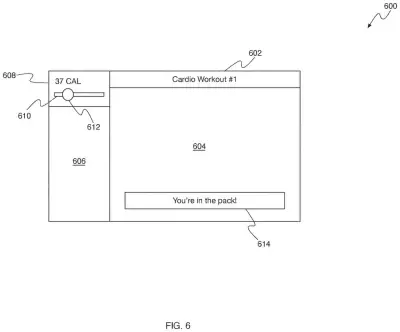
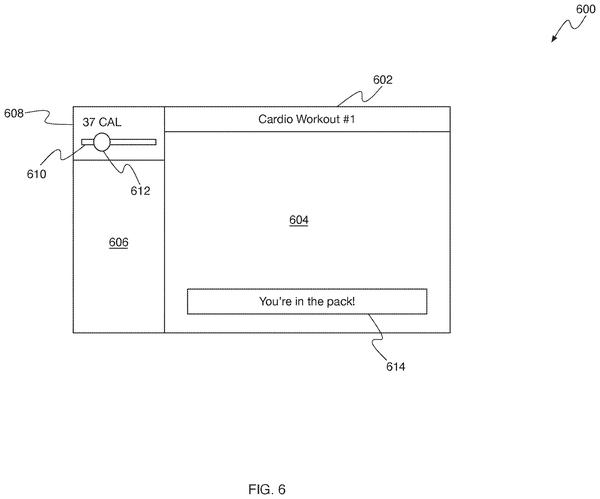
Right now, a fitness tracker mostly hands you raw numbers: steps, minutes, calories burned. A reading like 37 calories at the five-minute mark doesn't tell you whether you're slacking or crushing it. This Apple patent tries to fix that by giving your number some company.
Here's the idea. You start a workout video on your TV, set-top box or tablet while wearing your smartwatch. The watch tracks your effort and sends it over every few seconds, and the screen shows where you stand compared with people who already did the same workout at the same moment. Labels like "Behind the Pack" or "Leader of the Pack" can pop up to nudge you along.
When you finish, your watch sends a record of your session to a server, which folds it into the crowd's numbers for the next person.
… generating, based on the user activity data, a user activity timeline comprising biometric data corresponding to a plurality of time indices during a monitoring period between receiving the request to monitor user activity and receiving the workout termination message …
Translation: Your wearable builds a chronological log of your body's biometric data from the start to the end of the exercise session.
How your watch and TV split the workout
The claims in this filing focus on the wearable's job. A playback device (a set-top box, tablet or smart speaker showing the workout) asks the watch to start monitoring. The watch tracks your activity, then stops when the playback device sends a termination message. Afterward it builds a user activity timeline, which is biometric data (such as heart rate or calories) stamped at regular points in time, and transmits it.
The description fills in the rest. Crowd data is stored as METs (metabolic equivalents, a standard way to measure exercise effort that doesn't depend on body size). The playback device multiplies those values by your weight and elapsed time to turn them into calories that fit you. At each moment of the workout, the stored crowd data includes a range plus percentile markers (10%, 36%, 68% and 90% in one example), so your reading can be placed on a bar.
On the server side, the filing describes a few safeguards:
- Timelines are thrown out if you finished less than a set share of the workout (80% in one example) or if the numbers exceed human limits.
- Valid timelines update the crowd statistics on a schedule, using a method that avoids keeping every individual record, and are then deleted.
- The watch reports every 3 to 6 seconds in the examples given.
The playback device can also end the session itself if you stay still for a long stretch.
The playback device can present information comparing the user's performance during the workout to the community's past performance during the workout.
Translation: The screen shows how your current workout stats stack up against the historical data of everyone who previously did the routine.
Why a crowd comparison could change home workouts
If this ever shows up in a product, a living-room workout could feel less like exercising alone. The patent describes a screen that updates every few seconds with where you sit among past participants, plus short labels like "Middle of the Pack" or "Leader of the Pack." That is the same pull that makes people push harder in a group class, delivered to anyone with a watch and a screen.
It also fits how fitness services are built: the watch handles measuring, the TV, tablet or speaker handles the show, and a server keeps the crowd numbers. Because individual records are deleted after each update, the benchmark can grow without a growing pile of personal health data. Whether Apple builds it is unknown, since a patent filing is not a product plan.
This is the 16th Apple patent we've tracked since May in our Apple health sensors watchlist, joining the curved glass watch and the grip-sensing stylus.
Source: US 2026/0364405 A1 at the USPTO (PDF). Full patent text and figures are in the official publication.
Get our take in your Top Stories
Liked this breakdown? Add Patentlyze as a preferred source on Google, and our plain-English take shows up more often in your Top Stories the next time Apple patent news breaks.
Add Patentlyze on Google
One click.
There are more where this came from
We read every patent application Big Tech publishes and send you the ones worth knowing. Plain English, free, every week.
The drawings · 12 sheets
12 drawing sheets from US 2026/0364405 A1 · click any drawing to enlarge


Show the other 4 sheets


More from Apple
All 748 Apple patents →
More in Software
All 814 Software patents →
Apple
Apple Files Patent for Earbuds That Pause Your Podcast When You Doze Off
Apple
Apple Patents a Watch That Predicts Your Period and Fertile Days From Heart Rate
Apple
Apple Patents a Headset That Checks Your Temperature and Breathing From the Inside
Apple
No comments yet