
BMW
BMW · Automotive · Filed May 14, 2026 · USPTO published Nov 19, 2026 · This week's release
BMW Patents a System That Checks Your Eyes Before Changing Lanes
If you've ever felt queasy during a sudden lane change while staring at your phone, BMW has a patent for that. The system watches where you're looking and slows or cancels an automatic lane change if your eyes aren't pointed at the road ahead.
- Publication number
- US 2026/0365176 A1(US20260365176A1)
- Applicant
- Bayerische Motoren Werke Aktiengesellschaft
- Filed · Published
- May 14, 2026 · Nov 19, 2026
- Inventors
- Gunter HANNIG
- Status when we published
- Waiting for an examiner
- Document
- 9 claims
- US classification
- 701/25
How BMW's eye-check stops lane-change nausea
Ever been in a car that swerved suddenly while you were looking down at your phone? That lurching sideways sensation when your eyes aren't tracking the road is a classic recipe for motion sickness.
BMW's patent tackles this head-on for self-driving vehicles. When the car's automated system decides it needs to change lanes, it first checks a camera inside the cabin to see where you're looking. If your gaze matches what BMW calls the "traffic-facing target viewing direction" (basically: forward, through the windshield), the lane change happens normally. If you're glancing at a laptop, reading, or watching a video, the system either slows the maneuver way down or skips it entirely until you look up.
The car can also nudge you with a subtle alert (a soft light inside the cabin, or a sound) to let you know a lane change is pending, giving you a chance to glance up and clear it. As soon as you do, the lane change proceeds.
detecting a viewing direction of a user of the vehicle; comparing the detected viewing direction of the user with a traffic-facing target viewing direction; determining that the detected viewing direction deviates from the traffic-facing target viewing direction; and performing the lane change in a slowed-down manner or suppressing the lane change …
Translation: The car tracks where you are looking and slows down or cancels the lane change if you are not looking at the road.
How the camera-to-control-unit loop works
The patent describes a control loop that connects an interior camera, a gaze-analysis unit, and the automated driving function that handles lane changes.
Here's how the pieces fit together:
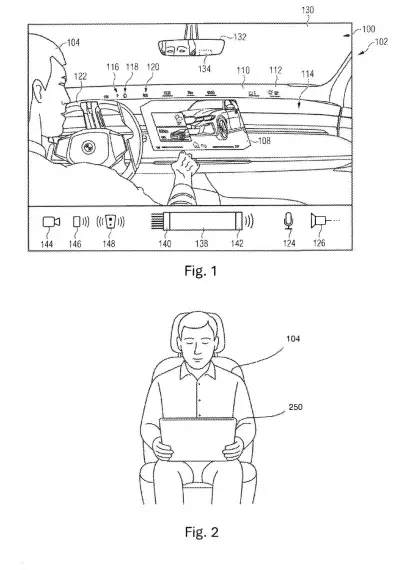
- Gaze detection: A camera inside the cabin (the patent specifically mentions one built into the rearview mirror) captures your face and tracks where your eyes are pointing.
- Target direction comparison: The system compares your actual gaze with a predefined "traffic-facing target viewing direction," meaning the angle at which you'd be looking through the windshield at traffic ahead.
- Lane-change modulation: If the two match, the automated lane change runs normally, following whatever speed and dynamics the driving function has set. If they don't match, the system either slows the lateral movement (reduces the speed of the steering sweep) or holds off entirely, even if every other condition for the lane change is already met.
- Speed threshold (optional): A secondary check can limit the override to speeds above a minimum threshold, since low-speed lane changes carry less risk of making someone sick.
The patent also describes personalized lane change dynamics, meaning the system can be tuned per driver so the threshold for slowing down or canceling reflects that person's specific sensitivity. The override cancels automatically the moment the driver looks forward again.
The lane change is suppressed or performed in a slowed-down manner despite the presence of the predetermined triggering conditions if the comparison reveals a deviation of the detected viewing direction from the traffic-facing target viewing direction.
Translation: Even if the car is ready to switch lanes, it delays or stops the maneuver if your eyes are pointed in the wrong direction.
What this means for passengers working in self-driving cars
For anyone who plans to use a self-driving car as a mobile office, this matters directly. The whole appeal of high-automation driving (SAE Level 3 and above) is that you get to stop watching the road. But current lane-change strategies were designed for attentive human drivers, so they prioritize speed, moving as quickly as traffic conditions allow. That's fine when your eyes are on the windshield. It's uncomfortable when you're hunched over a screen.
If this approach makes it into production vehicles, it could make the difference between autonomous driving feeling relaxing and just being an expensive form of nausea. BMW keeps filing on automated-driving comfort and occupant-sensing, and this patent fits that pattern directly.
BMW's fourth filing we've tracked since November in our BMW coverage follows work on floating air buttons and self-parking navigation.
Source: US 2026/0365176 A1 at the USPTO (PDF). Full patent text and figures are in the official publication.
Get our take in your Top Stories
Liked this breakdown? Add Patentlyze as a preferred source on Google, and our plain-English take shows up more often in your Top Stories the next time BMW patent news breaks.
Add Patentlyze on Google
One click.
There are more where this came from
We read the new patents from Big Tech, carmakers and more and send you the ones worth knowing. Plain English, free, every week.
The drawings · 1 sheet
1 drawing sheet from US 2026/0365176 A1 · click any drawing to enlarge

More from BMW
All 6 BMW patents →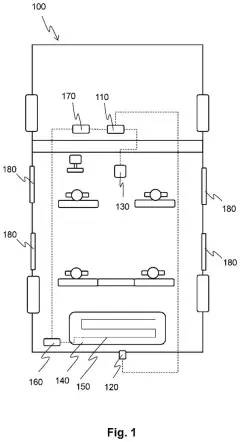
More in Automotive
All 432 Automotive patents →
Qualcomm
Qualcomm Files Patent to Help Self-Driving Cars Handle a New City
Nvidia
Nvidia Patents Object Outlines That Trade Detail for Speed on Cars and Robots
Sony
Sony Patents a Camera System That Measures Speed in Millionths of a Second
Nvidia
No comments yet