
Disney
Disney · AI / ML · Filed Apr 10, 2024 · USPTO published Nov 19, 2026 · This week's release
Disney Files Patent to Work Out Camera Positions Just by Watching People Move
Setting up several cameras usually means filming QR codes or calibration boards first. Disney's patent application says the person being filmed can do that job.
- Publication number
- US 2026/0368927 A1(US20260368927A1)
- Applicant
- Disney Enterprises, Inc.
- Filed · Published
- Apr 10, 2024 · Nov 19, 2026
- Inventors
- Dominik Tobias Borer, Mattia Gustavo Bruno Paolo Ryffel, Martin Guay, Jakob Joachim Buhmann, Robert W. Sumner
- Status when we published
- Approved; patent expected soon
- Document
- 20 claims
- US classification
- 382/154
- Examiner
- SUMMERS, GEOFFREY E (Art Unit 2669)
What Disney's marker-free camera tracking does
A few cameras ring a stage, all filming the same dancer. Before anyone can stitch those views together, the crew has to know exactly where each camera sits and which way it points. Conventional setups usually rely on QR codes, calibration boards or special hardware, props that have nothing to do with the performance.
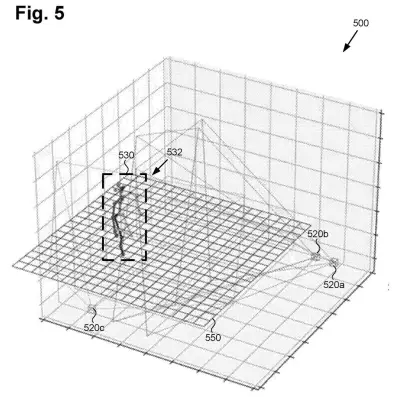
Disney's patent application skips the props. Software watches the person move, finds their joints in every camera's footage, and uses those body positions to work backward to where each camera must be. The system refines its guess about the person's pose and its guess about the camera locations at the same time, so each one helps correct the other.
It can even find the flat floor the person is walking on, which helps keep feet from looking like they slide.
… predict, after aligning, a sequence of poses of the subject based on a plurality of predetermined keypoints of the subject in each video frame of the plurality of video sequences; and calibrate, based on the plurality of the 3D movements and the sequence of poses, a location of each of the plurality of cameras.
Translation: The system tracks body joints to figure out where the cameras must be placed.
How Disney lines up views of one moving person
The system takes in video from two or more cameras that all watch the same moving subject, usually a person but possibly any object. In every frame of every video it finds a set of keypoints (preset spots such as a person's joints, or the corners and center of an object).
First, it lines up the direction the subject travels as each camera sees it. That is done by solving for an affine transformation (a combination of rotating, stretching and shifting coordinates) that makes the paths from different cameras match as closely as possible. The filing notes that up-and-down motion looks the same from any side, while left-right motion flips depending on where a camera stands.
Next, a trained machine learning model predicts the sequence of poses, and the system calibrates each camera's 3D location by checking how well those poses, projected back onto each camera's image, match what was filmed. The two steps run together in loops:
- Pose predictions improve the camera estimates.
- Better camera estimates improve the pose predictions.
- Extra checks keep motion smooth from frame to frame and poses believable.
The filing also describes finding the ground plane (the flat floor) from moments when a person's feet are still, using several people at once for more clues, and calibrating one moving camera while the others stay fixed.
Why skipping calibration boards matters to Disney
For anyone recording movement with several cameras, this removes a chore: no QR codes, calibration boards or special hardware, just the people already being filmed. The filing says it still works against a plain blue screen background, a scene with very little for a camera system to latch onto. A found floor and better camera positions also mean steadier foot contact, which cuts down on the sliding-feet look.
The patent office has approved the application, and once Disney pays the final fee it should be issued as a granted patent. The filing names no product or specific use inside Disney; it only describes the method.
That makes this Disney's ninth filing in our AI vision coverage we've tracked since July, following earlier applications like one on identifying soundtracks and one on cutting actors from footage.
Source: US 2026/0368927 A1 at the USPTO (PDF). Full patent text and figures are in the official publication.
Get our take in your Top Stories
Liked this breakdown? Add Patentlyze as a preferred source on Google, and our plain-English take shows up more often in your Top Stories the next time Disney patent news breaks.
Add Patentlyze on Google
One click.
There are more where this came from
We read every patent application Big Tech publishes and send you the ones worth knowing. Plain English, free, every week.
The drawings · 5 sheets
5 drawing sheets from US 2026/0368927 A1 · click any drawing to enlarge


More from Disney
All 64 Disney patents →
More in AI vision
All 351 AI vision patents →
Microsoft
Microsoft Patents a Way to Spot People in Video Before Even Opening the File
Nvidia
Nvidia Patents Technology That Changes Lighting on People in Video Without Flickering
Meta
AI Patent Splits Video Content From Camera Motion Control
Nvidia
No comments yet