
Ford
Ford · Automotive · Filed May 14, 2025 · USPTO published Nov 19, 2026 · This week's release
Ford Patents a Roof Rack That Folds Into the Roof and Charges Your E-Bike
Ford's patent application describes roof rack bars that sink flush into the roof, then rise with built-in lights and a plug that can charge an e-bike.
- Publication number
- US 2026/0365118 A1(US20260365118A1)
- Applicant
- Ford Global Technologies, LLC
- Filed · Published
- May 14, 2025 · Nov 19, 2026
- Inventors
- Joseph Ian Halaszynski, Jacob Michael Haspiel, John Galin
- Status when we published
- Examiner raised objections; the company can respond
- Document
- 20 claims
- US classification
- 224/309
- Examiner
- MCNURLEN, SCOTT THOMAS (Art Unit 3734)
What Ford's pop-up roof rack actually does
Every time you drive somewhere with nothing on top, your roof bars still sit up there in the wind, in plain view whether you need them or not. Ford's filing describes a roof rack that can sink down into the roof until it sits flush, then rise back up when you want to haul something.
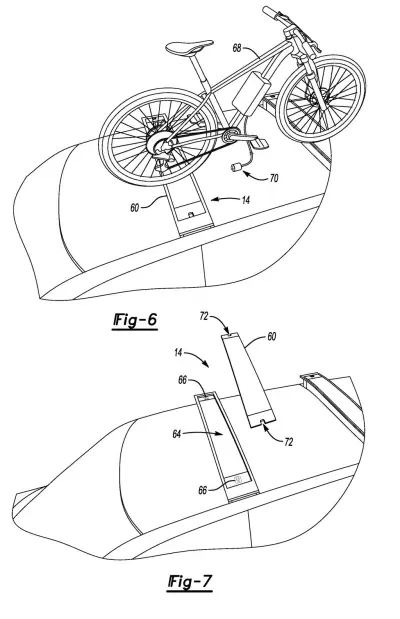
The twist is what's built into the rack. When it's raised, hidden lights can shine forward or out to the sides of the car, and an electrical outlet can sit in the bar or in its end posts. Ford's main example is an electric bike on the roof, plugged in so its battery charges from the car's own battery. Another version swaps the plug for a wireless charging pad on top of the bar.
You would raise or lower the rack with a key fob, your phone, a button on the car or a screen inside the cabin.
1 . A vehicle system, comprising: a roof rail assembly that is movable between a retracted position and a deployed position; at least one power delivery interface provided within the roof rail assembly; and at least one light provided within the roof rail assembly.
Translation: The roof rack can pop up or hide away while packing built in power outlets and lights.
How the rack sinks into the roof and powers up
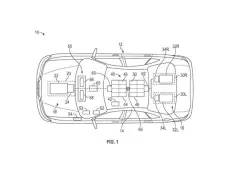
The filing covers a roof rail assembly (the crossbars or side rails that carry gear) that moves between a retracted and a deployed position. Retracted, the rail drops into a recess in the roof with its top surface roughly level with the roof around it. Deployed, it stands above the roof and can hold accessories such as a car top carrier, kayaks, skis or bikes.
Three things are built into the rail:
- Lights in the front edge of the crossbar, or in the support pillars (the end posts) to shine out to the sides. They are hidden when the rail is retracted.
- A power delivery interface, such as an electrical outlet under a cap in the rail, or one inside a support pillar.
- A wireless option: an inductive pad (a charger that passes power through the air with no plug) on top of the bar.
A motor-driven actuator does the lifting. The example uses a screw gear, and the filing lists others, including a ball screw and a four-bar linkage. Commands could come from a key fob, phone, exterior button or in-car screen, and the front and rear rails may move together. The rail can also stop at in-between heights.
In the main example, an e-bike plugs into the outlet and its battery charges from the car's accessory battery or main battery. The outlet stays usable whether the rail is up or down.
A vehicle system includes a roof rail assembly having a crossbar spanning between a plurality of support pillars. The roof rail assembly is transitionable between a retracted position and a deployed position.
Translation: The roof structure uses support pillars and a crossbar that shifts between stashed and active setups.
What this means for e-bike and gear haulers
For you, the appeal is a car that looks and drives like it has a clean roof most days, then turns into a hauler with light and power when you need it. The filing says a flush roof helps aerodynamics, though it gives no figures. Charging an e-bike from the car while it rides on the roof is the clearest everyday use it describes.
Keep in mind this is an application, not a product. The examiner's first review rejected the claims as filed, which is routine at this stage and usually followed by amendments. The filing does not name any vehicle that would get the rack.
Ford's seventh filing we've tracked since November in our Ford coverage follows patents like the trailer brake dial and the nudgeable self-driving wheel.
Source: US 2026/0365118 A1 at the USPTO (PDF). Full patent text and figures are in the official publication.
Get our take in your Top Stories
Liked this breakdown? Add Patentlyze as a preferred source on Google, and our plain-English take shows up more often in your Top Stories the next time Ford patent news breaks.
Add Patentlyze on Google
One click.
There are more where this came from
We read the new patents from Big Tech, carmakers and more and send you the ones worth knowing. Plain English, free, every week.
The drawings · 4 sheets
4 drawing sheets from US 2026/0365118 A1 · click any drawing to enlarge


More from Ford
All 8 Ford patents →
More in Automotive
All 432 Automotive patents →
Rivian
Rivian Files Patent for Front Lights Built to Break Away in a Pedestrian Crash
Toyota
Toyota Files Patent to Stop Cars From Draining While Plugged In
Hyundai & Kia
Kia Files Patent to Spread Wear Evenly Across a Hydrogen Car's Voltage Boosters
GM
No comments yet