
Google
Google · AI / ML · Filed Oct 16, 2025 · USPTO published Nov 19, 2026 · This week's release
Google Patents an AI That Splits Your Sound Request Into Speech, Music and Noise
Type 'a man speaking English with piano in the background' and this Google filing has an AI read it like a producer, handing the voice to one model and the piano to another.
- Publication number
- US 2026/0369263 A1(US20260369263A1)
- Applicant
- Google LLC
- Filed · Published
- Oct 16, 2025 · Nov 19, 2026
- Inventors
- Marco Tagliasacchi, Matthew Sharifi, Manuel Tragut, Neil Zeghidour, Zalán Borsos
- Status when we published
- Waiting for an examiner
- Document
- 20 claims
- US classification
- 704/259
- Parent application
- National Stage Entry of PCT/US2023/019293 (filed Apr 20, 2023)(PCTUS2023019293)
What Google's audio-splitting patent actually does
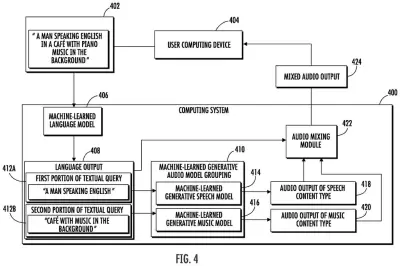
You type 'a man speaking English in a café with piano music in the background' into an audio generator and wait. Behind the scenes, one AI model has to turn that sentence into a voice and a piano at the same time, and that's a lot to ask of a single system.
Google's filing describes a different route. A language model (the same kind of AI that powers chatbots) reads your sentence and cuts it into pieces. 'A man speaking English' goes to a model that only makes voices, and 'café with music in the background' goes to one that only makes music. Each specialist produces its own clip.
Then the system mixes the clips together and sends you the result. Because you said background, the language model can tell the mixer to turn the music down so the voice stays clear.
… using, by the computing system, a machine-learned language model to select a first portion of the textual query as an input for a first machine-learned generative audio model of the plurality of machine-learned generative audio models …
Translation: An AI language model decides which part of your prompt goes to which specific audio generator.
How a language model hands out pieces of your prompt
The patent covers a way to turn one written request into several kinds of sound. It starts with a group of audio models, each trained for a single job: one makes speech, another makes music, another makes general background sound. A language model (the AI behind chatbots) reads your request and picks out the part that belongs to each specialist.
It works through the specialists one at a time, or all at once. Each time, the language model gets your full request plus an instruction such as 'find the part meant for the music model.' If your request has no speech in it, the language model answers 'NA' and the speech model is skipped.
The claims also have the language model predict controllable audio parameters (settings, like dials, that shape the result). Examples in the filing:
- Music: genre, instruments, and volume relative to other sounds
- Speech: the speaker's gender, emotional state, and volume
- General sound: the type of sound, and volume
The language model can also hand back its answer as structured text, such as a short label listing the task, genre and setting. Finally the clips are mixed, with a word like 'background' telling the mixer to lower the volume, or joined end to end for a prompt such as 'a person speaking, followed by jazz music.' The filing also describes adjusting the language model from user feedback, and applying the same idea to video and images.
… a machine-learned generative audio model grouping including a plurality of machine-learned generative audio models each trained to generate audio of a respective audio content type …
Translation: The system uses a team of specialized AI models, where each model focuses on making a different kind of sound.
Why the filing favors small audio specialists
If you've used an AI tool to make a sound clip and gotten a muddy mix where the voice fights the music, this is the problem the filing goes after. Splitting your request among specialists could mean clearer voices, music that sits where you asked, and fewer retries, especially for scenes with several layers of sound.
For Google, the pitch is cost as well as quality. The filing says one giant audio model takes far more power, memory and training effort than several small ones, so a service built this way would be cheaper to run. It also describes a single sentence ordering up a song, a music video and cover art as separate tracks you can edit one by one.
This is the 39th Google filing we've tracked on our AI models working in teams since May, adding to work like specialist helpers behind one chat box and blending models to resist tricks.
Source: US 2026/0369263 A1 at the USPTO (PDF). Full patent text and figures are in the official publication.
Get our take in your Top Stories
Liked this breakdown? Add Patentlyze as a preferred source on Google, and our plain-English take shows up more often in your Top Stories the next time Google patent news breaks.
Add Patentlyze on Google
One click.
There are more where this came from
We read every patent application Big Tech publishes and send you the ones worth knowing. Plain English, free, every week.
The drawings · 9 sheets
9 drawing sheets from US 2026/0369263 A1 · click any drawing to enlarge


Show the other 1 sheets

More from Google
All 1,127 Google patents →
More in AI / ML
All 2,738 AI / ML patents →
Samsung
Samsung Files Patent for a Voice Assistant That Picks the Right-Sized AI for Each Request
IBM
IBM Patents a Voice Survey That Asks Follow-Up Questions When Your Answers Are Vague
Microsoft
Microsoft Files Patent for AI Game Recaps Built From Your Play History
Activision (Microsoft)
No comments yet