
Google
Google · AI / ML · Filed May 12, 2025 · USPTO published Nov 12, 2026 · This week's release
Google Files Patent for Live Meeting Translation That Keeps Your Tone of Voice
Most live translation is either fast and clumsy or accurate and late. Google's patent tries to split the difference by waiting only as long as each phrase needs, then speaking the translation in a voice that mimics the original speaker's delivery.
- Publication number
- US 2026/0359581 A1(US20260359581A1)
- Applicant
- Google LLC
- Filed · Published
- May 12, 2025 · Nov 12, 2026
- Inventors
- Huib Victor Kleinhout, Maria Josefin Karlsson, Ryan Thomas Fedyk, Esbjörn Dominique
- Status when we published
- Waiting for an examiner
- Document
- 20 claims
- US classification
- 704/2
- Examiner
- CRESPO FEBLES, HECTOR J (Art Unit 2657)
What Google's live meeting translator actually does
Every time someone on a video call switches to a language you don't speak, you get two bad options: wait for a human interpreter, or read captions and miss how the person actually sounded. Google's patent describes a meeting tool that speaks the translation to you out loud, almost as it happens.
The interesting part is how it decides when to start talking. Translate too early and you get nonsense. The filing's example turns a German saying into "The morning hour has gold in the mouth." Wait for the whole phrase and the system can land on "The early bird gets the worm." So the tool waits only as long as it needs to.
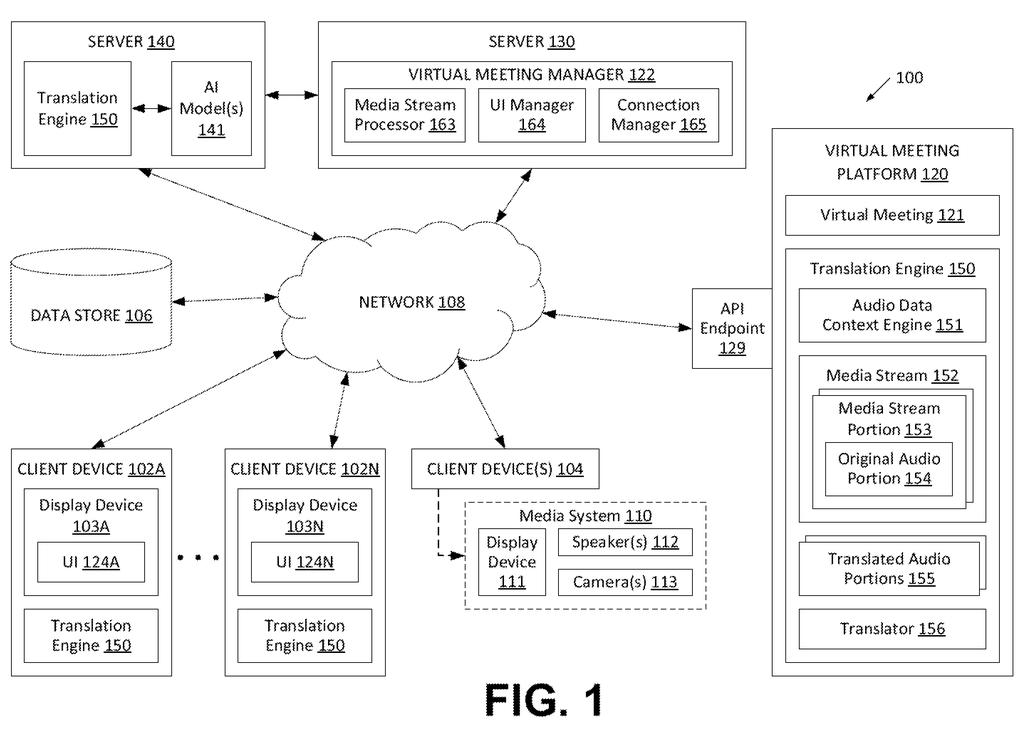
The translated voice also copies the speaker's pacing, emphasis and tone. It plays over the original voice, which stays audible but quieter.
… determining whether the first audio portion satisfies one or more translation sufficiency criteria; responsive to determining that the first audio portion satisfies the one or more translation sufficiency criteria, causing the first audio portion to be translated into the second language …
Translation: The system checks if a spoken segment is long enough to translate before sending it over.
How it decides when it has heard enough
The system listens to a meeting's audio in small chunks. For each chunk it asks whether there is enough to translate well. The filing calls these checks translation sufficiency criteria (rules about whether the system has heard enough to translate accurately). They include:
- A word criterion: enough words to form a translatable unit
- An idiom criterion: a full figure of speech, not half of one
- Limits on input length, processing time and maximum delay between the original and the translation
If a chunk falls short, the system holds off, then joins it with the next chunk and checks again. The thresholds can change with the language pair. The filing says Spanish to Portuguese needs less audio than English to Russian, because those two languages share more structure.
Once a chunk passes, an AI model (software trained on many examples) turns speech in one language into speech in another. The filing says this can happen directly, with no step through written text. The output is synthesized speech that matches the original's prosody (the music of speech: volume, pitch, speed, rhythm and emphasis).
The translation plays as an overlay, louder than the original voice underneath. The speaker can also be shown options and pick a translation. The filing says participants can give or withdraw consent for translation and for voice synthesis at any time.
… providing the first audio portion as input to an artificial intelligence (AI) model trained to translate speech in the first language into speech in the second language.
Translation: An artificial intelligence model then handles translating the spoken words from one language to another.
Why a slight delay beats a literal translation
If you work with colleagues, clients or family who speak another language, this describes a call where everyone talks in their own language and hears the others in theirs. Because the translation keeps the speaker's emphasis, a question still sounds like a question and a joke has a chance of sounding like one.
The filing also treats delay as something to manage. It does this by sizing the chunks it translates, filling gaps between them and letting short word-by-word translations make up for long idiom pauses. Anyone who has watched awkward silences stack up on a multilingual call will recognize the problem. The patent names no product, so any rollout is a separate question.
Google's 68th filing in the voice and speech AI work we've tracked since May builds on earlier applications like teaching new languages without retraining and noise-filtering earbuds for voice commands.
Source: US 2026/0359581 A1 at the USPTO (PDF). Full patent text and figures are in the official publication.
Get our take in your Top Stories
Liked this breakdown? Add Patentlyze as a preferred source on Google, and our plain-English take shows up more often in your Top Stories the next time Google patent news breaks.
Add Patentlyze on Google
One click.
There are more where this came from
We read every patent application Big Tech publishes and send you the ones worth knowing. Plain English, free, every week.
The drawings · 6 sheets
6 drawing sheets from US 2026/0359581 A1 · click any drawing to enlarge


More from Google
All 1,079 Google patents →
More in AI / ML
All 2,637 AI / ML patents →
Adobe
Adobe Files Patent for an AI Writer That Copies a Brand's Voice
Sony
Sony Patents a Trick for Giving Game Characters Distinct Voices by Translating Twice

Samsung
Real-Time Voice Translation Patent Preserves Each Speaker's Tone
Samsung
No comments yet