
Google
Google · Antenna & radio · Filed May 8, 2025 · USPTO published Nov 12, 2026 · This week's release
Google Patents Satellites That Link by Laser to Act as One AI Computer
Google's filing sketches an AI computer built from many flat, solar-powered satellites that talk to each other by laser. The patent is about the hard part: getting all those beams to find each other and stay locked on.
- Publication number
- US 2026/0361406 A1(US20260361406A1)
- Applicant
- Google LLC
- Filed · Published
- May 8, 2025 · Nov 12, 2026
- Inventors
- Travis Roland Beals, Thomas Fischbacher, Blaise Aguera-Arcas, Urs Koester
- Status when we published
- Waiting for an examiner
- Document
- 31 claims
- US classification
- 398/96
- Examiner
- BELLO, AGUSTIN (Art Unit 2635)
What Google's laser-linked AI satellites do
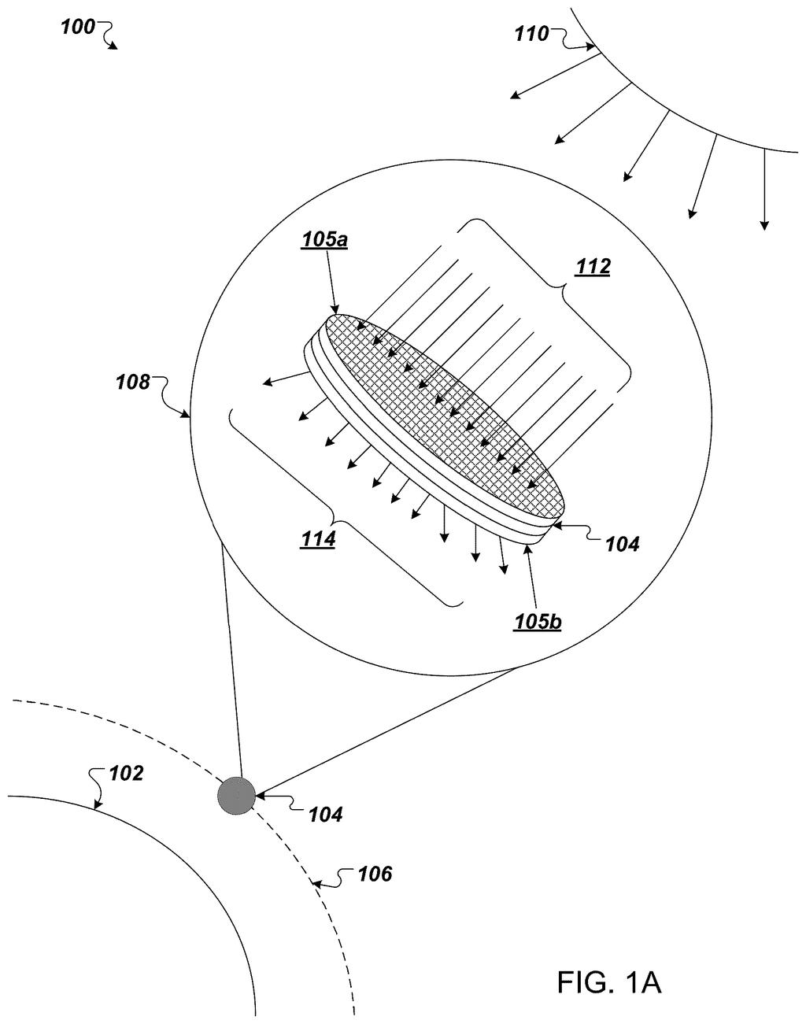
You're one of many flat, solar-powered satellites, each about two meters wide, drifting in orbit hundreds of meters from your neighbors. Your job is to help the swarm behave like one giant AI computer, which means you need fast, dependable links to the others.
Google's filing covers how that works. Each satellite first figures out where the others are, for example by swapping GPS coordinates over radio. Then it aims laser links at a chosen few (say eight out of 30 nearby) and fine-tunes the aim until the signal is as strong as it can get.
Once the beams lock on, they serve as the cables inside a computer. The AI chips on every satellite share work over those links, so training or running an AI model is spread across the whole swarm.
… adjust at least one of the optical inter-satellite communication link devices in the satellite module to establish a communication channel through at least one optical inter-satellite communication link of the other satellite module …
Translation: The satellite moves its lasers to lock onto and connect with neighboring satellites.
How each satellite finds and locks onto its neighbors
The claims describe a satellite module with several optical inter-satellite link devices (light-based transmitters and receivers) spread around its outer surface, plus a communication processor that runs three steps:
- Locate the neighbors. The processor works out where other modules are relative to itself, for instance from GPS coordinates swapped over a radio channel.
- Aim. For each neighbor it picks, it adjusts one of its link devices. That can mean steering a lens, tilting a gimbal (a pivoting mount), driving a MEMS device (a microscopic moving part built on a chip), or firing thrusters to turn the whole satellite.
- Use the links as wiring. The channels connect ML hardware accelerators (chips built for AI math) on different satellites into one compute node.
The description adds that satellites first take a coarse position, for example about 100 meters apart in one or several flat planes or in a loose cloud, and then fine-tune each beam for the strongest received signal. Better aim means the satellites can get by with lower-power transmitters.
Other claims cover an N×M optical collimator (a grid of fiber channels behind one lens) where a few channels send an orientation signal so neighbors can line up, wavelength division multiplexing (sending several colors of light down one channel for more bandwidth), and a machine-learned control model that can handle the alignment.
… data links connecting machine-learning (“ML”) compute nodes formed by ML hardware accelerators within each satellite module …
Translation: These laser connections turn the fleet into a single massive artificial intelligence supercomputer in space.
Why the filing pitches orbit as the next data center
For you, nothing changes soon. The reason to care is the backdrop: AI services eat huge amounts of electricity and land, and the filing says demand for AI chips is outrunning what existing data centers can hold. Putting the chips in orbit swaps grid power for sunlight and avoids needing real estate on Earth, with little to no carbon emissions, according to the filing.
The laser links are the piece that makes the idea hang together. One flat satellite carries only so much computing, so a swarm works only if its members can talk quickly and reliably. This filing is about that wiring. It also says the groupings can change: large formations for training a model, then smaller ones for answering questions once training is done.
Google's third antenna and radio filing we've tracked since July follows one on pointing a phone to connect devices and one on multi-antenna distance measurement.
Source: US 2026/0361406 A1 at the USPTO (PDF). Full patent text and figures are in the official publication.
Get our take in your Top Stories
Liked this breakdown? Add Patentlyze as a preferred source on Google, and our plain-English take shows up more often in your Top Stories the next time Google patent news breaks.
Add Patentlyze on Google
One click.
There are more where this came from
We read every patent application Big Tech publishes and send you the ones worth knowing. Plain English, free, every week.
The drawings · 17 sheets
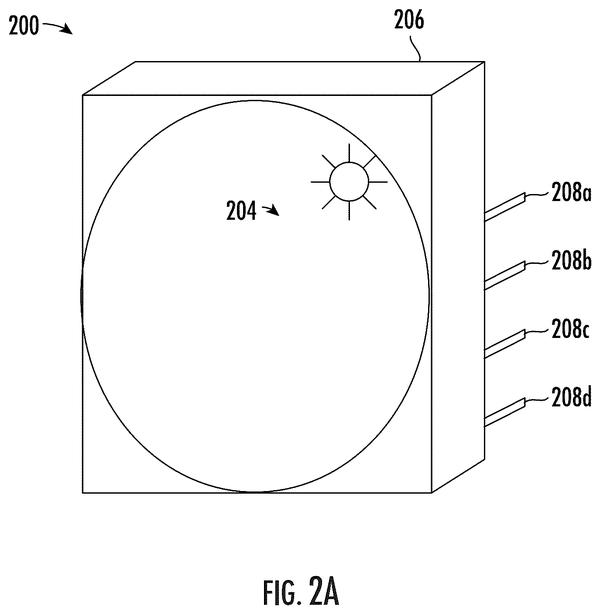
17 drawing sheets from US 2026/0361406 A1 · click any drawing to enlarge


Show the other 9 sheets


More from Google
All 1,079 Google patents →
More in Antenna & radio
All 32 Antenna & radio patents →
Intel
Intel Patents a Way to Route Data Signals Through a Computer's Metal Frame
Apple
Apple Files Patent to Pack Extra Data Feeds Into a Single USB Connection
Samsung
Samsung Files Patent for an Earring Whose Jewelry Doubles as a Bluetooth Antenna
Sony
No comments yet