
Google
Google · Software · Filed Jul 27, 2026 · USPTO published Nov 19, 2026 · This week's release
Google Files Patent for Filling the Black Bars Around Vertical Videos
Watch a phone video on a wide screen and you usually get black bars down the sides. Google's patent describes sending a second, cheap video stream just to fill in those empty edges.
- Publication number
- US 2026/0370905 A1(US20260370905A1)
- Applicant
- Google LLC
- Filed · Published
- Jul 27, 2026 · Nov 19, 2026
- Inventors
- Yeping Su, Neil Aylon Charles Birkbeck, Balineedu Chowdary Adsumilli
- Status when we published
- Waiting for an examiner
- Document
- 20 claims
- US classification
- 725/131
- Parent application
- Continuation of 18/143,057 (filed May 3, 2023)(18143057)
What Google's two-stream video patent does
Imagine you filmed a clip upright on your phone, and now you're watching it on a wide TV or with your phone turned sideways. Usually you get a thin strip of video in the middle with big empty bars on each side, or the sides of the picture get chopped off to make it fit.
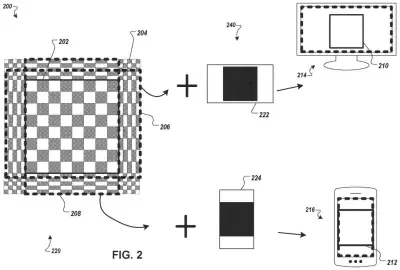
Google's patent describes another route. Your device receives two versions of the same video at once. One is the main picture in its original shape. The other is a rougher version shaped for the wider screen, which acts as a backdrop. Your device unpacks both at the same time, lays the main video on top, and can blend the seam so you barely notice it.
The backdrop doesn't need to be sharp, because the main video covers its middle anyway. The filing says that hidden part can use fewer bits (the small units of data that make up a video), so the extra stream stays cheap to send.
… generating a composited media item based on the first bitstream and the second bitstream, wherein the second bitstream provides content to fill display regions outside the first aspect ratio …
Translation: Merging two video streams so the second one fills the empty space around the main video.
How a second stream fills the screen edges
The filing bundles two ideas. In the first (claim 1), your device receives two bitstreams (streams of video data) for the same video: one built for a first aspect ratio (the picture's width-to-height shape, such as tall and narrow), and one for a second, wider shape.
Each stream goes to its own decoder (the component that unpacks compressed video), and the two run at the same time. If the device picks the wider shape, it layers the two together, with the second stream filling the regions outside the first. That backdrop can use a lower resolution or frame rate, or even be still images, and the part hidden under the main video can carry fewer bits. Metadata (instructions riding along with the video) can set where the overlay goes and whether to blend the seam.
The second idea (claims 9 and 18) uses a scalable bitstream: a sharp base layer for the central region, plus a more compressed enhancement layer for the surroundings. To hit the requested aspect ratio, the device expands that outer region using methods such as:
- Geometric prediction (guessing the size and placement of objects)
- Content adaptive warping (stretching an image unevenly based on what is in it)
- Seam carving (adding or removing thin paths of pixels in the least important areas)
Why this matters for phone video streaming
If this ever shows up in a video app, the payoff is simple: a clip filmed upright on your phone could fill a wide screen without black bars or lopped-off edges. The filing also describes a device that can rebuild the picture when you switch between modes, such as turning your phone from vertical to horizontal.
For the company serving the video, the appeal is storage and bandwidth. Instead of keeping a full copy of every video for each screen shape, a platform could store one main version plus a cheap backdrop, and send less data to your device. The filing also says creators would not have to choose a crop for each format, which saves them a chore.
This is the 1081st Google filing we've tracked since May in our Google coverage, a corpus that spans work like raw camera data processing and a dome mic for meetings.
Source: US 2026/0370905 A1 at the USPTO (PDF). Full patent text and figures are in the official publication.
Get our take in your Top Stories
Liked this breakdown? Add Patentlyze as a preferred source on Google, and our plain-English take shows up more often in your Top Stories the next time Google patent news breaks.
Add Patentlyze on Google
One click.
There are more where this came from
We read every patent application Big Tech publishes and send you the ones worth knowing. Plain English, free, every week.
The drawings · 6 sheets
6 drawing sheets from US 2026/0370905 A1 · click any drawing to enlarge


More from Google
All 1,127 Google patents →
More in Software
All 814 Software patents →
Microsoft
Microsoft Patents an AI Helper That Moves Around Your Screen
Apple
Apple Files Patent for Voice Assistant Replies That Fit Around Your Phone's Camera Cutout
Microsoft
Microsoft Files Patent to Schedule Around Double-Booked Jobs Instead of Giving Up
Sony
No comments yet