
DeepMind (Google)
Google · AI / ML · Filed May 15, 2026 · USPTO published Nov 19, 2026 · This week's release
Google Files Patent for Training AI to Grade Its Own Thinking, Step by Step
Google has filed a patent application for training an AI to grade every step of its own thinking, so it learns to back up and try a different approach instead of rambling.
- Publication number
- US 2026/0368501 A1(US20260368501A1)
- Applicant
- Google LLC
- Filed · Published
- May 15, 2026 · Nov 19, 2026
- Inventors
- Tze Way Eugene Ie, Shenao Zhang, Yunxuan Li, Tianqi Liu, Yaqing Wang, Peter Ward Grabowski, Yinxiao Liu
- Status when we published
- Waiting for an examiner
- Document
- 20 claims
- US classification
- 706/25
- Parent application
- Claims priority from a provisional application 63806662 (filed May 15, 2025)
What Google's step-by-step AI grading does
Imagine you're solving 2x + 3 = 7 on scratch paper. Halfway through, you notice a step went nowhere, so you cross it out and try a different route. AI models are supposed to do something similar when they "think" before answering, but they often just write phrases like "let me reconsider" without really changing course.
A new Google patent application describes a training method that grades every step of the AI's thinking, not just its final answer. During practice, the AI writes several attempts at the same problem, and the system checks each step against the known correct answer. Steps that move the AI toward the right answer earn credit. Steps that look helpful to the AI but lead nowhere get marked down.
The goal is an AI that learns to back up, drop a bad idea and try another, using fewer words along the way.
… obtaining, using the generative neural network, a plurality of candidate reasoning trajectories generated using the generative neural network in response to the prompt, each candidate reasoning trajectory comprising a respective sequence of reasoning steps followed by a respective candidate response to the prompt; …
Translation: The AI creates multiple step by step paths of thought leading to different possible answers.
How Google compares expected and actual progress
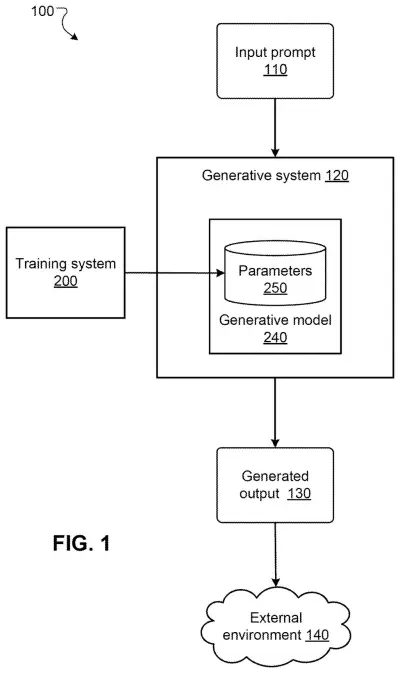
The patent describes a training loop for a large language model (the AI behind chatbots). It starts with a practice question and its known correct answer, such as "Solve for x in 2x+3=7" with the answer "x=2." The model writes several candidate reasoning trajectories (separate attempts, each a chain of reasoning steps ending in a final answer).
Then, for every step in every attempt, the system computes two things:
- Quality value: an estimate of how much that step helps future reward. It is built from how likely the model is to reach its answer with and without the step, plus a check of whether the final answer matches the correct one.
- Weighting factor: a comparison of observed progress (how much earlier steps raised the odds of producing the correct answer) with predicted progress (how much they raised the odds of the model's own answer). Big gaps mean the model's assumptions were wrong, so those paths count for less.
The weighted values then drive a policy gradient update, a standard reinforcement learning method that nudges the model toward steps that earned higher scores. The filing also describes "reflective" steps, where the model returns to an earlier point and tries a different step, and says the method can cover code, images, audio and calls to outside software tools.
In its charts, the filing compares the method with baseline training on math benchmarks including GSM8K and MATH. It reports higher accuracy with fewer tokens (the small chunks of text an AI writes).
A system receives a prompt and obtains a corresponding ground truth response. Using the generative neural network, the system generates a plurality of candidate reasoning trajectories, each including a sequence of reasoning steps followed by a candidate response.
Translation: The AI looks at a question and its correct answer, then generates several different paths of reasoning to try and solve it.
Why rambling AI reasoning is expensive to run
If this training approach works as described, the AI tools you use could reach correct answers with less rambling. Shorter reasoning means faster replies and less computing power per question, which adds up for any service answering millions of them. The filing says that baseline models, when set to be more random, fill their thinking with empty self-reflection that eats processing time and memory.
The uses the filing lists are down to earth: checking a student's math homework, debugging code, diagnosing a faulty machine from sensor readings, or planning a task for a robotic arm. Reasoning you can read step by step also lets a person decide whether to trust the action it recommends. Keep in mind that this is a patent application, so it describes a method, not a shipping feature.
This is the 28th Google filing we've tracked since May in our AI guardrails race, following one on vibration confidence signals and one on AI fact-checking with citations.
Source: US 2026/0368501 A1 at the USPTO (PDF). Full patent text and figures are in the official publication.
Get our take in your Top Stories
Liked this breakdown? Add Patentlyze as a preferred source on Google, and our plain-English take shows up more often in your Top Stories the next time Google patent news breaks.
Add Patentlyze on Google
One click.
There are more where this came from
We read every patent application Big Tech publishes and send you the ones worth knowing. Plain English, free, every week.
The drawings · 6 sheets
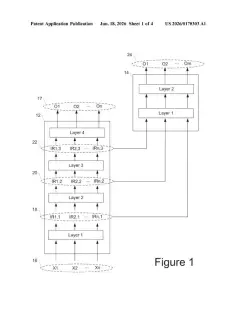
6 drawing sheets from US 2026/0368501 A1 · click any drawing to enlarge


More from Google
All 1,127 Google patents →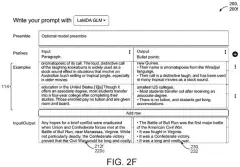
More in AI training & infrastructure
All 323 AI training & infrastructure patents →
Samsung
Samsung Patents a System That Makes AI Grade Its Own Homework
IBM
IBM Files Patent for an AI That Quizzes Itself and Learns From Expert Corrections
IBM
IBM Files Patent to Dock Points From Resume Scores That Lean on Gendered Words
Salesforce
No comments yet